Episode Details
Back to Episodes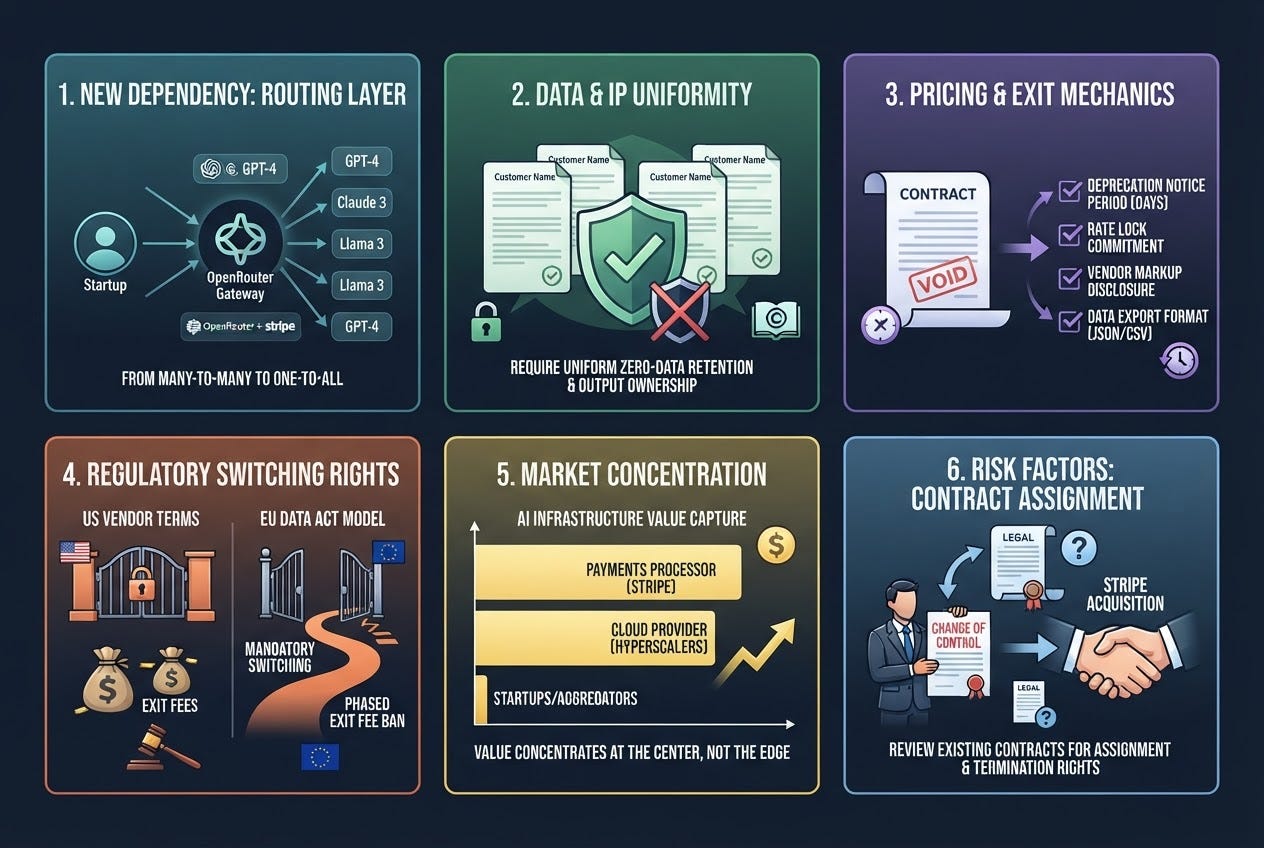
Stripe Bought OpenRouter
Description
Stripe’s acquisition of OpenRouter for more than $7 billion, announced in August 2026, puts the company that marketed itself as the neutral alternative to picking one AI model inside the payment processor that already handles a large share of the software industry’s revenue. A startup that signed with OpenRouter specifically to avoid depending on a single model provider now depends on a single company for model access, billing, and the routing logic that decides which model sees its traffic. The contract signed before the announcement is not the contract that exists after it, and counsel should read it again this week rather than next quarter.
The overlooked mechanic sits in the router itself, not in the model list. OpenRouter evaluates each incoming request for task complexity, price, speed, and reliability, then sends it to whichever of the more than four hundred models it carries fits best, a design its cofounder built specifically so no developer had to bet the product on one provider. That protection was always a matter of contract and company intention, never architecture. Nothing in the underlying technology stopped the company running the router from becoming the exact dependency it was hired to remove, and the technology has not changed in the past six weeks. The ownership has.
A model provider agreement without a stated deprecation window leaves a startup rebuilding its prompt library on a schedule the provider sets alone. The number that matters is the count of days between a provider’s retirement notice and the date the prior model version actually stops answering requests, paired with a promise that the price does not move during that window. A router adds a second failure mode on top of the first: if the aggregator decides which models stay in its own catalog, a startup can lose a model the aggregator drops for its own commercial reasons even while the underlying provider is still willing to sell it directly. A most favored nation clause negotiated with the model provider protects against that provider raising its own price. It does nothing about the aggregator raising the markup layered on top, which is why a startup should demand the markup disclosed per provider rather than folded into one blended rate.
The Federal Trade Commission’s January 2025 staff report on cloud and AI developer partnerships found that Microsoft, Google, and Amazon each locked their AI partners into billions of dollars in spending commitments and conditions restricting service through competing cloud providers. The report matters here because it confirms, from inside the industry’s own largest deals, that the contract terms creating dependency are precisely the ones a startup rarely has the size to negotiate away: minimum spend, exclusivity, and a window into a partner’s roadmap that the partner cannot get in return.
Microsoft’s own agreement with OpenAI shows the other direction is possible once a company has enough weight to demand it. The two companies restructured their partnership in April 2026, ending Microsoft’s exclusive cloud rights so OpenAI could serve customers through any cloud provider, while keeping Microsoft’s license to OpenAI’s models in place, now non exclusive, through 2032, alongside a revenue sharing arrangement running through 2030 under a stated cap. A startup will never negotiate a deal that size, but the shape of it is the template worth copying: separate the model license from the infrastructure relationship in the contract language itself, so a change on one side does not force a rebuild of the other.
OpenRouter’s own product already contains the terms worth insisting on. Its Bring Your Own Key program charges a 5 percent markup on traffic routed through a customer’s own provider account while granting enterprise customers $200,000 in complimentary monthly allowance, and its zero data retention feature commits certain provider endpoints to storing no prompt or output at all, a