Episode Details
Back to Episodes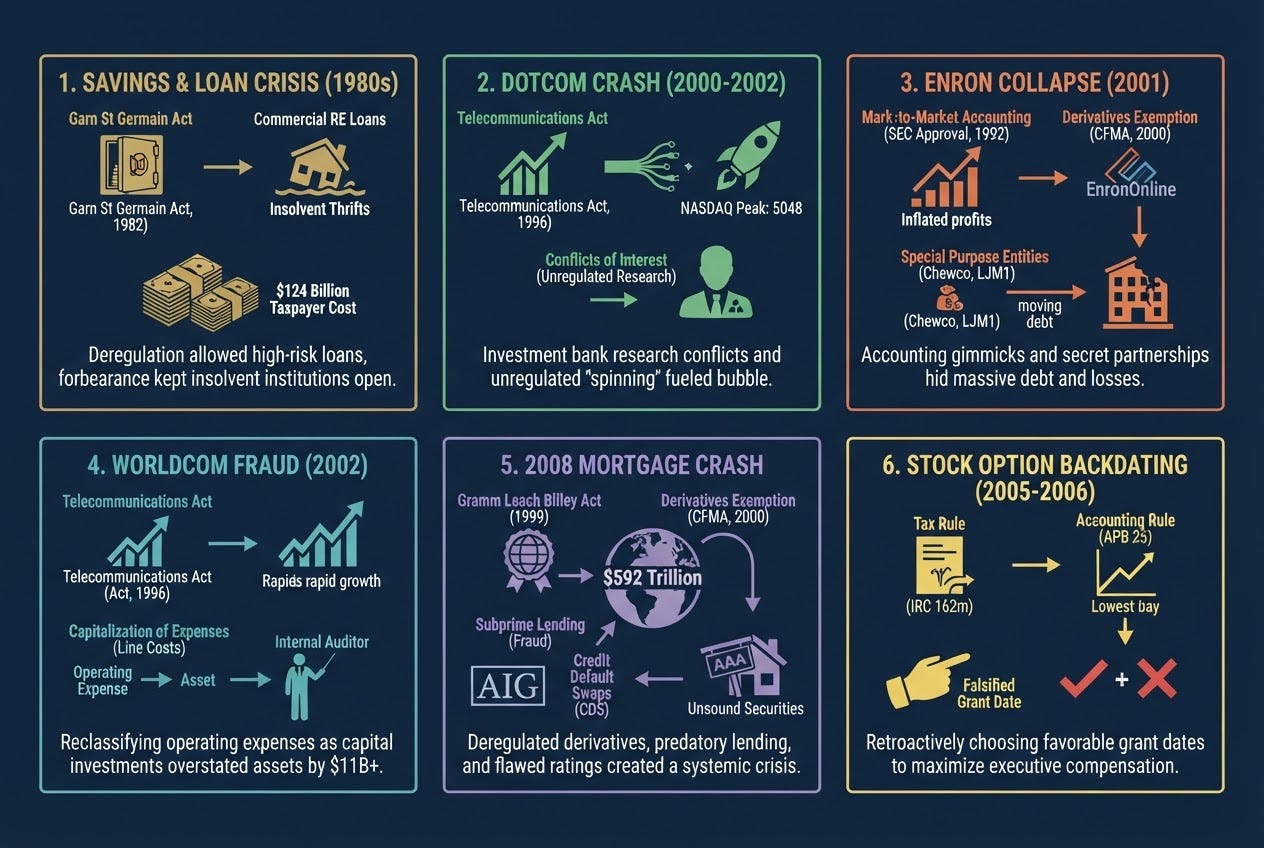
Government Action and Fraud in Six American Financial Debacles
Description
Executive Summary
Government deregulation and supervisory forbearance caused or worsened six American financial crises between 1982 and 2008, and fraud enlarged the losses in each one. The Savings and Loan Crisis, the dotcom crash, the Enron collapse, the WorldCom fraud, the 2008 mortgage crash, and the 2005 to 2006 stock option backdating scandal each began with a government decision that widened the room for risk or loosened the supervision of it. Fraud then converted ordinary business failure into public loss.
The Savings and Loan Crisis cost taxpayers about $124 billion after the Garn St Germain Act of 1982 let thrifts make commercial real estate loans while regulators lowered capital requirements and kept insolvent institutions open. The dotcom crash erased roughly $5 trillion in market value after investment bank research conflicts went unregulated. Enron relied on a 1992 accounting approval and a 2000 derivatives exemption. WorldCom overstated assets by more than $11 billion through line cost accounting. The 2008 crash followed a 2000 statute that barred regulation of over the counter derivatives, a 2004 capital rule that left investment banks at leverage near 30 to 1, and mortgage fraud that grew twentyfold in suspicious activity reports between 2003 and 2007. Option backdating grew from a tax rule and an accounting rule that rewarded options priced at market.
The statutes, settlement figures, and convictions described here are settled. The weight each cause deserves is contested. Congress answered the thrift losses with the Financial Institutions Reform, Recovery, and Enforcement Act of 1989, the dotcom, Enron, and WorldCom scandals with the Sarbanes Oxley Act of 2002, and the 2008 crash with the Dodd Frank Act of 2010. The Supreme Court then narrowed the prosecution tools in Arthur Andersen LLP v. United States in 2005 and Skilling v. United States in 2010.
Detailed Findings
What did the six debacles have in common?
In each of the six debacles, a government decision widened the room for risk, and supervisors who could see the risk growing allowed fraud to grow with it. The sequence runs in four steps: a statute or rule grants permission, supervisors tolerate the resulting excess, insiders commit fraud that hides the losses, and Congress writes a repair statute after the public pays.
Each permission carries a date. The Garn St Germain Depository Institutions Act of 1982, 96 Stat. 1469, opened thrift balance sheets to commercial lending. The Telecommunications Act of 1996, 110 Stat. 56, invited a telecommunications construction boom. The Gramm Leach Bliley Act of 1999, 113 Stat. 1338, and the Commodity Futures Modernization Act of 2000, 114 Stat. 2763, removed the barriers between commercial banks, investment banks, and insurers and placed over the counter derivatives outside federal and state regulation. Section 162(m) of the Internal Revenue Code, added in 1993, capped the deduction for executive salary at $1 million and pushed pay into stock options.
The tolerance is equally specific. The Federal Home Loan Bank Board lowered the thrift net worth requirement from 5 percent to 3 percent between 1980 and 1982. The Securities and Exchange Commission adopted a voluntary capital supervision program for investment bank holding companies in 2004. The Federal Reserve held authority under the Home Ownership and Equity Protection Act of 1994 to set mortgage lending standards for all lenders and did not use it before the housing market peaked. The commission that investigated the 2008 crisis concluded that regulators possessed ample power and chose inaction.
The repairs came after the losses. The cost of the six events ranges from the $124 billion that taxpayers absorbed in the thrift crisis to the roughly $5 trillion in market value that the technology stock collapse destroyed, with Enron shareholders alone losing about $74 billion. The rest of this report takes each eve