Episode Details
Back to Episodes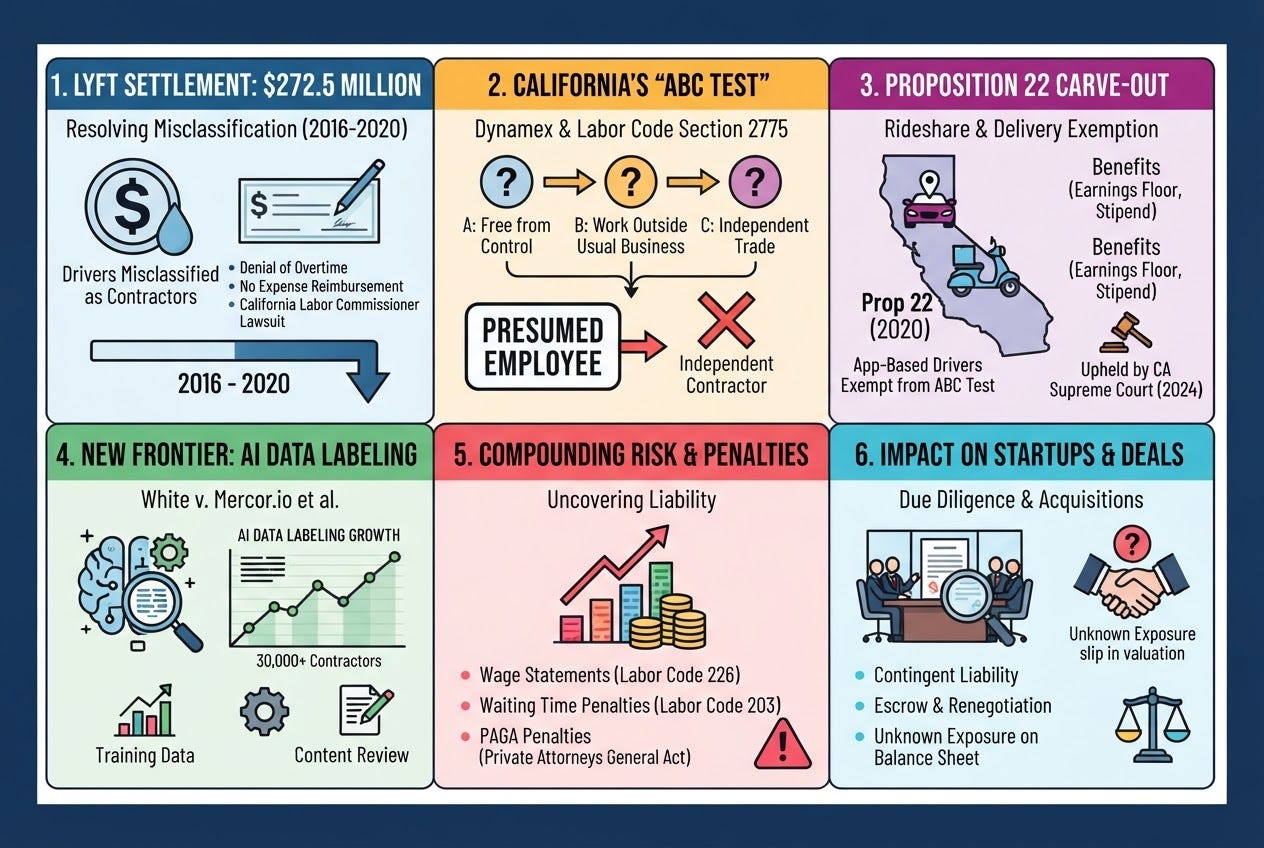
The Lyft Settlement For Gig Worker Misclassification Risk
Description
On October 1, 2026, Lyft agreed to pay $272.5 million to settle a California Labor Commissioner lawsuit accusing the company of misclassifying drivers as independent contractors from April 6, 2016, through December 15, 2020. Eighty seven percent of that figure, $236.875 million, goes straight to drivers rather than to the state treasury or to outside counsel. The Labor Commissioner’s office filed the underlying case in August 2020, which means Lyft spent six years and a California Supreme Court decision on Proposition 22 before writing the check. A parallel suit against Uber, filed the same month on the same legal theory, is still working its way through an arbitration dispute at the California Court of Appeal. If you run a venture funded company with any contractor workforce, that six year gap between filing and payment is the part that should worry you, not the dollar figure.
California did not invent a new standard to catch Lyft. Dynamex Operations West, Inc. v. Superior Court (2018) set the rule that every worker is presumed an employee unless the company proves the worker operates free of its control, performs work outside the company’s usual business, and runs an independently established trade of the same kind. The legislature wrote that presumption into Labor Code section 2775 through Assembly Bill 5 in 2019. Voters then carved app based rideshare and delivery drivers out of it through Proposition 22 in November 2020, trading the ABC test for a net earnings floor and a health stipend, and the California Supreme Court upheld that trade as constitutional in Castellanos v. State of California (2024). The carve out is specific to transportation network companies and delivery network companies. It does not cover a company that routes data labeling tasks, content moderation jobs, home repair gigs, or grocery fulfillment runs through an app and calls the workers contractors.
Uber’s case shows why the Lyft number matters even to startups nowhere near the rideshare market. Uber moved to compel arbitration of the Labor Commissioner’s claims, the San Francisco Superior Court said no in September 2022, and the California Court of Appeal stayed the case in December 2022 while it sorts out whether a state agency suing in its prosecutorial capacity is bound by a driver’s individual arbitration agreement. Most venture backed companies write a mandatory arbitration clause into every contractor agreement they sign, on the theory that it keeps disputes out of court and off the public record. That theory has never been tested against a state labor agency that is not a party to the contract and does not need the worker’s consent to sue. Until the Court of Appeal rules, a startup cannot assume its arbitration clause does anything at all against the one plaintiff with the authority Lyft just paid $272.5 million to settle with.
The theory has already left the rideshare industry. White v. Mercor.io Corporation, filed in the Northern District of Texas in May 2026, accuses the AI infrastructure company of misclassifying more than 30,000 contractors who supplied training data labor to customers that include OpenAI, Anthropic, and Meta, allegedly to avoid payroll tax and benefit costs. A separate complaint against Surge AI describes a data labeler who was told what hours to work, what tools to use, and how to complete each task, while being paid as a contractor. Scale AI faces its own dispute over Kenyan content reviewers paid as little as $2 an hour to review violent material with no mental health support and none of the protections an employee would receive. None of these companies run a transportation network. Each one built a labor pipeline on the same control pattern Dynamex was written to catch.
In thirty years of counseling technology companies through financings and acquisitions, I have sat across the table more than once while a buyer’s counsel found, deep in diligence, that a chunk of the target’s workforce loo