Episode Details
Back to Episodes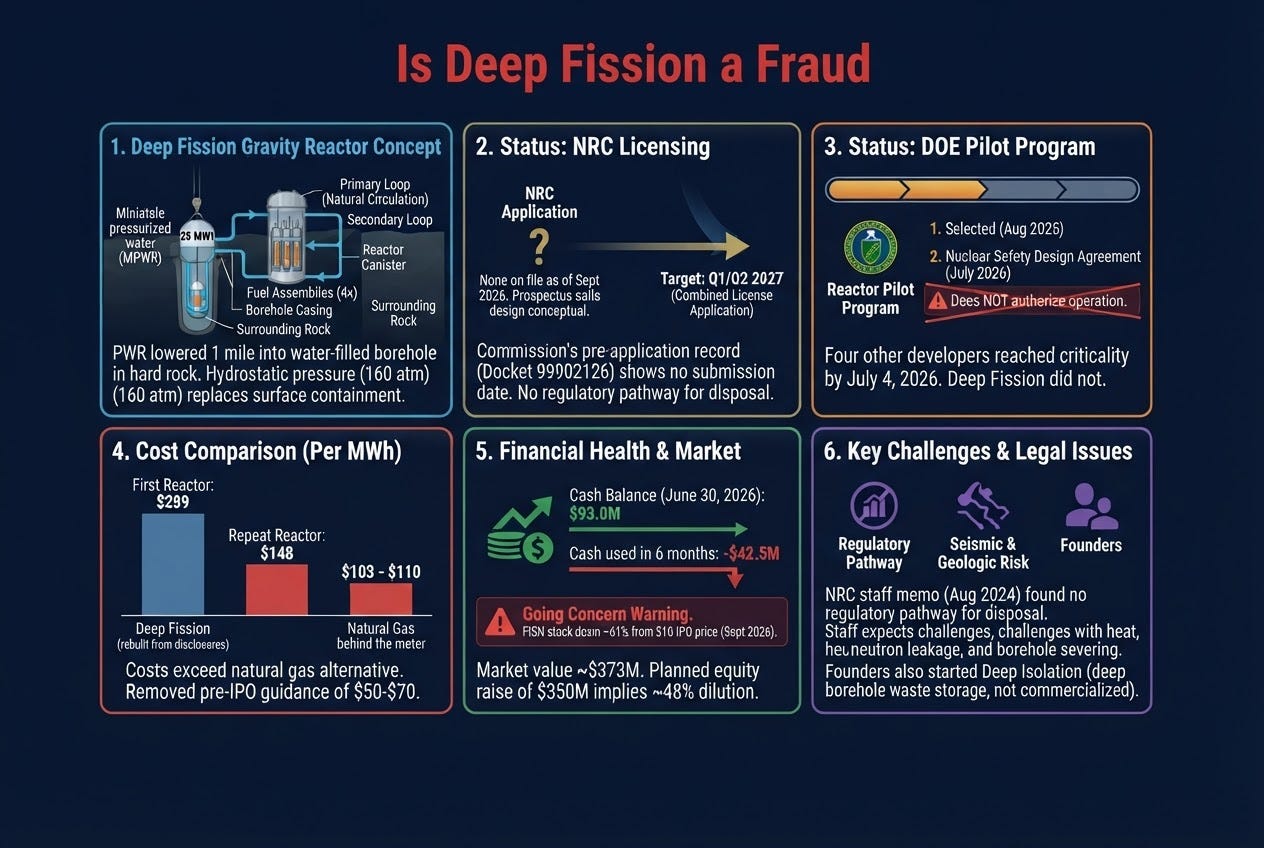
Deep Fission Gravity Reactor
Description
Deep Fission’s one mile deep Gravity reactor has no Nuclear Regulatory Commission license application on file as of September 2026, and its June 2026 prospectus describes the design as conceptual. The Commission’s pre application record under Docket 99902126 shows no date for a combined license submission. The Department of Energy approved a Nuclear Safety Design Agreement for the project in July 2026, a milestone that authorizes no operation.
Gravity is a miniature pressurized water reactor fueled with low enriched uranium, which Deep Fission, a California company founded in 2023 and listed on Nasdaq since June 2026, intends to lower into a water filled borehole in hard rock. Data center developers and shareholders carry the exposure. Four other developers in the Department of Energy Reactor Pilot Program reached criticality on or before July 4, 2026. Deep Fission did not.
The cost record is the weakest part of the file. The company removed its pre IPO guidance of $50 to $70 per megawatt hour from its prospectus, and rebuilding the calculation from the capital and operating figures it did disclose gives $289 for a first reactor and $148 for a repeat reactor. At June 30, 2026 the company held $93.0 million in cash, had used $42.5 million of it in six months, and carried a going concern warning.
Two bodies of law frame the exposure. Atomic Energy Act Section 103 and 10 CFR Parts 52 and 53 govern the license the company still has to obtain, and an August 2024 NRC staff memorandum found no regulatory pathway for disposing of a reactor in a borehole. Securities Act Section 11 and Exchange Act Rule 10b5 govern the statements made to investors, and two plaintiff firms announced investigations on September 29 and October 1, 2026.
Detailed Findings
What is the Deep Fission Gravity reactor and how does it work
The Gravity reactor is a four assembly pressurized water reactor, fueled with uranium oxide enriched below 5 percent uranium 235, that Deep Fission would lower into a cased borehole filled with water roughly one mile below the surface.
The April 22, 2026 conceptual design description, revision 0, specifies four standard fuel assemblies in a 17 by 17 array of 264 rods each, a thermal rating of 25 megawatts, and a borehole of about 38 inches inner diameter with a nominal 2 inch casing. Three water loops move the heat: a primary loop that circulates by natural convection, a pumped secondary loop, and a tertiary loop that drives the surface turbine and generator. Containment is assigned to the fuel and cladding, a reactor canister, and the borehole itself, including its water column, a closure device, and the surrounding rock. The same document describes the design as being in a pre final phase, with the safety classification of structures and components preliminary and subject to refinement.
The company attributes its cost and speed advantages to that geometry. The water column supplies roughly 160 atmospheres of hydrostatic pressure at depth, which the company says removes the need for the thick above ground containment structure and some of the safety systems a conventional plant carries. Spent fuel can be stored in the borehole or retrieved to the surface for conventional management. The company intends to take part in owning and operating its plants, which makes it the likely licensee and the party carrying nuclear liability.
I stood reactor watches on a nuclear submarine, and the maintenance and casualty philosophy of that pressurized water plant rested on a trained crew being able to reach the equipment. A reactor a mile down a borehole removes that option from the design. Every component below the surface has to be qualified to run to retirement without a hand on it, and I did not find in the public record how that qualification will be demonstrated.
How have the Gravity design parameters changed since 2024
The company’s own documents give different power ra