Episode Details
Back to Episodes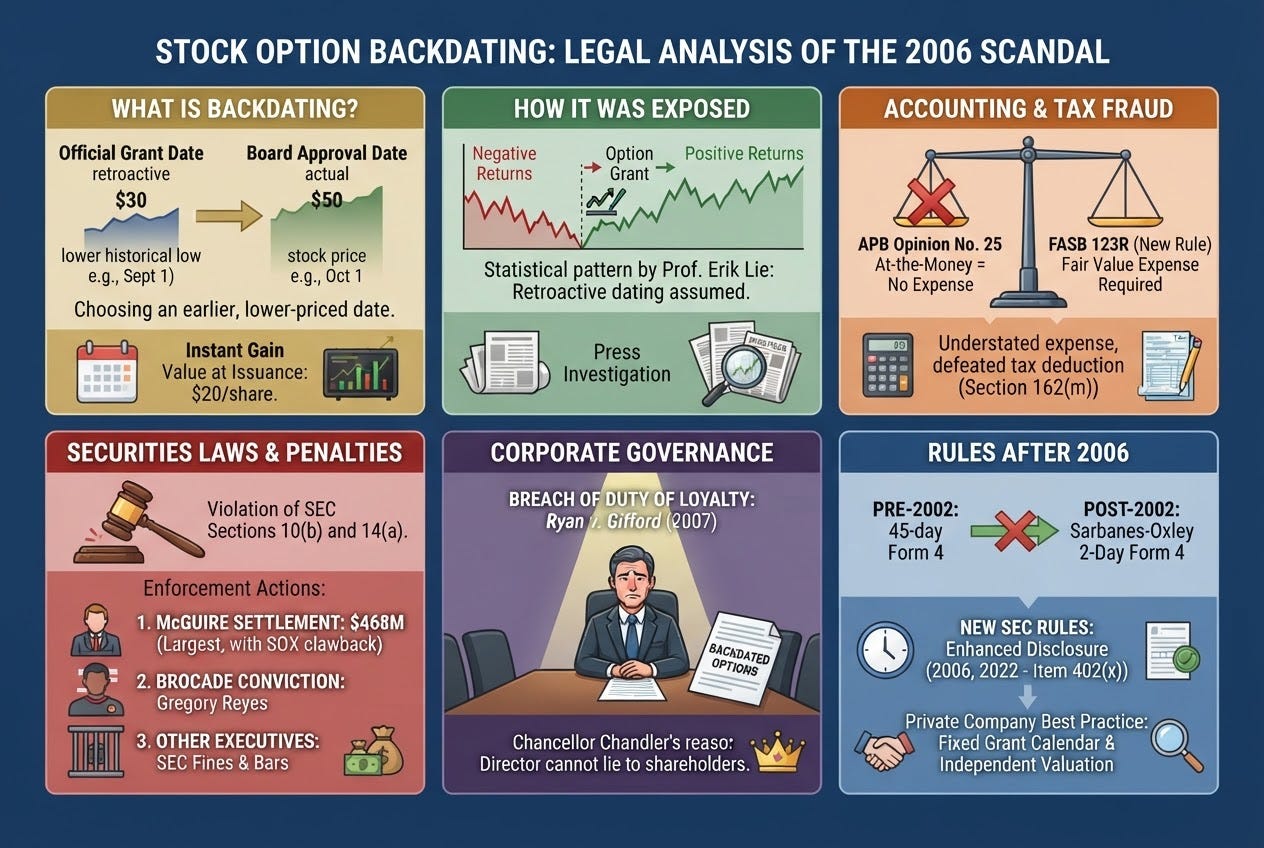
Stock Option Backdating Cost the UnitedHealth CEO $468 Million
Description
Stock option backdating cost former UnitedHealth Group chief executive William McGuire $468 million on December 6, 2007, after the SEC alleged he selected low price grant dates retroactively.
Backdating means writing a grant date earlier than the date the board acted, so the exercise price matches a historical low. A $30 exercise price on a stock that trades at $50 hands the executive $20 per share on the first day. The practice violated federal securities law when companies hid that gap from investors and auditors.
The numbers explain the reaction. Professor Erik Lie studied 39,888 option grants at 7,774 companies from 1996 to 2005 and estimated that 14 percent of the grants were backdated or manipulated. Roughly 200 companies faced federal investigation or restated earnings by January 2008. The research and a March 2006 newspaper investigation produced the caseload, and the newspaper series won the 2007 Pulitzer Prize for Public Service.
How did companies profit from backdating without recording the cost?
Accounting Principles Board Opinion No. 25 let a company record zero compensation expense for an option priced at market on the grant date, and required expense for an option granted in the money. Backdating relabeled in the money options as at the money options, and the expense never reached the income statement. The SEC alleged that Brocade Communications avoided reporting hundreds of millions of dollars of expense between 1999 and 2004, in part by dating grants for new hires to days before they had interviewed. For UnitedHealth the SEC alleged an understatement of $1.526 billion in stock based compensation from 1994 to 2005.
FASB Statement No. 123(R), effective June 15, 2005 for most public companies, ended the arbitrage by requiring expense for all share based payments. It was issued in December 2004, more than a year before the press investigation, so the accounting incentive had already disappeared when the scandal broke.
What did backdating do to taxes and proxy statements?
Section 162(m) of the Internal Revenue Code capped the corporate deduction for executive pay at $1 million and exempted performance based pay. In Memorandum AM2009006, dated July 17, 2009, the IRS Chief Counsel concluded that a discounted option cannot qualify for that exemption, even if the exercise price is raised later. The same memorandum treated a backdated option meant to be an incentive stock option as a nonstatutory option, so the employee owes ordinary income tax on the spread at exercise.
Proxy statements added a securities law problem. They told shareholders that exercise prices equaled fair market value on the grant date, and for a backdated grant that sentence was false. That placed the practice under Section 10(b) of the Securities Exchange Act of 1934 for fraud, Section 14(a) for the proxy, and Section 13(b)(2) for books and records and internal accounting controls.
Did the courts and prosecutors treat backdating as fraud?
The Delaware Court of Chancery answered for directors in Ryan v. Gifford on February 6, 2007: directors who approve backdated options in violation of a shareholder approved plan, while representing compliance, act in bad faith and breach the duty of loyalty. Section 102(b)(7) of the Delaware General Corporation Law does not exculpate that conduct. The same day the court decided In re Tyson Foods and allowed spring loading claims to proceed, which concern grants made days before good news and carry no false date.
Prosecutors had a harder path. A jury convicted Brocade chief executive Gregory Reyes on August 11, 2007, and the Ninth Circuit reversed in United States v. Reyes on August 18, 2009 because of prosecutorial misconduct. A second jury convicted him on nine of ten counts on March 26, 2010, and the Ninth Circuit affirmed on October 13, 2011. The McGuire settlement carried a ten year bar from serving as an officer or director, and about