Episode Details
Back to Episodes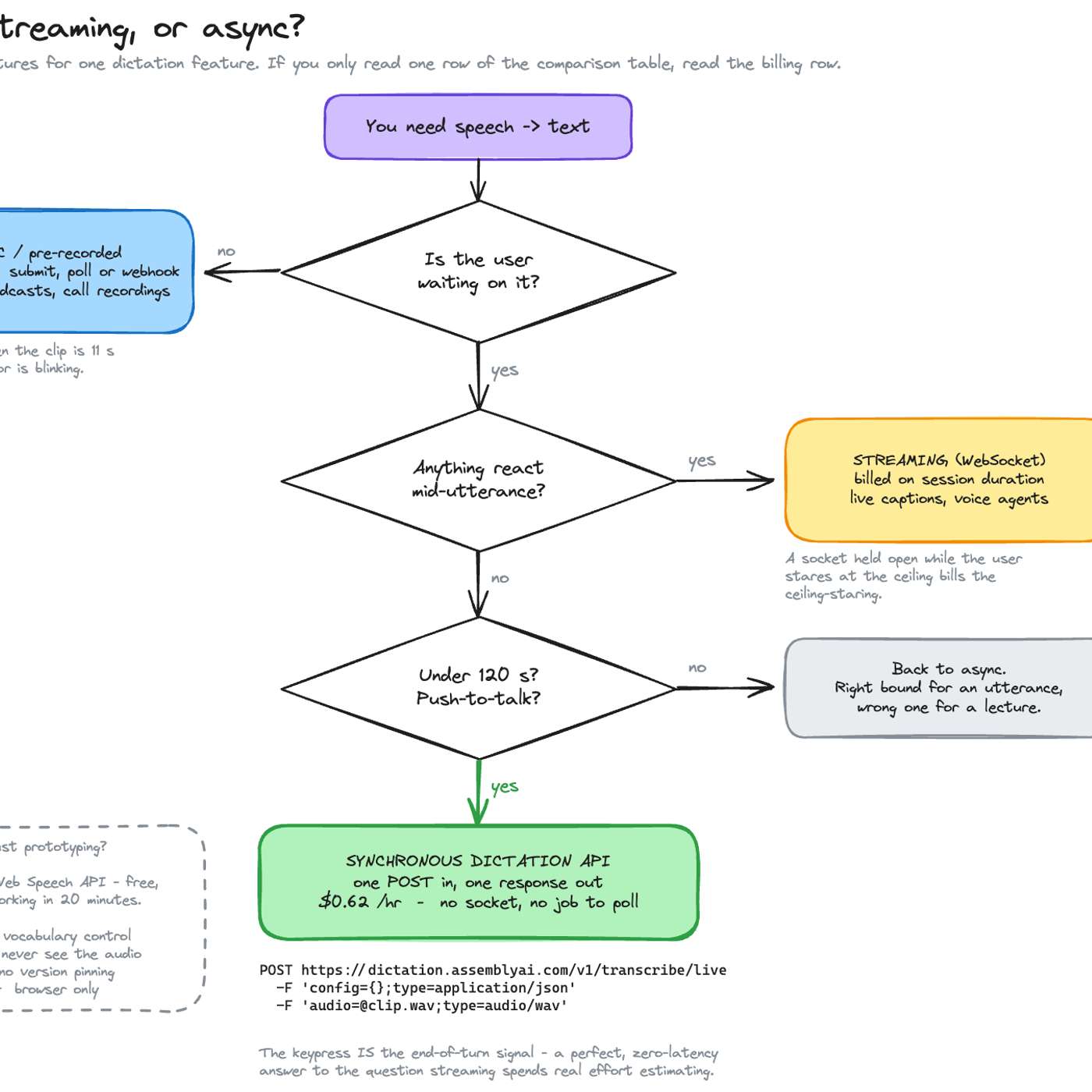
Designing a Low-Latency Speech-to-Text Pipeline for Dictation
Description
This story was originally published on HackerNoon at: https://hackernoon.com/designing-a-low-latency-speech-to-text-pipeline-for-dictation.
Push-to-talk dictation doesn't need a WebSocket. Here's how streaming, async, and a sync dictation API compare on latency, billing, and failure modes.
Check more stories related to undefined at: https://hackernoon.com/c/undefined.
You can also check exclusive content about #speech-to-text, #dictation-api, #assemblyai, #voice-interfaces, #streaming-transcription, #web-speech-api, #speech-recognition, #good-company, and more.
This story was written by: @assemblyai. Learn more about this writer by checking @assemblyai's about page,
and for more stories, please visit hackernoon.com.
Dictation has different architectural requirements from live captions, voice agents, and long-form transcription. This article compares browser, streaming, asynchronous, and synchronous approaches, then explains why a synchronous request model can make sense for push-to-talk dictation, including the trade-offs around latency, retries, cleanup, customization, and cost.