Episode Details
Back to Episodes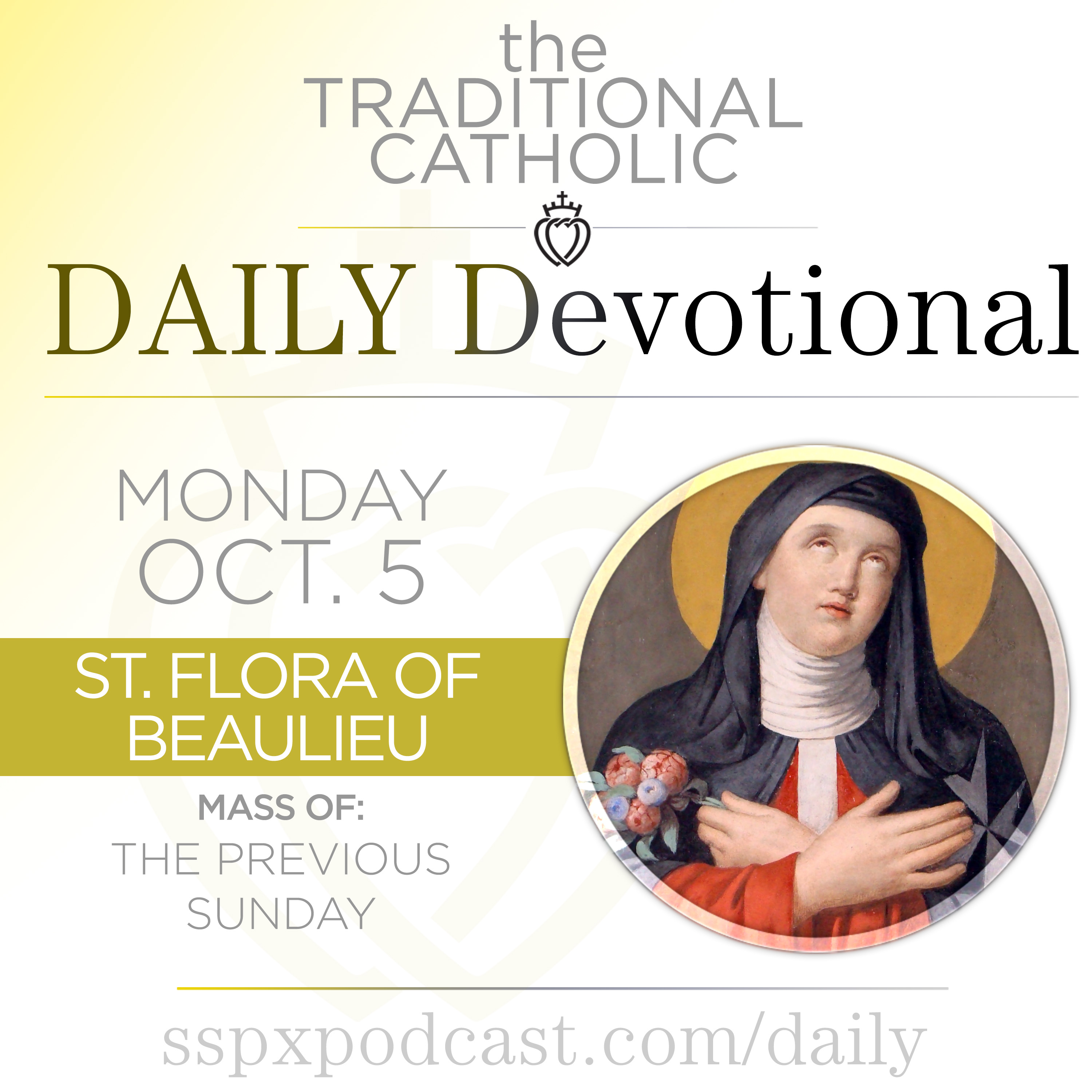
Oct 5 – S Flora of Beaulieu
Published 2 weeks, 6 days ago
Description
It's the Feast of Feria, 4th Class, with the color of Green. In this episode: the meditation: "The Wedding Feast of the Son", today's news from the Church: "About Pope Leo XIV", a preview of the Sermon: "Prayer and St. Thérèse", and today's thought from the Archbishop Marcel Lefebvre.
Have feedback or questions about the DD or our other shows? podcast@sspx.org
Saint Flora of Beaulieu is one of those medieval saints whose life was almost completely hidden inside a convent, and yet the stories that survived about her are surprisingly vivid. She was born around 1300 in the Quercy region of southern France. Her family was prosperous, and like many parents of the time, they expected Flora eventually to marry. Flora had absolutely no interest in that plan. From childhood she wanted religious life, and while still young she entered the monastery of Beaulieu, where she became a nun of the Order of Saint John of Jerusalem, better known today as the Knights . That alone is interesting. We usually picture the Hospitallers as armored knights defending pilgrims in the Holy Land. But the order also included religious women who lived lives of prayer and service. Flora belonged to one of those communities. And convent life was not immediately easy for her. Early accounts describe Flora going through years of spiritual dryness, anxiety, and temptation. At times she apparently wondered whether she had made a terrible mistake by entering religious life. She stayed. Eventually those difficult years gave way to an unusually intense life of prayer. Flora became especially devoted to the Passion of Christ and the Holy Eucharist, and other sisters began reporting that she would fall into ecstasy during prayer. One of the strangest traditions concerns the Eucharist. According to accounts of her life, while Flora was praying during Mass she saw Christ Himself in the Sacred Host. Other mystical experiences followed, and she became known for a remarkable awareness of events taking place far from the convent. One tradition says that during prayer she experienced a vision of a battle involving the Knights Hospitaller overseas and somehow knew of their victory before news could possibly have reached Beaulieu. For a cloistered nun in fourteenth-century France, that's quite a story. But Flora apparently wasn't interested in becoming a local celebrity. She continued the ordinary routine of convent life, trying to keep attention away from herself even as people increasingly sought her prayers. She died around 1347. Her relics remained at Beaulieu for centuries, and devotion to her became particularly strong in the surrounding region. The old convent church associated with her still survives near Issendolus, preserving the memory of a woman who spent most of her life within a few monastery walls. Flora never founded anything. She never traveled as a missionary. She barely went any
Sources Used Today:
- "The Wedding Feast of the Son" — From the Assumption to Advent
- "About Pope Leo XIV" (FSSPX.news)
- "Prayer and St. Thérèse" (SSPX Sermons)
- The Spiritual Life — Archbishop Marcel Lefebvre (Angelus Press)
Saint Flora of Beaulieu is one of those medieval saints whose life was almost completely hidden inside a convent, and yet the stories that survived about her are surprisingly vivid. She was born around 1300 in the Quercy region of southern France. Her family was prosperous, and like many parents of the time, they expected Flora eventually to marry. Flora had absolutely no interest in that plan. From childhood she wanted religious life, and while still young she entered the monastery of Beaulieu, where she became a nun of the Order of Saint John of Jerusalem, better known today as the Knights . That alone is interesting. We usually picture the Hospitallers as armored knights defending pilgrims in the Holy Land. But the order also included religious women who lived lives of prayer and service. Flora belonged to one of those communities. And convent life was not immediately easy for her. Early accounts describe Flora going through years of spiritual dryness, anxiety, and temptation. At times she apparently wondered whether she had made a terrible mistake by entering religious life. She stayed. Eventually those difficult years gave way to an unusually intense life of prayer. Flora became especially devoted to the Passion of Christ and the Holy Eucharist, and other sisters began reporting that she would fall into ecstasy during prayer. One of the strangest traditions concerns the Eucharist. According to accounts of her life, while Flora was praying during Mass she saw Christ Himself in the Sacred Host. Other mystical experiences followed, and she became known for a remarkable awareness of events taking place far from the convent. One tradition says that during prayer she experienced a vision of a battle involving the Knights Hospitaller overseas and somehow knew of their victory before news could possibly have reached Beaulieu. For a cloistered nun in fourteenth-century France, that's quite a story. But Flora apparently wasn't interested in becoming a local celebrity. She continued the ordinary routine of convent life, trying to keep attention away from herself even as people increasingly sought her prayers. She died around 1347. Her relics remained at Beaulieu for centuries, and devotion to her became particularly strong in the surrounding region. The old convent church associated with her still survives near Issendolus, preserving the memory of a woman who spent most of her life within a few monastery walls. Flora never founded anything. She never traveled as a missionary. She barely went any