Episode Details
Back to Episodes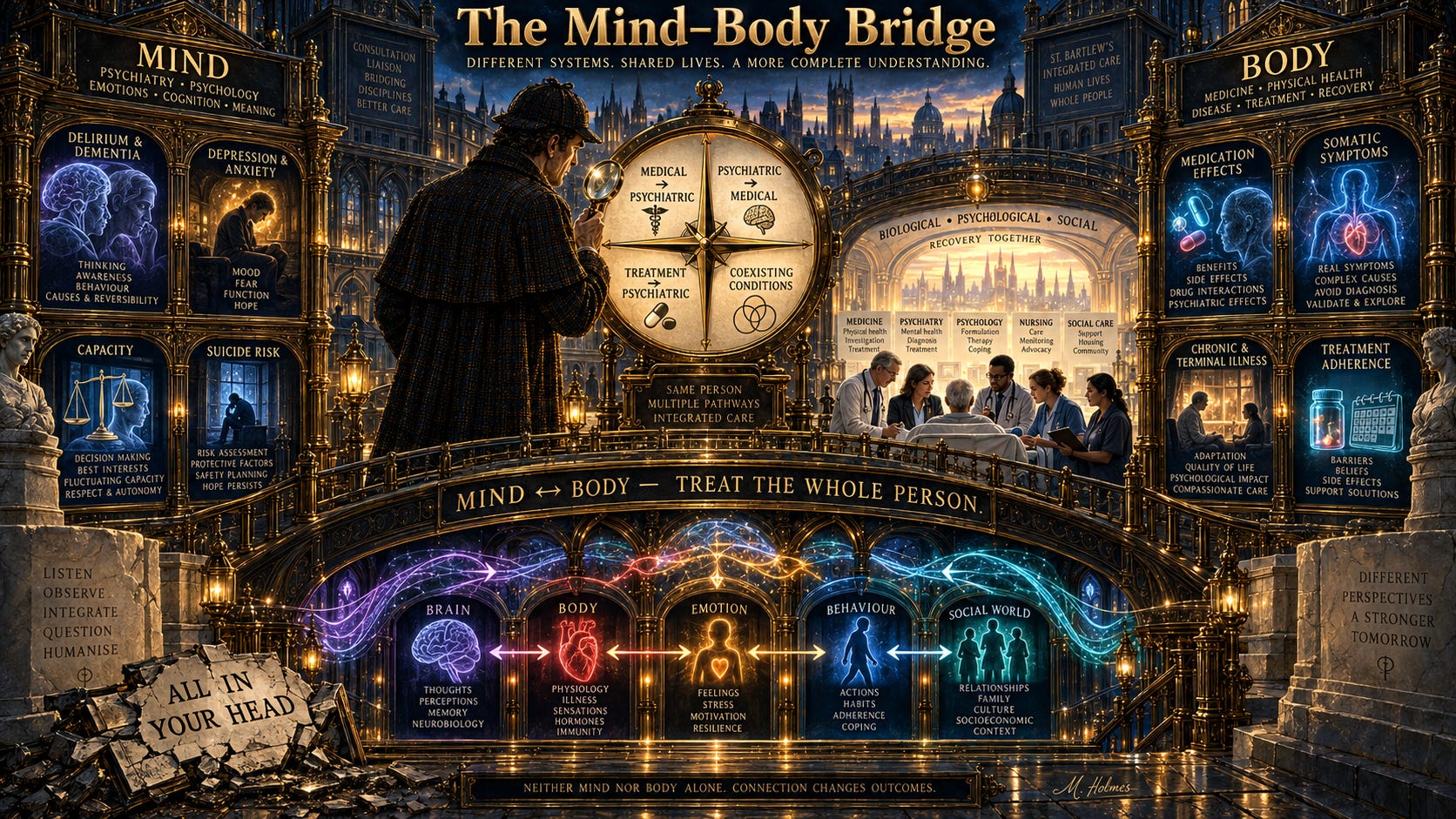
PSYCH 142: Consultation-Liaison Psychiatry and Psychosomatic Medicine
Description
Medlock Holmes enters The Hospital of Two Wings.
For generations, one wing has been labelled BODY and the other MIND. Patients are routinely carried from one to the other, as though every symptom must belong exclusively to one side.
Holmes immediately notices the flaw.
A bridge connects them.
Consultation-liaison psychiatry operates on this bridge: the part of psychiatry concerned with psychiatric problems arising within medical settings and with the complex, bidirectional relationships between physical illness and mental health. The older term psychosomatic medicine literally reflects the relationship between psyche and soma - mind and body - but historically became burdened by the misleading implication that symptoms were somehow imaginary or “all in the head”. The field increasingly adopted the name consultation-liaison psychiatry to better describe its clinical work.
The history of the specialty becomes a detective story in its own right. Holmes follows medicine from ancient recognition that emotions influence the body, through hysteria and conversion, psychoanalytic theories, physiological models of stress, psychoneuroimmunology and finally the modern biopsychosocial model.
The crucial insight is that causation rarely travels in only one direction:
PHYSICAL ILLNESS ↔ BRAIN ↔ PSYCHOLOGICAL RESPONSE ↔ BEHAVIOUR ↔ SOCIAL ENVIRONMENT
Modern C-L psychiatry therefore addresses an enormous range of problems: delirium and dementia caused by medical disease; depression and anxiety occurring alongside physical illness; psychiatric effects of medications such as corticosteroids; somatic symptom disorders; substance withdrawal; psychiatric complications of psychotropic treatment; adjustment to cancer, transplantation, disability or terminal illness; suicidality; treatment adherence; and assessment of decision-making capacity.
Holmes also discovers why this matters beyond psychological wellbeing. Psychiatric morbidity is exceptionally common among medically ill patients and can affect treatment adherence, disability, length of hospitalisation, quality of life and medical outcomes. The chapter reports psychiatric morbidity in roughly 20–65% of patients with medical conditions, depending on the illness, with delirium occurring in approximately 20% of hospital inpatients.
Assessment therefore demands more than a conventional psychiatric interview. Holmes must examine the medical record, medications, laboratory investigations, neurological findings, cognition, collateral information, the reason the treating team requested help and - crucially - the patient’s own experience of illness.
Treatment is similarly integrated. Psychotropic prescribing must account for organ function, drug interactions and medical vulnerability, while psychotherapy may address fear, disability, pain, changing roles, adherence, loss, dying and adaptation.
By the end, Holmes removes the old signs from the hospital.
There is no separate Mind Hospital and Body Hospital.
There is only:
THE PATIENT
Key Takeaways
1. Consultation-Liaison Psychiatry Sits at the Medicine–Psychiatry Interface
C-L psychiatry specialises in psychiatric assessment and treatment within the context of physical illness.
Its central question is:
“How are the medical and psychiatric problems interacting?”
2. “Psychosomatic” Does Not Mean Imaginary
Historically, psychosomatic became associated with the dismissive idea that unexplained symptoms were “all in your head”.
That is misleading.
The original concept concerns relationships between:
PSYCHE ↔ SOMA
Listen Now
Love PodBriefly?
If you like Podbriefly.com, please consider donating to support the ongoing development.
Support Us