Episode Details
Back to Episodes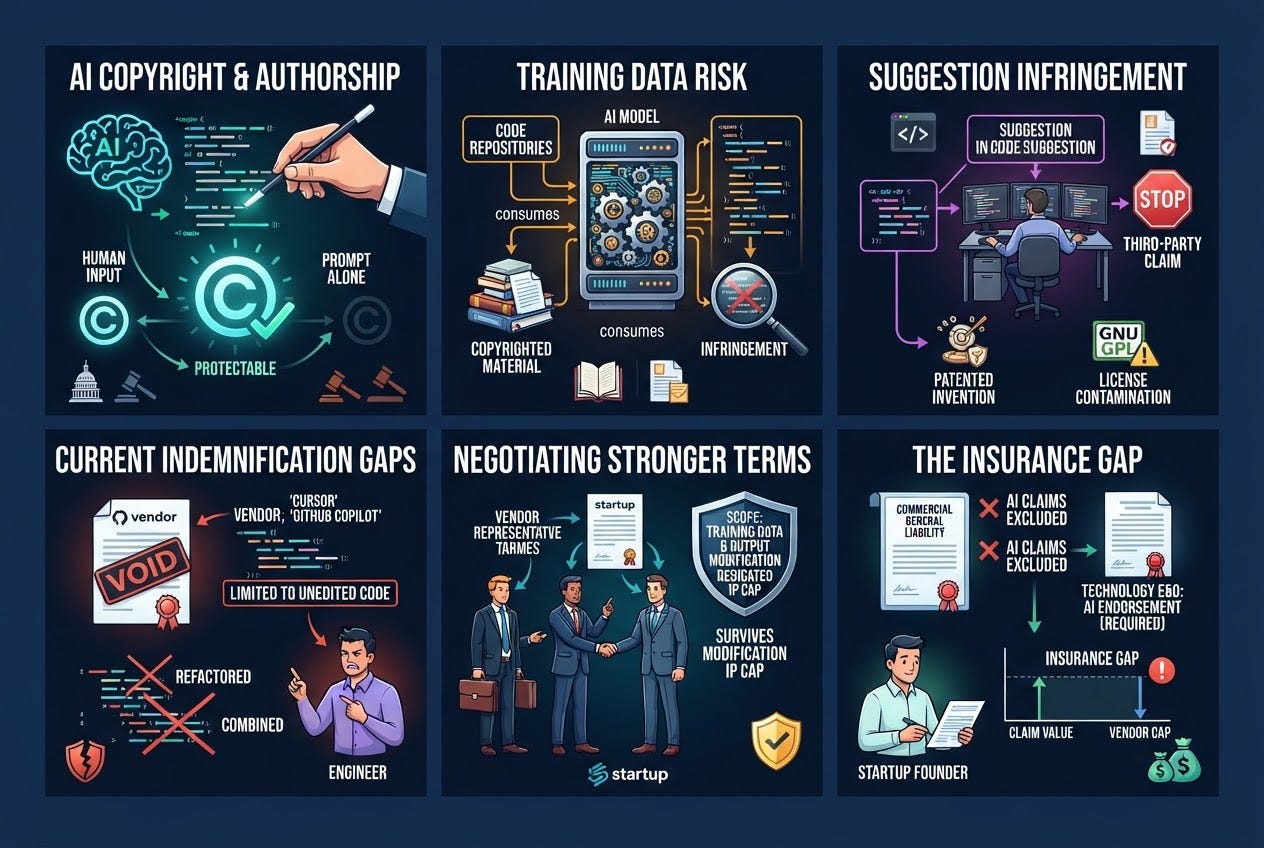
Copyright Ruling Makes AI Coding Tool Indemnification Vital
Description
The Copyright Office settled one question about AI generated code in its January 29, 2025 report and left the harder one standing: code a tool such as Cursor writes without a human supplying the expression cannot be copyrighted, but the report never says who bears the loss when that same code infringes somebody else’s copyright or patent. The District of Columbia Circuit closed the door on a related argument in Thaler v. Perlmutter on March 18, 2025, holding that human authorship is required as a matter of statutory law, and the Supreme Court declined to reopen that door in March 2026. Startups shipping product built with an AI coding tool are left with a settled rule on ownership and an open exposure on infringement, and the only place that exposure gets allocated is the vendor contract most engineering teams signed without a lawyer in the room.
I have reviewed dozens of these agreements for engineering teams this year, and the pattern repeats. Every vendor now markets an indemnification commitment. Cursor’s Master Services Agreement promises to defend a customer against a claim that the service or a suggestion infringes a third party’s rights. Microsoft extends its Customer Copyright Commitment to GitHub Copilot and Azure OpenAI output. Both promises look generous until an engineer does the one thing every engineer does to a suggestion before it reaches production: changes it. Cursor’s terms exclude modified or combined output from coverage. Microsoft’s commitment turns on system level filters staying enabled and on the customer proving compliance if a claim is ever tendered. Neither vendor indemnifies the actual file that ends up in the repository, because that file is never the unedited suggestion the model produced.
The litigation backdrop explains why vendors wrote the clauses this way. Doe v. GitHub, Inc. has run since 2022 on the theory that Copilot’s suggestions reproduce licensed open source code without carrying the license terms along, and the Ninth Circuit trimmed the case on September 16, 2026 by dismissing the plaintiffs’ Digital Millennium Copyright Act claim, while explicitly leaving the underlying copyright and license breach counts pending in district court. Thomson Reuters Enterprise Centre GmbH v. Ross Intelligence Inc. answered a closely related question for training data on February 11, 2025, holding that training a competing product on copyrighted material is not fair use. Andersen v. Stability AI Ltd. shows how long this kind of claim can run before it resolves: a 2024 order let the theory that a model’s weights encode the training data survive dismissal, and the case will not reach trial until April 5, 2027. A vendor negotiating an indemnification clause today is pricing risk against litigation that will not be resolved for years.
A startup’s counsel should treat four terms as the actual negotiation, not the marketing page. Scope should cover both the training data the vendor used and the specific output delivered to the customer, and it should cover patent claims alongside copyright, since a narrow copyright only promise leaves the more expensive patent risk with the customer. Survival matters more than scope: the indemnity has to cover a suggestion after ordinary engineering changes, renaming variables, adding error handling, refactoring for a company’s own conventions, because a clause that only covers the unedited suggestion covers almost nothing a team ships. The cap has to sit outside the ordinary service fee cap; industry benchmarking of enterprise AI contracts signed between the third quarter of 2023 and the first quarter of 2026 found that only 22 percent of surveyed agreements carried an indemnity fully excluded from the general cap, which means most startups signing standard terms today are capped at a fee figure that will not cover a real infringement defense. Cooperation is the fourth term: the vendor should supply the filtering tools it requires as a condition of cov