Episode Details
Back to Episodes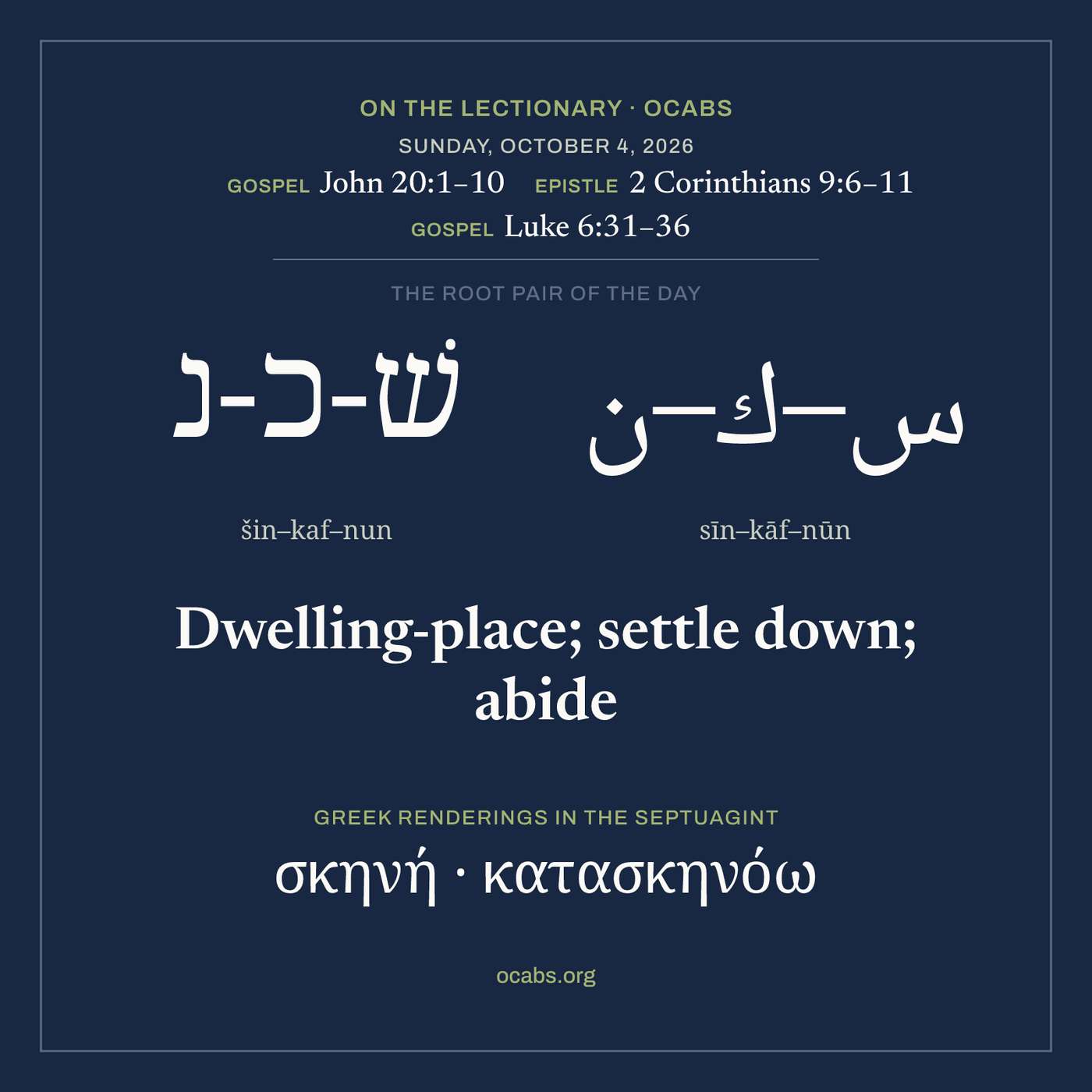
John 20:1-10 · 2 Corinthians 9:6-11 · Luke 6:31-36 — Sunday, October 4, 2026
Description
A daily note from the team at OCABS.ORG, drawing on the published works of Fr. Paul Nadim Tarazi, with citations to his books and lectures.
Readings: John 20:1-10; 2 Corinthians 9:6-11; Luke 6:31-36.
Only one note bears on John 20:1-10 directly: Fr. Paul observes that chapter 20, with its own closing statement of purpose, "sounds like the end of the book," while chapter 21 forms a later "second ending," perhaps added by the beloved disciple's own circle after his death. The passages do not address the particulars of this morning's scene at the tomb.
On the epistle, Fr. Paul traces how Paul moves from moral to factual pressure, recalling his boasting to the Macedonians before using the sowing-reaping image, also found in 1 Corinthians and Galatians: "he who sows sparingly will also reap sparingly, and he who sows bountifully will also reap bountifully." He grounds cheerful giving in scripture, redirecting Psalm 112:9 so its description of "the man who fears the Lord" now applies to God, and echoing Isaiah 55:10-11, where the Lord's word, like rain, gives "seed to the sower and bread to the eater," so God is shown to supply and multiply the harvest of righteousness. The aim, Fr. Paul notes, is that such giving will "produce thanksgiving to God," language tied to Paul's priestly offering of the Corinthians' faith, as in Philippians.
On the Gospel from Luke, Fr. Paul reads this teaching as part of the new Law Jesus gives from the level place, paralleling Moses on the mountain, so the whole discourse stands as the "Law of Christ." He stresses Jesus sets no condition of reciprocity: loving only those who love back, or lending only to those who repay, puts one on the level of "sinners." God himself is "kind to the ungrateful and the selfish," a word Fr. Paul ties to the fruit of the Spirit in Galatians. "Be merciful, even as your Father is merciful" stands, he says, at the center of the whole discourse, since children must resemble the father who both begets and rears.
The root pair of the day · שׁ-כ-נ šin–kaf–nun, מִשְׁכָּן miškan · س–ك–ن sīn–kāf–nūn, مِسْكِين miskīn · dwelling-place; settle down; abide. Zeraʿ and zarʿ name the act of sowing that frames the epistle: "he who sows sparingly will also reap sparingly." Fr. Paul traces this image through Paul's letters to Isaiah's seed given to the sower, and Greek sperma and speiro carry the same seed-sowing sense in John 4:37 and Mark 4:14. The root roots Paul's whole argument that God multiplies the harvest of righteousness. cf. The Consolation of Consonants
Sources: Tarazi, The New Testament: An Introduction, vol. 3, Johannine Writings, p. 13; Tarazi, 2 Corinthians: A Commentary, p. 177; Tarazi, 2 Corinthians: A Commentary, p. 177; Tarazi, 2 Corinthians: A Commentary, p. 178; Tarazi, 2 Corinthians: A Commentary, p. 179; Tarazi, 2 Corinthians: A Commentary, p. 158; Tarazi, 1 Corinthians: A Commentary, p. 163; Tarazi, The Rise of Scripture, p. 471; Orthodox Audio Bible Commentary, Luke (vol. 42), part 1, at 2:20:04; Orthodox Audio Bible Commentary, Luke (vol. 42), part 1, at 2:22:08; Tarazi, Galatians: A Commentary, p. 83; Tarazi, The New Testament: An Introduction, vol. 2, Luke and Acts, “Luke’s Sources Other then Mark”; Tarazi, The New Testament: An Introduction, vol. 2, Luke and Acts, “The Law of Christ”; Orthodox Audio Bible Commentary, Luke (vol. 42), part 1, at 2:24:54.
Opening music: Taksim Arbi, Bichi Slama, oud (Tunis, Archives de la Parole, 1930s), public domain. Source: gallica.bnf.fr / BnF.