Episode Details
Back to Episodes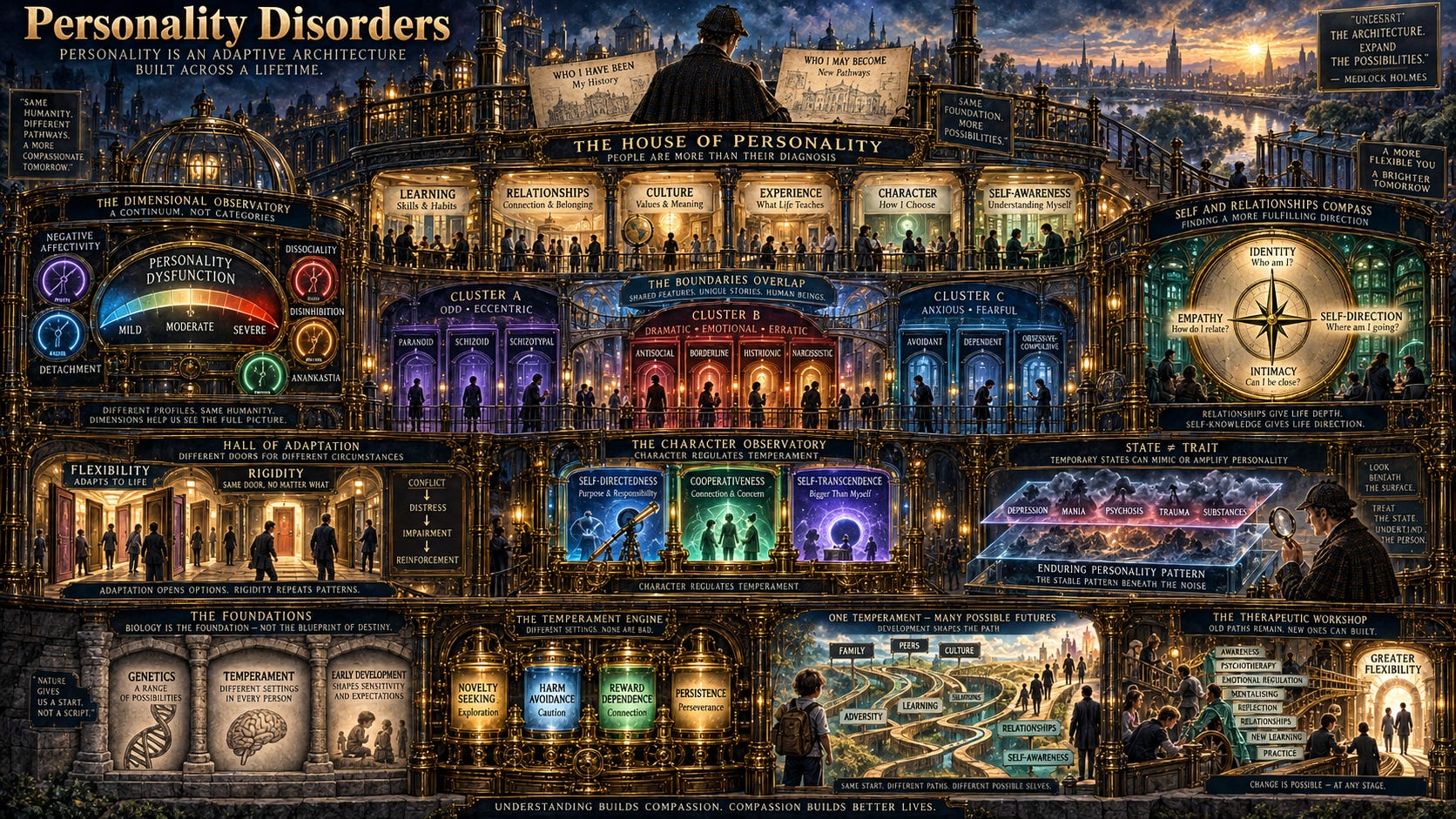
PSYCH 141: Personality Disorders
Description
Personality disorder emerges not because someone has a distinctive personality, but when enduring patterns become sufficiently inflexible and maladaptive to repeatedly disrupt the self, relationships and functioning.
Medlock Holmes enters The House of Personality, an extraordinary mansion that has been under construction since childhood.
Its foundations contain inherited temperament. Its rooms have been shaped by development and experience. Its doors determine how readily someone approaches or avoids the world; its windows influence how they interpret other people; and its internal corridors represent the habitual ways in which emotion, identity, relationships and behaviour become connected.
Every house is different.
Difference itself is not disorder.
The mystery begins when Holmes discovers that some houses have become rigid. The same doors open regardless of circumstance. The same corridors are travelled despite repeatedly leading to conflict. Strategies that may once have been adaptive become increasingly difficult to modify.
This chapter takes Holmes beneath diagnostic labels to explore the architecture of personality itself. Personality is presented as a dynamic biopsychosocial system emerging from interactions between temperament, character, learning, development, environment and self-awareness.
Holmes encounters two competing maps of personality disorder. The traditional DSM model divides disorders into three familiar clusters: Cluster A, characterised broadly by odd or eccentric patterns; Cluster B, by dramatic, emotional or impulsive patterns; and Cluster C, by anxious or fearful patterns. Yet the boundaries overlap considerably.
A newer dimensional perspective asks a different question. Rather than simply asking “Which personality disorder does this person have?”, clinicians can ask:
“How impaired is personality functioning, and what traits characterise that impairment?”
This becomes particularly important in ICD-11, where personality disorder is primarily classified by severity - mild, moderate or severe - followed by trait qualifiers.
The chapter also challenges therapeutic pessimism. Personality is relatively enduring, but it is not necessarily immutable. Psychotherapy, relationships, learning and increasing self-awareness can alter how people regulate emotion, pursue goals, understand themselves and relate to others.
Holmes therefore leaves the mansion with a different question from the one with which he entered.
Not:
“What kind of difficult person is this?”
But:
“What enduring pattern is operating here, how did it develop, what function does it serve, and where might greater flexibility become possible?”
Key Takeaways
1. Personality Is Not the Same as Personality Disorder
Personality describes relatively enduring patterns in how someone:
* experiences themselves
* experiences other people
* regulates emotions
* behaves
* pursues goals
* adapts to the environment.
Having unusual or extreme traits does not automatically indicate pathology.
The chapter specifically emphasises that even extreme temperament variants need not produce personality disorder.
2. Think in Terms of Adaptation
A useful overarching model is:
PERSONALITY = TEMPERAMENT × CHARACTER × DEVELOPMENT × EXPERIENCE × SELF-AWARENESS
Personality is not merely something a person has.
It is part of the system through which they continually adapt.
3. Personality Disorder Involves Enduring Maladaptation
The important features are:
PERSISTENT