Episode Details
Back to Episodes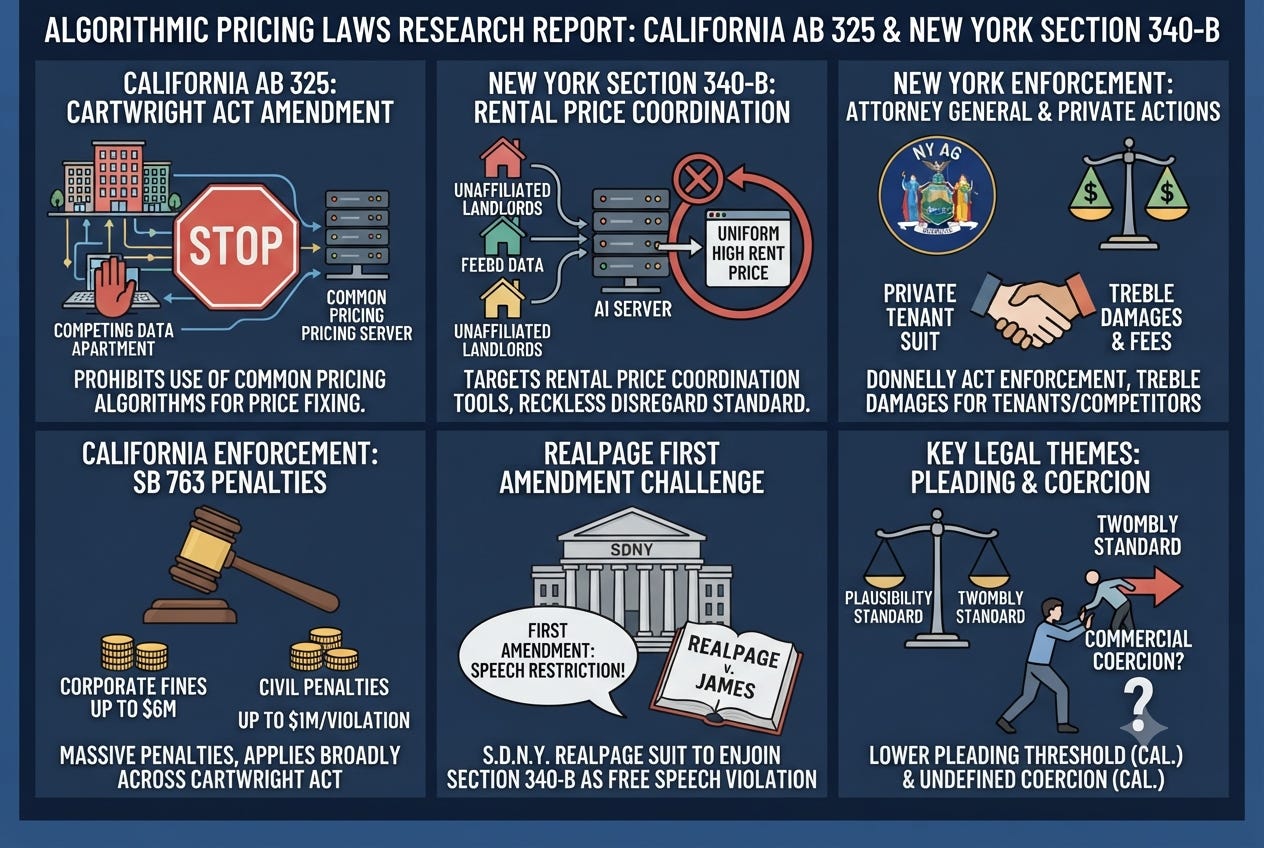
California and New York Ban Algorithmic Price Coordination
Description
California Assembly Bill 325 and New York General Business Law Section 340-B, both in force by January 2026, prohibit two or more businesses from using a common pricing algorithm to set prices, rents, or wages, and both let a plaintiff win without proving the businesses ever spoke to each other directly. AB 325 amends the Cartwright Act to punish a company that distributes an algorithm built on competitor data or that coerces another company into following that algorithm’s recommendation. Section 340-B punishes any software that pools rent data from multiple unaffiliated landlords and hands back a recommended price, and it punishes the landlord who follows that recommendation with reckless disregard for where the number came from. A vendor selling a pricing tool to hotels, apartment owners, staffing agencies, or any other industry that competes on price now operates under legal exposure that did not exist a year ago.
The catalyst was RealPage. Reporting in 2022 on RealPage’s YieldStar software, which collected rent data from competing landlords and recommended prices back to them, produced a wave of private antitrust suits and, eventually, a United States Department of Justice case that ended in a proposed consent judgment on November 24, 2025. That judgment bars RealPage from recommending prices built on competitor lease data less than 12 months old. California and New York decided the federal settlement did not go far enough and wrote their own prohibitions directly into state law, with AB 325 covering every industry that shares a pricing algorithm across competitors and Section 340-B covering residential rental housing specifically.
AB 325 adds Section 16729 to the Business and Professions Code. A common pricing algorithm is any methodology, including a computer, software, or other technology, used by two or more persons, that uses competitor data to recommend, align, stabilize, set, or otherwise influence a price or commercial term, and the statute defines commercial term broadly enough to reach compensation paid to an employee or an independent contractor. The statute draws no line between public and nonpublic data, so a tool built entirely from prices posted on a public website carries the same exposure as one built from a confidential data feed. A single company running an algorithm on its own proprietary data sits outside the statute because the definition requires two or more persons, which means the safest compliance path for a vendor is walling off each customer’s pricing data so that no algorithm output reflects more than one company’s information.
AB 325’s companion provision, Section 16756.1, changes something most people outside a courtroom never notice: the pleading standard. Since Bell Atlantic Corp. v. Twombly in 2007, a plaintiff alleging a price fixing conspiracy has generally had to plead facts that exclude the possibility a company acted alone. Section 16756.1 drops that requirement for Cartwright Act claims and asks only whether a conspiracy is plausible. I have watched more than one algorithmic pricing complaint die at the motion to dismiss stage because the plaintiff could not allege the one fact that separates parallel pricing from an actual agreement: proof the companies compared notes. California just removed that obstacle for its own courts, and the question every litigator I know is now asking is whether a federal judge in San Francisco or Los Angeles, sitting in diversity jurisdiction, has to follow California’s rule or gets to apply Twombly anyway.
Section 340-B works differently because it targets a specific software function, not an industry wide agreement. New York Governor Kathy Hochul signed Senate Bill 7882 on October 16, 2025, and the statute took effect December 15, 2025. It defines a coordinating function as software that collects rent or pricing data from multiple unaffiliated landlords, analyzes that data computationally, including through training an artifi