Episode Details
Back to Episodes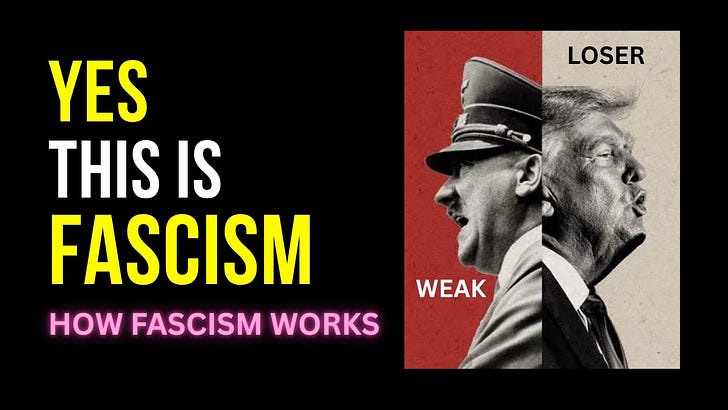
Is This Fascism? Yes
Description
In 1922, 30,000 men in black shirts marched on Rome and demanded control of the Italian government. The King of Italy could have used the military to stop them. He did not. He handed power to their leader, Benito Mussolini, rather than risk a civil war. Within three years Italy was a one-party fascist state. Within two decades tens of millions of people were dead.
Fascism didn’t die with Mussolini or with Hitler. It’s a system. It has a structure. It has tactics that repeat across every country and every century where it appears. And in 2018, former Yale philosophy professor named Jason Stanley published a book identifying exactly what those tactics are.
Stanley was the Jacob Urowsky Professor of Philosophy at Yale University. He is the child of refugees who escaped World War II Europe. He has spent his career studying authoritarianism and propaganda. His book “How Fascism Works: The Politics of Us and Them” identifies ten tactics that every fascist movement in history has used to take power. Not some of them. All of them.
What Fascism Actually Is
The word fascism gets used loosely. It gets thrown at anyone people disagree with. That carelessness is dangerous because fascism is not an insult. It is a system with a specific definition, a specific origin, and a specific set of mechanics.
Fascism is a system where one man has total power over everything. The government. The military. The courts. The economy. And it is enforced by violence. You submit or you are punished. There is no middle ground.
Fascism has no policies. It has no economic plan. No vision for how society should function. It is purely a mechanism for one man to seize absolute power and keep it. Everything else, the rallies, the slogans, the scapegoats, the culture wars, is just a tool to get there.
Benito Mussolini invented it in Milan, Italy in 1919. The country had just come out of World War I on the winning side but got almost nothing from the peace deal. The economy was in ruins. People had no work. The national mood was humiliation and desperation.
Mussolini exploited that desperation with three claims: your country used to be great, someone took that greatness from you, and democracy is too weak to get it back. His answer was to concentrate all power in a single leader, himself, who would punish the nation’s enemies and restore its strength.
The trade was simple. Citizens give up their freedom, their right to question, their right to disagree. In return, the leader gives them someone to blame.
That transaction sits at the center of every fascist movement in history. The leader needs an enemy because rage is the only glue holding the system together. Without someone to hate, the entire structure collapses.
Fascism also leads with violence. Mussolini built a private militia called the Blackshirts. They attacked socialists, beat union organizers, and physically removed political opponents from local governments. Violence was not a byproduct of the movement. It was the operating system. In 1922, Mussolini marched 30,000 Blackshirts on Rome and demanded power. The King of Italy handed it to him rather than risk civil war.
Hitler watched closely. He took Mussolini’s model and adapted it. Where Mussolini used brute force to seize power, Hitler used democracy itself. He ran in elections. He exploited free speech, free assembly, and every legal right available to citizens of a democratic republic. He used the system to get inside the system. Then he dismantled every one of those rights so no one could use them to challenge him.
This is the mechanism that makes fascism uniquely dangerous among authoritarian systems. It weaponizes the openness of democracy against itself. It walks through the front door, smiles at everyone in the room, and then locks the door behind it.
The Ten Tactics
Jason Stanley’s framework is not a theory. It is a pattern ex