Episode Details
Back to Episodes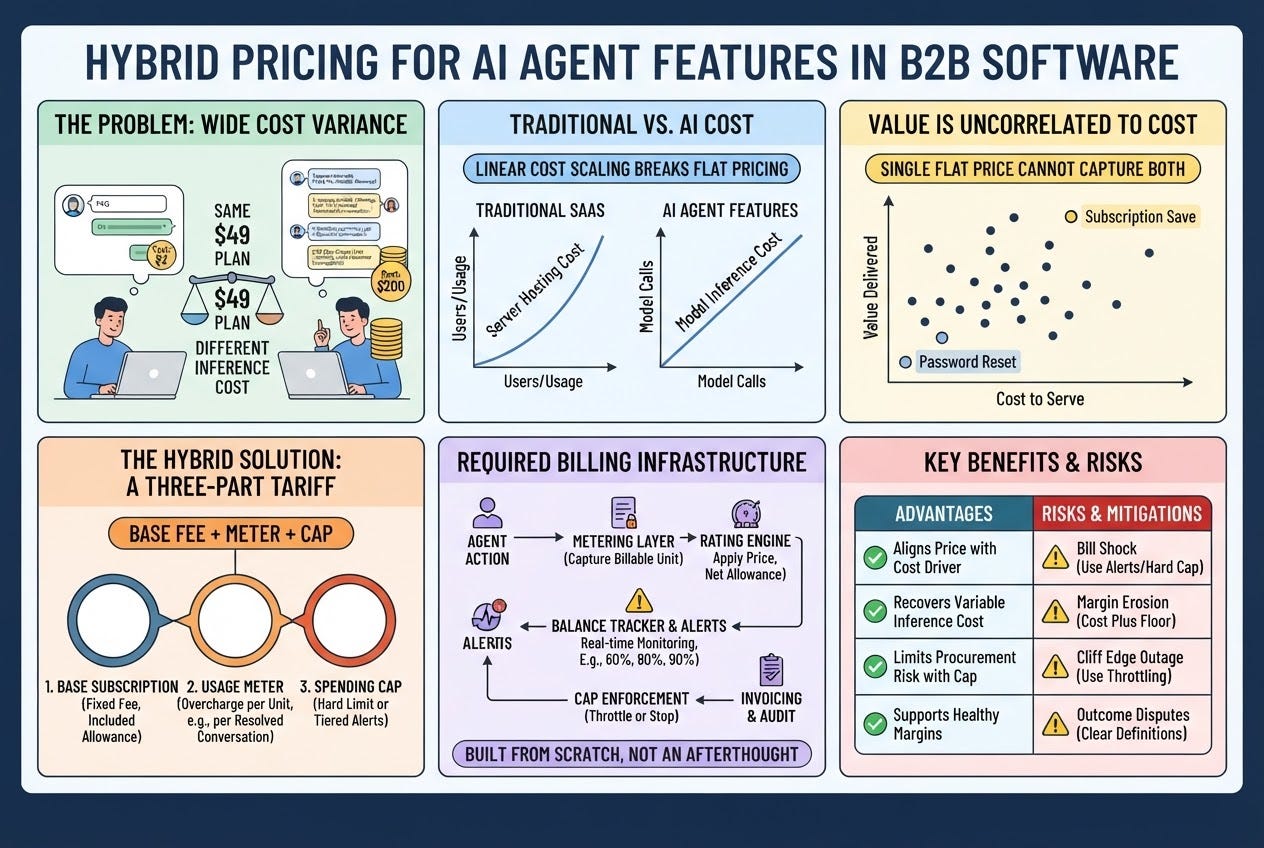
How Should Saas Companies Price AI Agent Features
Description
Two customers on the same 49 dollar monthly plan for an AI agent feature can cost a vendor 2 dollars and 200 dollars respectively in model inference, a spread of roughly a hundred to one that no flat subscription price can absorb. Hybrid pricing, a base subscription fee layered with a usage meter and a spending cap, reached 37 percent adoption among business to business software companies in 2026, up from 25 percent a year earlier. The reason is not fashion. Per seat pricing was built for a product whose cost to serve barely moved with usage, and an AI agent’s cost to serve moves with usage more than almost any cost line SaaS pricing has ever had to track.
The mechanism is worth stating plainly because it explains why the fix is not simply charging more. An agent’s cost to serve rises with how many model calls a task takes, how long the context window runs, and how many tool steps or retries a conversation needs. A one line answer to a frequently asked question might call a model once. A multi step troubleshooting conversation can call it dozens of times. Meanwhile the value the agent delivers runs on an entirely separate curve: an agent that resolves a password reset and an agent that saves a 12,000 dollar annual contract from canceling can cost the vendor nearly the same to run while delivering value that differs by orders of magnitude. Cost varies one way. Value varies another. A price built to track only one of them misprices the other.
The margin numbers show how much is riding on getting this right. A July 2026 survey of roughly 305 software company executives found aggregate AI gross margins at 45 percent in 2025, projected to climb to 53 percent in 2026 and 59 percent by 2027, against 70 to 85 percent for conventional software. Among companies already charging for consumption, only 15 percent absorb the full inference cost themselves. The rest pass it through to the customer in some form, which tells you cost plus overage pricing is closer to standard practice than to an aggressive outlier move.
Four live examples show the range of ways companies are solving this in 2026. One customer support platform charges 29 to 132 dollars a month per seat plus 99 cents per resolved conversation, and it gives customers a native dashboard to set spend reminders and hard limits themselves, refunding a charge if the customer later reopens the case. A competing support platform charges 1.20 to 1.50 dollars per verified resolution on top of its seat fees, with an annual ceiling of 10,000 resolutions across every plan, but no way to cap a bill short of pausing the agent entirely. One CRM platform sells prepaid credits, 10 to 15 cents per agent action with a 500 dollar minimum purchase, which caps spend by construction since there is no credit left to overspend. One enterprise conversational agent vendor charges an annual platform fee near 150,000 dollars plus 1 to 2.50 dollars per successful outcome, fully negotiated, with no public pricing and no disclosed cap at all. Only two of these four have actually solved the spending cap problem. The other two have built a meter and left the ceiling to chance.
That gap is the whole story. A developer once ran up a 500 dollar bill experimenting with a general purpose model API. A logistics company took a 25,000 dollar hit from a misconfigured mapping integration. Those are not edge cases for an AI agent feature with no visible cap. They are the predictable result of charging by usage without telling the customer where the usage stops. In contract negotiations over an AI vendor agreement, the clause that stalls the deal is rarely the headline price per unit. It is the absence of an answer to one question a general counsel always asks: what is the most this can cost us in a single month. A vendor without an answer loses the negotiation, whatever the rate card says.
The structure that works combines three pieces, and the order matters. A base fee should cover fixed co