Episode Details
Back to Episodes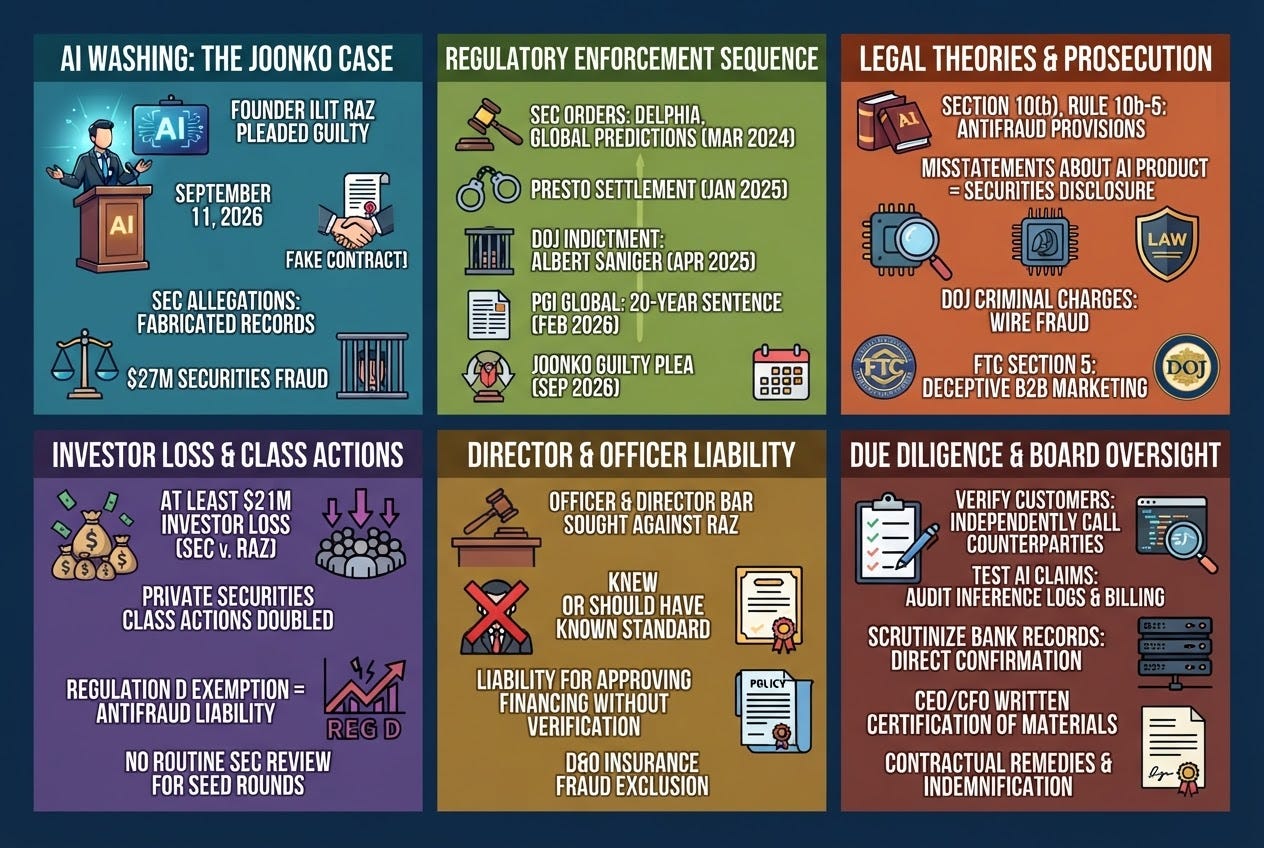
How Does AI Washing Become Securities Fraud
Description
Ilit Raz stood before United States District Judge Alvin K. Hellerstein on September 11, 2026 and admitted what investors had suspected since the middle of 2023: the 100 customers, the seven figure revenue, and the 100,000 active candidates she described to raise $27 million for Joonko were largely invented. The admission closes a case the Securities and Exchange Commission opened as a civil matter in June 2024, SEC v. Ilit Raz, and it confirms a pattern that had been building since March 2024, when the SEC brought its first AI washing orders against Delphia and Global Predictions. Federal prosecutors and regulators have now charged five separate founders and executives with describing an artificial intelligence capability their company did not have, and every one of those cases used the same antifraud statute that has governed securities fraud since 1934.
The mechanism is not complicated once the artificial intelligence terminology is stripped away. Section 10(b) of the Securities Exchange Act of 1934 and Rule 10b-5 make it unlawful to make a material misstatement in connection with the purchase or sale of a security, and a startup raising a priced round is selling a security to each investor who wires money into the round. A claim that a product runs on a predictive model, that 100,000 candidates use a platform, or that a trading algorithm executes trades is a factual statement about the business exactly like a revenue figure, and it is tested the same way: does a reasonable investor consider it important to the decision to invest. Joonko’s claimed Fortune 500 customer list and Nate’s claimed 93 to 97 percent purchase automation rate both fail that test for the same reason. Neither existed.
Nate is the clearest illustration of how an artificial intelligence claim becomes a criminal count rather than a civil one. Former chief executive Albert Saniger told investors his shopping application completed the overwhelming majority of purchases without human involvement, when in fact hundreds of contract workers in the Philippines processed the transactions by hand. Saniger restricted internal access to the metrics that would have shown the gap. The Department of Justice charged Saniger with securities fraud and wire fraud, each carrying a maximum of 20 years in prison, the same sentencing exposure Raz now faces. A company’s labor cost structure is not something a founder can hide forever: a business running 95 percent on artificial intelligence spends its money on cloud inference, not on a call center payroll, and that discrepancy sits in the general ledger for anyone who asks to see it.
Ramil Palafox took the same misrepresentation into a different market. PGI Global raised approximately $198 million from investors worldwide on the promise of an automated trading platform built on artificial intelligence that never placed a legitimate trade, and Palafox diverted more than $57 million of that money into vehicles, watches, and real estate before a sentence of 20 years closed the matter in February 2026. The Federal Trade Commission has built a parallel track for the same conduct aimed at business customers rather than investors: its 2026 settlement with CMG Media Corporation addressed a company that sold a voice targeting tool described as artificial intelligence built on nothing but a purchased email list. The SEC’s enforcement division, the SEC’s examination staff, the Department of Justice, and the FTC are now reading an artificial intelligence claim in a pitch deck or a sales brochure as a factual representation to be tested rather than a marketing flourish to be waved through.
What this means for the next founder raising a priced round is that the diligence a lead investor already performs on revenue and customers has to extend to the artificial intelligence claim with the same rigor, and the founder who wants to survive that diligence should get there first. A board that signs a term sheet on the str