Episode Details
Back to Episodes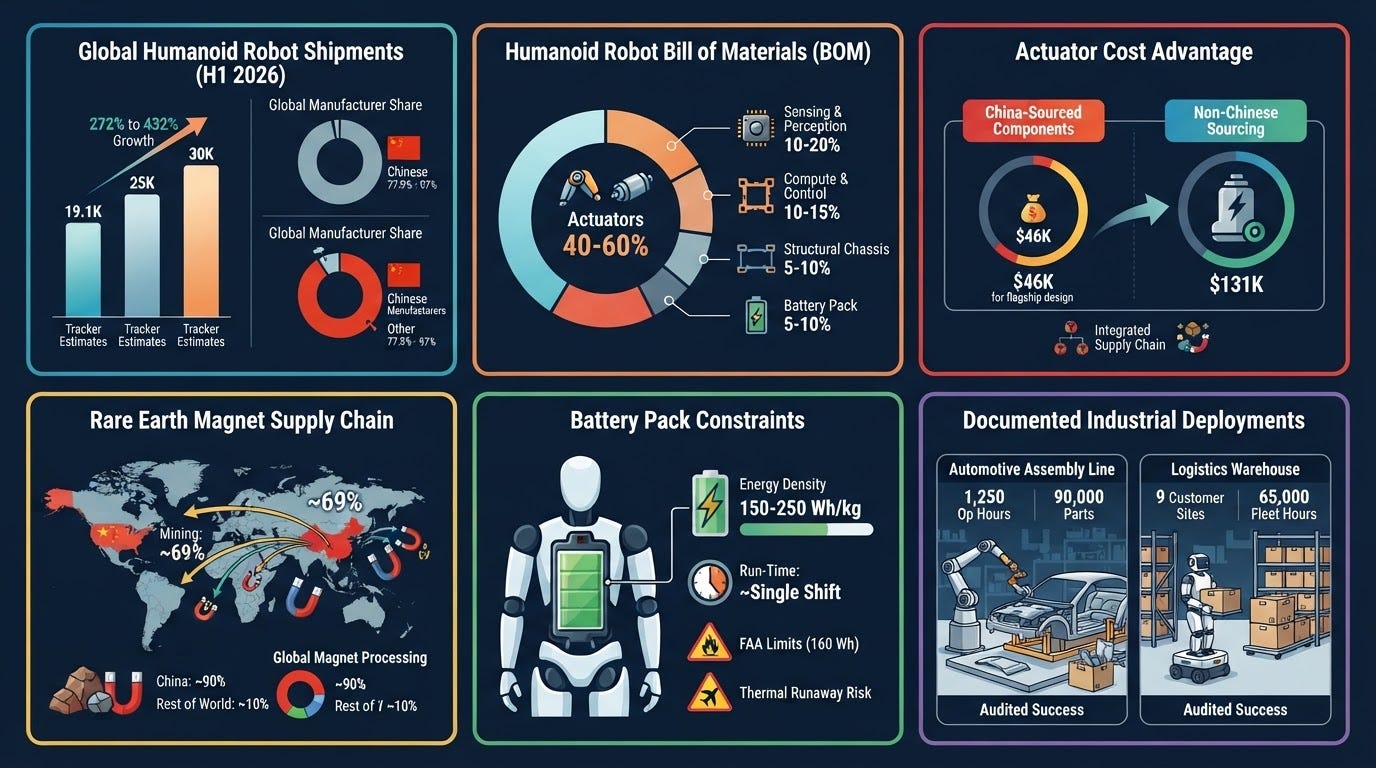
China Shipped Most of the World’s Humanoid Robots This Year
Description
Agibot shipped roughly 8,400 humanoid robots in the first half of 2026, more than the entire global industry shipped in all of 2023. The company passed Unitree for the top global shipment position inside a market that grew between 272 percent and 432 percent year over year, depending on which tracker counted the units. Between 77.9 percent and 97 percent of every humanoid robot shipped in the first half of 2026 came out of a Chinese factory, and the two leading companies controlled roughly three quarters of global volume between them. For a founder raising a venture round on the premise that physical artificial intelligence has entered its commercial phase, that concentration is the more important number, not the growth rate.
The growth rate alone invites the wrong conclusion. A 272 to 432 percent jump sounds like an industry crossing from demonstration into mass deployment, and several of this year’s funding rounds were priced on exactly that story. But one tracker put the entire global market at only about 5,100 units in the first half of 2025, meaning a large share of that eye catching percentage comes from a tiny base rather than from a sudden arrival of real paying customers. The more useful question is not how fast the number grew but what the units are actually doing once they leave the factory.
By that measure, two programs clear a real bar and most do not. A Figure AI robot loaded sheet metal parts inside BMW’s Spartanburg, South Carolina plant for eleven months, logging 1,250 operational hours and better than 99 percent placement accuracy across more than 90,000 parts and 30,000 finished vehicles. Agility Robotics’ Digit moved totes across nine customer facilities under multi year service contracts, logging more than 65,000 cumulative operating hours. Compare that to Tesla’s Optimus, which remains an internal test with no external customer and no published operating hours, or to the Walker series pilots running inside several Chinese automakers, most of which do not disclose fleet size or intervention rate at all. A shipment count cannot tell you which bucket a robot falls into. Only audited hours and named customers can, and in 2026 almost nobody discloses both.
The bill of materials explains why China is winning the shipment count regardless of how the deployment question resolves. Actuators, the motors and gear reductions inside every joint, run 40 to 60 percent of a humanoid robot’s total cost, and China controls an estimated 69 percent of the rare earth mining and 90 percent of the magnet processing that feeds those motors. One widely cited teardown put a flagship design’s bill of materials at roughly $46,000 built with Chinese components against roughly $131,000 for the identical specification built without them, a near threefold gap that has nothing to do with labor cost and everything to do with who controls the magnet supply.
Germany is not trying to win that fight on finished units, and that is the more interesting story for a founder reading this from outside China. Schaeffler redesigned its strain wave gear, the precision component inside every shoulder and elbow joint, cutting manufacturing cost by more than 25 percent and material use by more than 75 percent, and won an award for it at Hannover Messe in April 2026 with series production targeted for mid 2027. Bosch and Schunk are jointly building a robotic hand meant to sell into multiple robot platforms rather than one. Fraunhofer IPA has pegged the component market those two bets address at roughly $30 billion by 2030. Neither company is trying to out ship Agibot. They are doing exactly what Schaeffler and Bosch have done in the automotive supply chain for fifty years: selling the part every manufacturer needs rather than building the finished machine themselves.
In drafting cross border component supply agreements for hardware companies, the clause that resurfaces hardest during a renegotiation is always the ex