Episode Details
Back to Episodes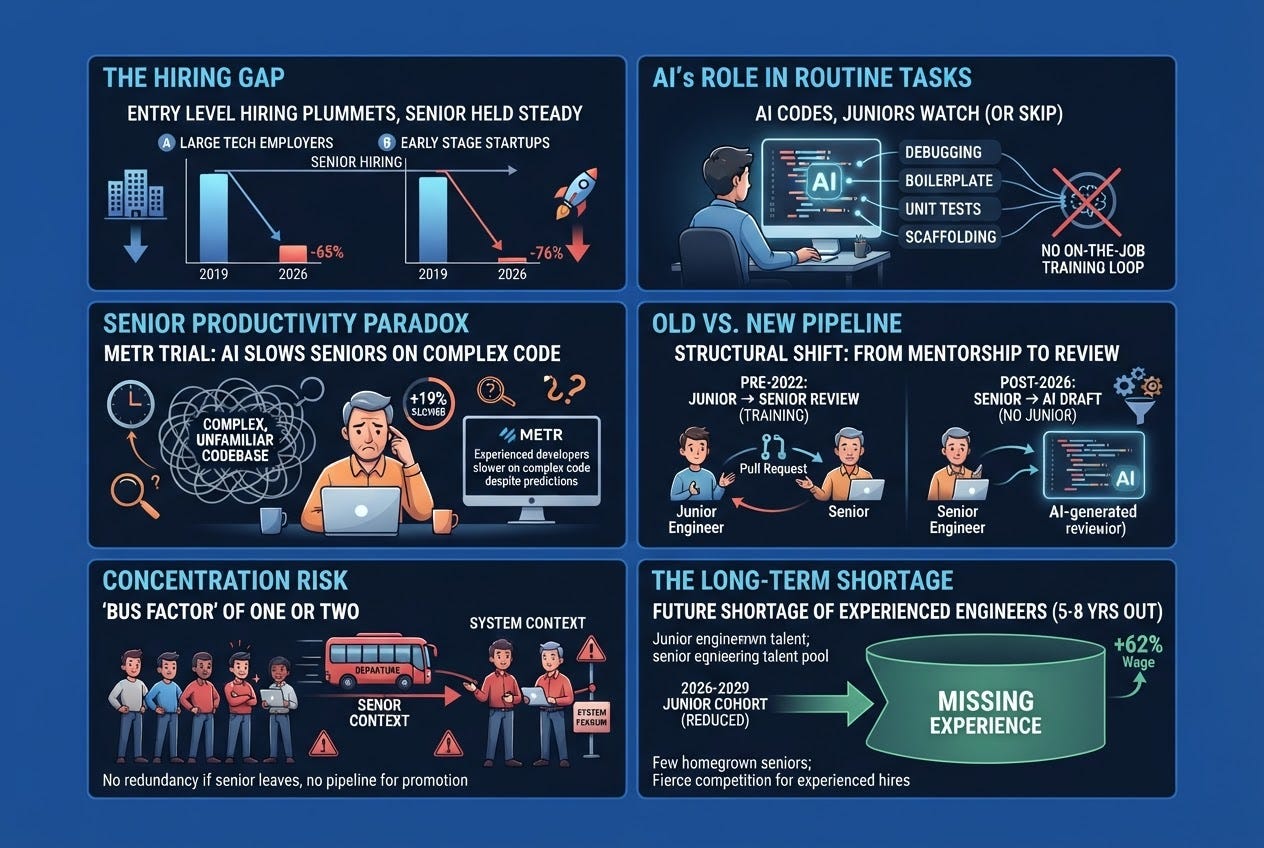
Hiring Junior Engineers or AI
Description
A founder who reads SignalFire’s 2026 State of Talent Report and concludes that artificial intelligence has made junior engineers obsolete is reading the easy half of the data. The harder half, several pages past the headline decline in entry level hiring, is a randomized trial showing that the same AI coding tools made experienced developers 19 percent slower on the kind of codebase a startup actually has three years after it stops hiring juniors. The founders acting on the easy half of this report right now are building the exact talent shortage the harder half predicts.
SignalFire’s data, covered separately by Startup Fortune, found that entry level and new graduate coding hires at large technology employers fell by roughly half to two thirds since 2019, while senior, staff, and principal engineering hiring held close to pre pandemic volume. Early stage, venture backed startups cut entry level hiring even harder, down approximately 76 percent against the same baseline, even as their overall engineering hiring rose 7 percent. Put plainly: the next engineer a growing startup hires is overwhelmingly likely to be senior, not junior, and AI coding tools are a documented part of the reason why.
The mechanism is not mysterious. Code completion tools are strong at the exact category of task a new graduate used to be hired to do: implement a function against a clear specification, write a test, fix a bug with a known reproduction step. The output is checkable, the context is bounded, and a wrong answer costs almost nothing to catch and retry. A senior engineer paired with one of these tools does not need a junior engineer to absorb that category of work anymore, and a founder watching the monthly burn rate notices immediately.
Here is the twist that did not make most of the coverage. METR, a nonprofit research group, ran a randomized trial on sixteen experienced open source developers across 246 real issues, letting a coin flip decide whether each developer could use AI tools on a given task. The developers who used AI tools took 19 percent longer, not shorter, to finish. They had predicted a 24 percent speedup going in, and after finishing slower, they still believed the tools had made them 20 percent faster. The tasks in that trial were not clean, bounded functions. They were fixes inside large, established codebases the developers had not written themselves, which is a much closer description of a startup’s codebase in year three than its codebase in month one.
That distinction is the whole argument. The AI paired senior engineer model looks unambiguously good on a greenfield codebase, which is exactly the codebase every seed stage company starts with. It looks worse once the codebase accumulates the complexity, the undocumented decisions, and the tribal knowledge that three years of growth produce, because that is precisely the condition under which METR’s developers slowed down. A founder who skips junior hiring is betting that this particular limitation gets engineered away before the bill comes due.
The bill, when it comes, is a staffing problem, not a code quality problem. A junior engineer becomes a senior engineer through roughly two years of writing code, having it fail, and absorbing a senior reviewer’s correction into judgment that no AI model has demonstrated it can transfer. An organization that never hires juniors never produces that judgment internally. It has to buy it externally, in a market where SignalFire already documents a 62 percent wage premium for AI fluent engineers, a premium set by every other company making the identical staffing bet at the identical moment.
I have sat on the other side of this exact gap during technical diligence on a seed round, watching an investor’s engineering advisor ask a two person engineering team who else understood the payment reconciliation service well enough to debug it without the founder in the room. The answer was nobody. That is