Episode Details
Back to Episodes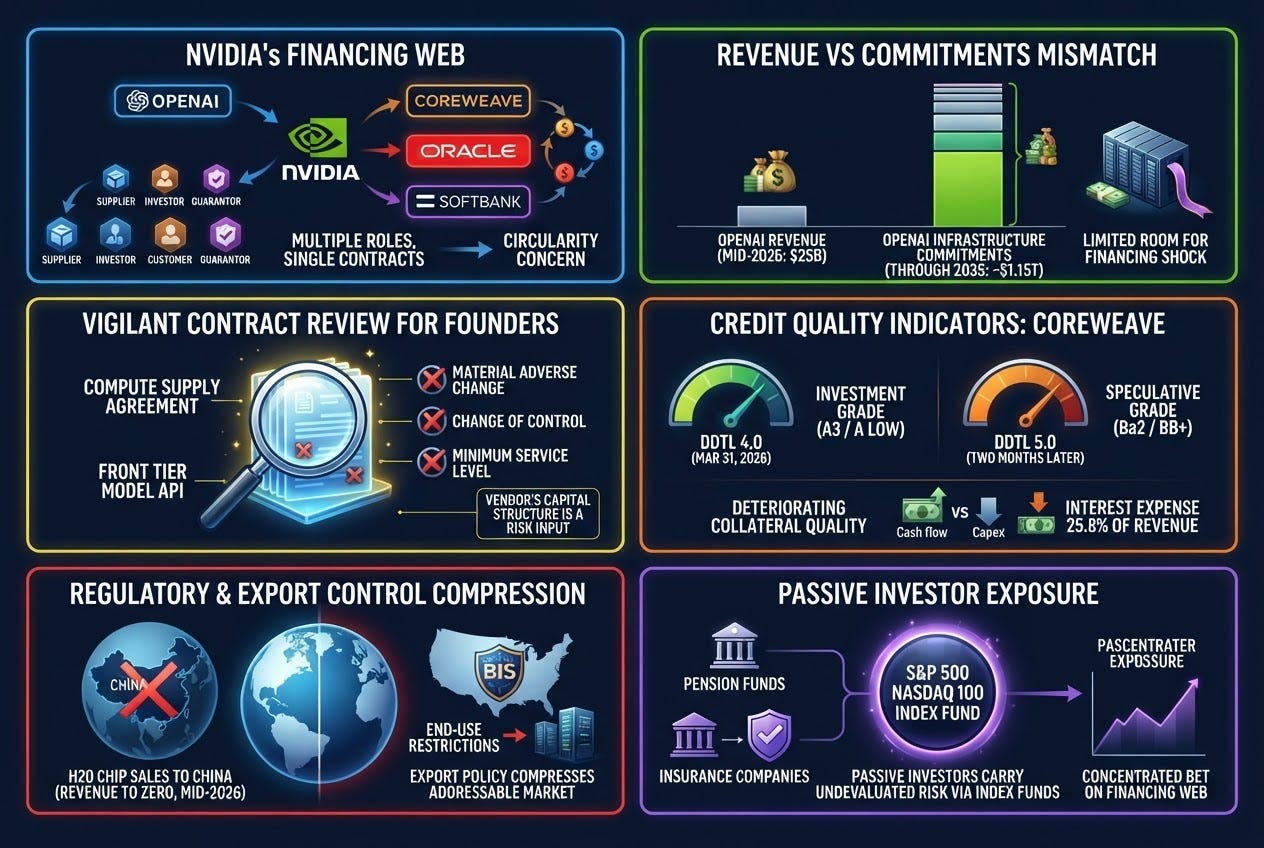
Nvidia’s Circular Financing Web
Description
Jensen Huang told Goldman Sachs’ Communacopia and Technology Conference in September 2026 that Nvidia collects roughly $100 in customer orders for every $1 it commits to artificial intelligence labs, and he treated that ratio as a complete answer to circular financing criticism. It is not a complete answer for the founder who signed a three year capacity reservation on a frontier model application programming interface, or the general counsel drafting a term sheet for an infrastructure round, because the ratio describes Nvidia’s own books. It says nothing about whether the customer generating those orders can still pay for them if one piece of the financing structure under that customer comes apart.
I have sat across the table from enough technology vendors over three decades to know that a supplier’s balance sheet becomes the customer’s problem the moment the supplier also becomes the customer’s financier. That is exactly the structure now underlying a meaningful share of the compute capacity being sold to startups. Nvidia is OpenAI’s chip supplier. Nvidia was, as of a September 2025 letter of intent, also positioned to invest up to $100 billion in OpenAI. Huang walked that figure back in February 2026, telling reporters the pledge was never a commitment and that the real number would not approach $100 billion. By July 2026, Nvidia was discussing a $250 billion guarantee on OpenAI’s Ohio data center alongside a separate plan to finance $350 billion of OpenAI’s own purchases of Nvidia chips, a pairing one report described bluntly: you buy from me, I invest in you, and everything is fine unless one of us has a problem, in which case both of us have a problem.
The number that actually shipped looks different from every number that preceded it. On August 17, 2026, Nvidia finalized a $105 billion guarantee for the Ohio project, down from the $250 billion first floated and the sub $120 billion figure reported three days earlier, plus a direct $1.5 billion equity stake in the project developer, SB Energy. Nvidia’s stock fell roughly 4.5 percent on the news, and its credit default swap spreads recorded their largest intraday move since November 2025. Markets were not pricing Huang’s $100 for $1 ratio. They were pricing the fact that Nvidia had just agreed to make good on OpenAI’s lease and power payments, and to guarantee the value of the completed infrastructure, if OpenAI defaults.
CoreWeave shows the same structure on the supply side, not the demand side. Nvidia holds roughly $2 billion of CoreWeave equity purchased in January 2026. Nvidia sells CoreWeave the chips that make up most of its fleet. And under a separate agreement worth $6.3 billion through April 2032, Nvidia is contractually obligated to buy CoreWeave’s unsold capacity if customer demand falls short. CoreWeave’s own numbers show why that backstop matters: a first quarter 2026 free cash flow of negative $4.71 billion, interest expense eating 25.8 percent of revenue, and a full year funding gap north of $17 billion between planned capital spending and operating cash flow. CoreWeave’s $8.5 billion DDTL 4.0 loan facility, closed March 31, 2026, was the first graphics processing unit backed loan to earn an investment grade rating, which is precisely what let pension funds and insurers, previously barred from holding this kind of paper, start buying it. Two months later, the follow on DDTL 5.0 facility priced two full ratings notches lower, a sign the agencies themselves were not fully comfortable with what they had just rated.
A founder reading this correctly does not conclude that Huang is lying about the $1 trillion order backlog for Blackwell and Vera Rubin systems through 2027 that he first disclosed at Nvidia’s GTC keynote in March 2026. The backlog is real in the sense that the purchase orders exist. What a founder should conclude is that the revenue behind a meaningful share of those orders runs through a small number of counterparties wh