Episode Details
Back to Episodes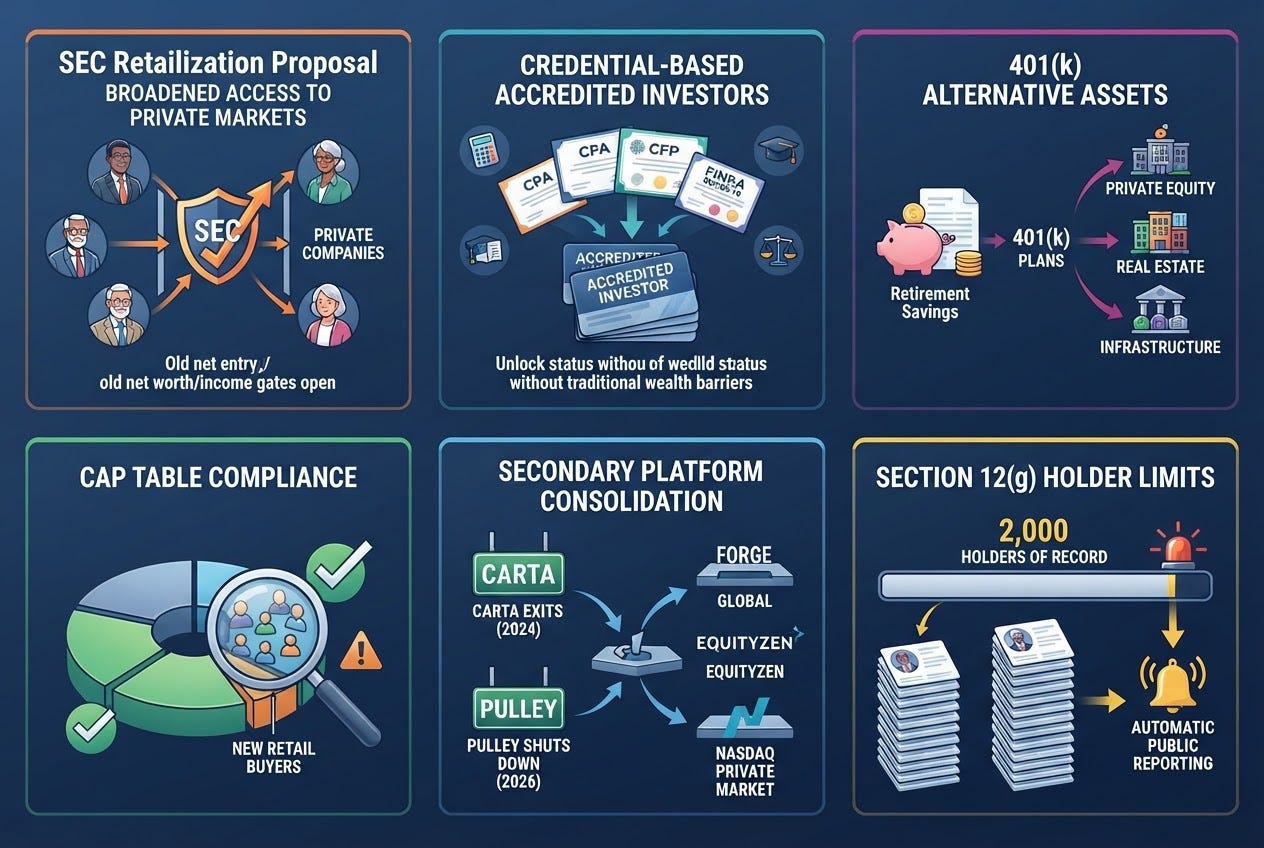
Accredited Investor Reform Reshapes Startup Secondary Sales
Description
The Securities and Exchange Commission’s September 30, 2026, vote to open the accredited investor definition to professional credentials, not only income and net worth, lands on a capitalization table that already has fewer places to run a clean secondary sale. Carta closed its secondary trading desk in January 2024, and Pulley shuts down for good on December 8, 2026, so the same founders who are about to meet a larger buyer pool are doing it with two fewer platforms built to manage who actually ends up on the stockholder register.
The mechanic most boards overlook is not in the Regulation D exemption itself. It is in Rule 13e-4’s 20 business day tender offer window, a rule written for a buyer pool that was small, institutional, and already known to the company’s counsel. That assumption is now wrong twice over, once because the Commission wants to admit credentialed individuals with no net worth floor, and once because a listed fund can now hand a company’s economics to retail without the buyer ever touching an accreditation form.
Rule 501(a)(10) of Regulation D already lets the Commission designate a professional credential as a qualifying status for accredited investor treatment by order, without a formal rulemaking. The September 30, 2026, proposal would apply that authority to a Certified Public Accountant license, a Chartered Financial Analyst charter, a Certified Financial Planner certification, a FINRA Series 79 license, FINRA Series 86 or 87 licenses, and a new FINRA developed examination. None of the six carries an income or net worth test, and a holder does not even need to be practicing in the field the credential represents, only keep the license current.
The Chairman tied the proposal to an executive order signed August 7, 2025, titled Democratizing Access to Alternative Assets for 401(k) Investors, which directs the Department of Labor to revisit its fiduciary guidance and directs the Commission to weigh revisions to the accredited investor and qualified purchaser definitions for defined contribution plan participants. Where the credential pathway adds individual buyers one license at a time, the executive order adds a second channel that moves retirement capital through plan fiduciaries and target date fund managers, several layers removed from any diligence a portfolio company’s own counsel performs on the ultimate buyer.
A retail investor does not even have to wait for either of those changes to take indirect exposure to a venture backed company’s stock. Powerlaw Corp, a closed end fund operated by Akkadian Ventures, has deployed $355 million across 18 private technology companies, including OpenAI, SpaceX, and Anthropic, acquired through direct purchases, employee share deals, and special purpose vehicles, and the fund is pursuing a Nasdaq listing of its own shares rather than the underlying companies’ stock. Once that listing closes, a retail brokerage account buys Powerlaw Corp the way it buys any other listed security, and no accreditation ever attaches to the end buyer because the purchase is an interest in a registered fund, not a direct stake in OpenAI, SpaceX, or Anthropic.
On the other side of the ledger, the platforms that used to give a founder a controlled venue for a secondary sale have thinned out. Carta exited secondary trading in January 2024 after a customer accused the company of using cap table data to connect buyers and sellers without consent, and chief executive Henry Ward disclosed that the secondary business brought in about $3 million of Carta’s roughly $370 million in annual revenue, a rounding error next to the $250 million the company earned from cap table administration. Pulley, which raised more than $50 million from General Catalyst, Stripe, and Founders Fund, will cease operating on December 8, 2026, and is sending its customers to Carta. Forge Global, EquityZen, Nasdaq Private Market, and Hiive now absorb a larger share of transaction volume at