Episode Details
Back to Episodes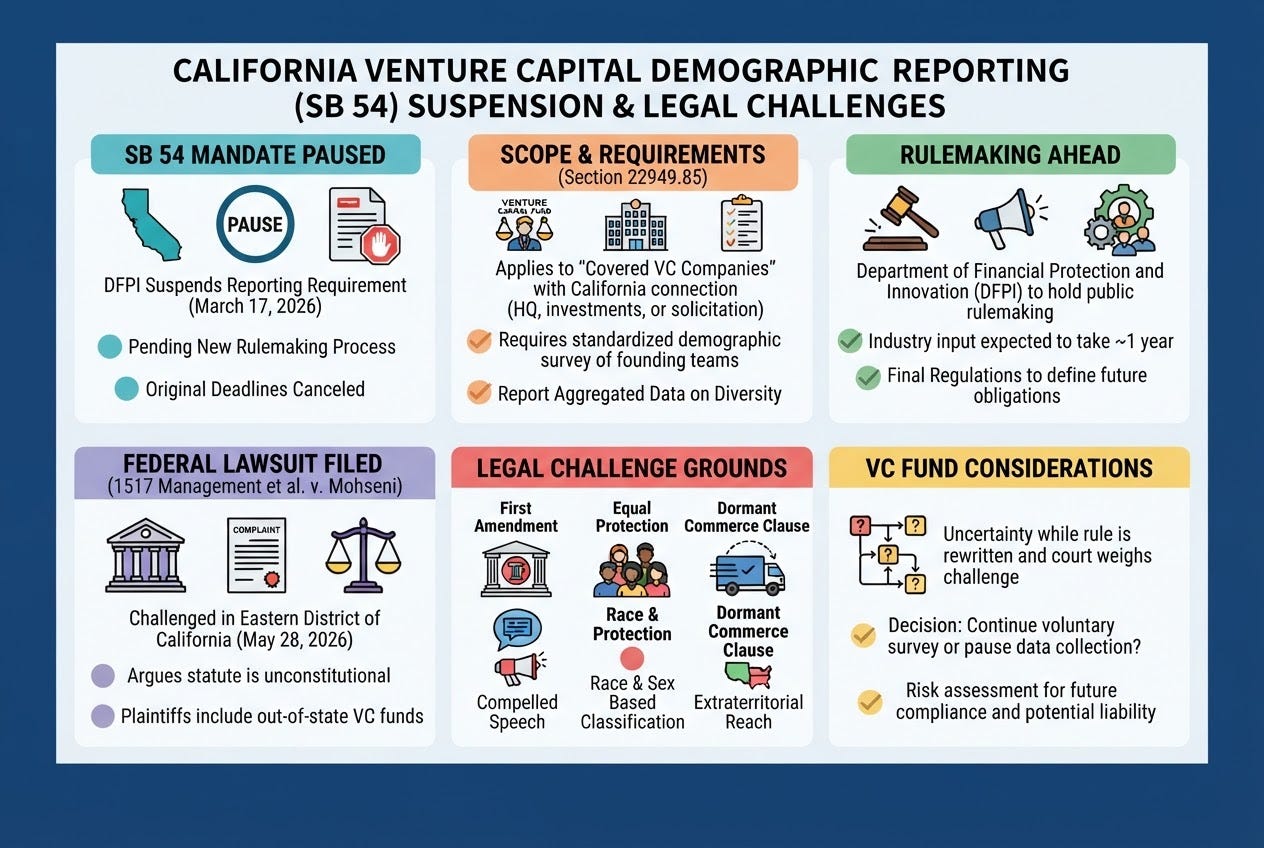
California Suspends Venture Capital Demographic Reporting
Description
California’s Department of Financial Protection and Innovation suspended enforcement of Senate Bill 54’s venture capital founder demographic reporting mandate on March 17, 2026, and told covered funds to pause all work related to reporting until further notice. The statute, codified at California Business and Professions Code section 22949.85, was six weeks from its April 1 reporting deadline when the department pulled it back for a rulemaking it expects to take about a year. A fund that spent the first quarter of 2026 building a founder survey into its closing checklist now has to decide what to do with that checklist, and the department’s notice does not answer that question for them.
Start with what section 22949.85 actually asked a covered fund to do. A venture capital company with a California connection, defined broadly enough to catch a fund that merely solicits an investment from a California resident, had to distribute a standardized survey to the founding team of every company it funded and ask each founder whether they identify as a woman, nonbinary, a member of a list of named racial and ethnic categories, disabled, a veteran, or lesbian, gay, bisexual, transgender, or queer. The fund then reported the aggregated results, investment counts and dollar amounts by diverse founding team category, to the state. Senate Bill 164 moved administration from the California Civil Rights Department to the Department of Financial Protection and Innovation in 2024, added a 175 dollar filing fee, and backstopped the whole structure with a penalty of up to 5,000 dollars a day after a 60 day cure period.
The department’s stated reason for pulling the rule back was interpretive uncertainty in the statute and the mechanics of its own portal, not a concession that the mandate is unlawful. But the suspension landed five weeks before a much sharper challenge arrived in federal court. On May 28, 2026, 1517 Management Company LLC and four affiliated Colorado funds sued the department’s commissioner, Khalil Mohseni, in the Eastern District of California. Represented by Pacific Legal Foundation, the plaintiffs argue the founder survey itself is compelled speech under the same First Amendment theory the Supreme Court used in National Institute of Family and Life Advocates v. Becerra, 585 U.S. 755 (2018), that the racial and sex based categories violate equal protection, and that reaching a fund through its California resident investors violates the Dormant Commerce Clause. The complaint makes a specific argument: the department’s suspension and promised rulemaking cannot cure these defects, because the compelled survey and its categories are written into the statute itself, not into a form the department could simply redraft.
That argument has a California precedent behind it. In Crest v. Padilla, No. 19STCV27561 (Cal. Super. Ct. L.A. County May 13, 2022), a state trial court struck down California’s board gender diversity statute on equal protection grounds, and a companion ruling the same spring did the same to the state’s ethnic and LGBTQ board diversity statute. Neither statute survived appeal because the state dropped its defense. A separate federal line points the same direction: in American Alliance for Equal Rights v. Fearless Fund Management, LLC, No. 23-13138 (11th Cir. 2024), the Eleventh Circuit enjoined a venture fund’s grant contest restricted to Black women owned businesses under 42 U.S.C. section 1981. A government mandate that sorts founders by race to produce a public report sits closer to the statutes that lost in both of those cases than to anything that has survived.
None of that tells a fund what to do with the founders it already surveyed, or the ones raising money right now. The department suspended the obligation to register and report, but the first report, whenever it comes due, will still cover 2025 and 2026 investment activity, and founder demographic data gets harder to reconstruct the