Episode Details
Back to Episodes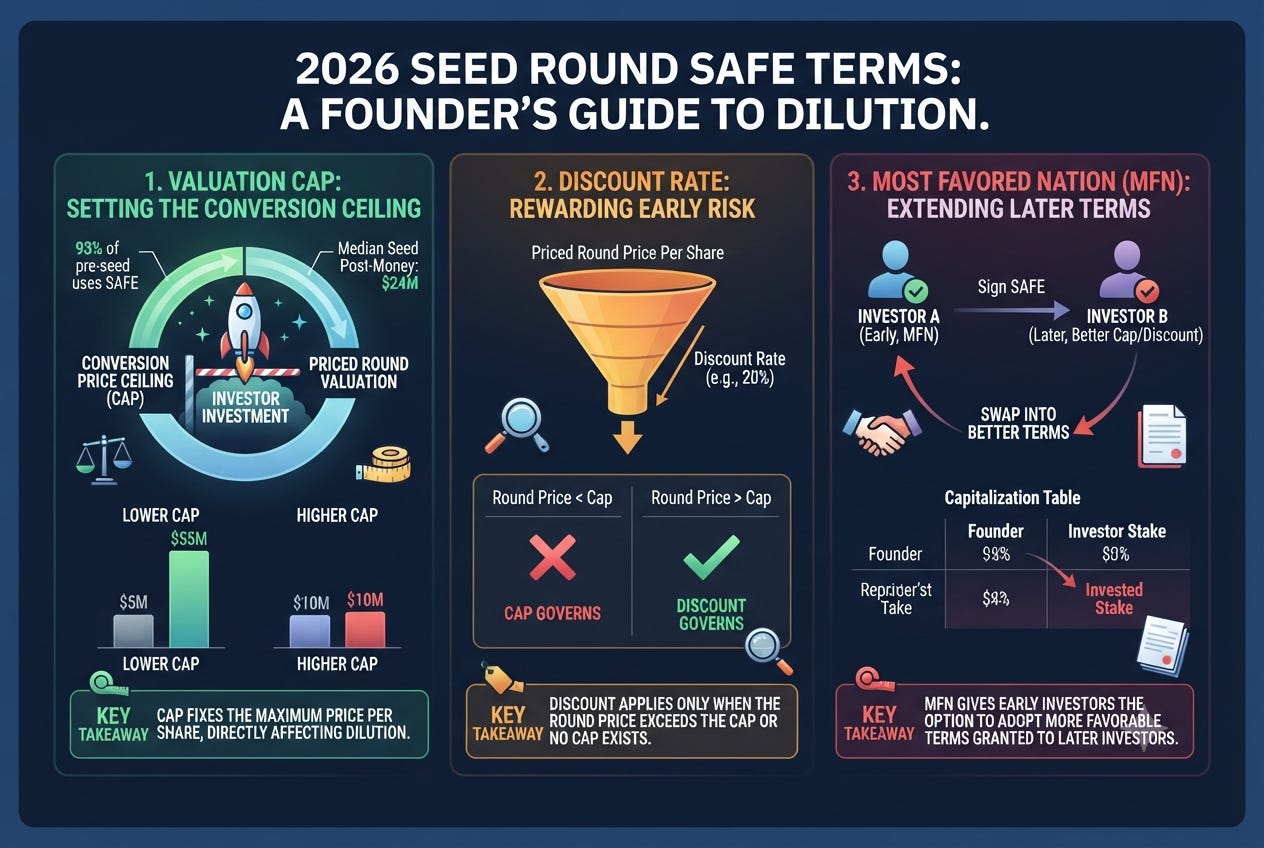
The Valuation Cap in a SAFE Decides Most Founder Dilution
Description
A founder signing a Simple Agreement for Future Equity in 2026 gives up more ownership through the valuation cap than through the discount rate or the most favored nation clause, because the cap alone fixes the price at which the entire investment converts to shares. Nationwide 2026 seed data put the median post money valuation near $24,000,000, and a cap negotiated even $2,000,000 below the market range for a founder’s own sector can shift several percentage points of the company permanently onto an investor’s side of the capitalization table.
The mechanic most founders miss is not the cap and not the discount. It sits inside the most favored nation clause attached to the first, smallest check a company ever signs. An early angel writing an uncapped $150,000 or $200,000 SAFE almost always asks for most favored nation protection, and founders sign it without objection because the check is small and the founder is eager to close it. Eight months later, when the lead investor prices the round at an $8,000,000 or $10,000,000 cap, that early clause quietly resets the angel’s conversion price to match, even though the angel bore a fraction of the diligence cost the lead investor paid to reach that number.
Y Combinator’s 2018 post money SAFE rewrite fixed the math: a $500,000 investment on a $5,000,000 cap converts to 10 percent ownership, regardless of the discount rate or any later negotiated term. The same $500,000 on a $3,000,000 cap converts to nearly 16.7 percent instead. Every dollar a founder concedes on the cap, not on the discount and not on the most favored nation term, is the dollar doing most of the dilution work.
The discount rate only changes the outcome when it produces a better price than the cap, which happens only when the eventual priced round values the company above the cap or when the SAFE carries no cap at all. Cap only SAFEs, the version without any discount, now hold roughly half to three fifths of the market, and where a discount survives, it clusters between 10 percent and 25 percent with a median near 20 percent. A founder who trades a lower cap for a smaller discount is almost always trading a certain, larger cost today for an uncertain, smaller one that only shows up if the company beats its own cap by the time it prices.
A most favored nation clause resets an early SAFE holder’s conversion price to match any later, more generous SAFE, and under the post money structure that reset dilutes only the founders, never the investor who negotiated the later terms. The standard mechanics run on written notice and a 10 to 30 day election window, after which the capitalization table adjusts to reflect the elected price. Because a post money SAFE fixes each investor’s percentage the moment it converts, the lead investor’s stake never moves when an earlier holder invokes the clause.
In thirty years of reviewing capitalization tables for technology companies, the single most common gap I have found sits exactly here: a founder who priced the final, largest SAFE correctly and then discovered, only at the Series Seed closing, that the earliest and smallest check on the table had quietly repriced itself downward to match. Nationwide 2026 data treat 15 to 25 percent cumulative dilution across a full seed stack as normal and treat anything above 25 to 30 percent as a warning sign heading into the priced round. A founder who models the stack as a whole, not check by check, is the founder who catches that warning sign before the lead investor does.
The Securities and Exchange Commission warned as early as May 9, 2017, that a SAFE may be neither simple nor safe, because the instrument is only a conditional promise that may never convert at all. Internal Revenue Code Section 1202, reshaped by the One Big Beautiful Bill Act for stock acquired after July 4, 2025, now offers a tiered exclusion schedule, 50 percent at three years, 75 percent at four, and the full 100 percent at five, and t