Episode Details
Back to Episodes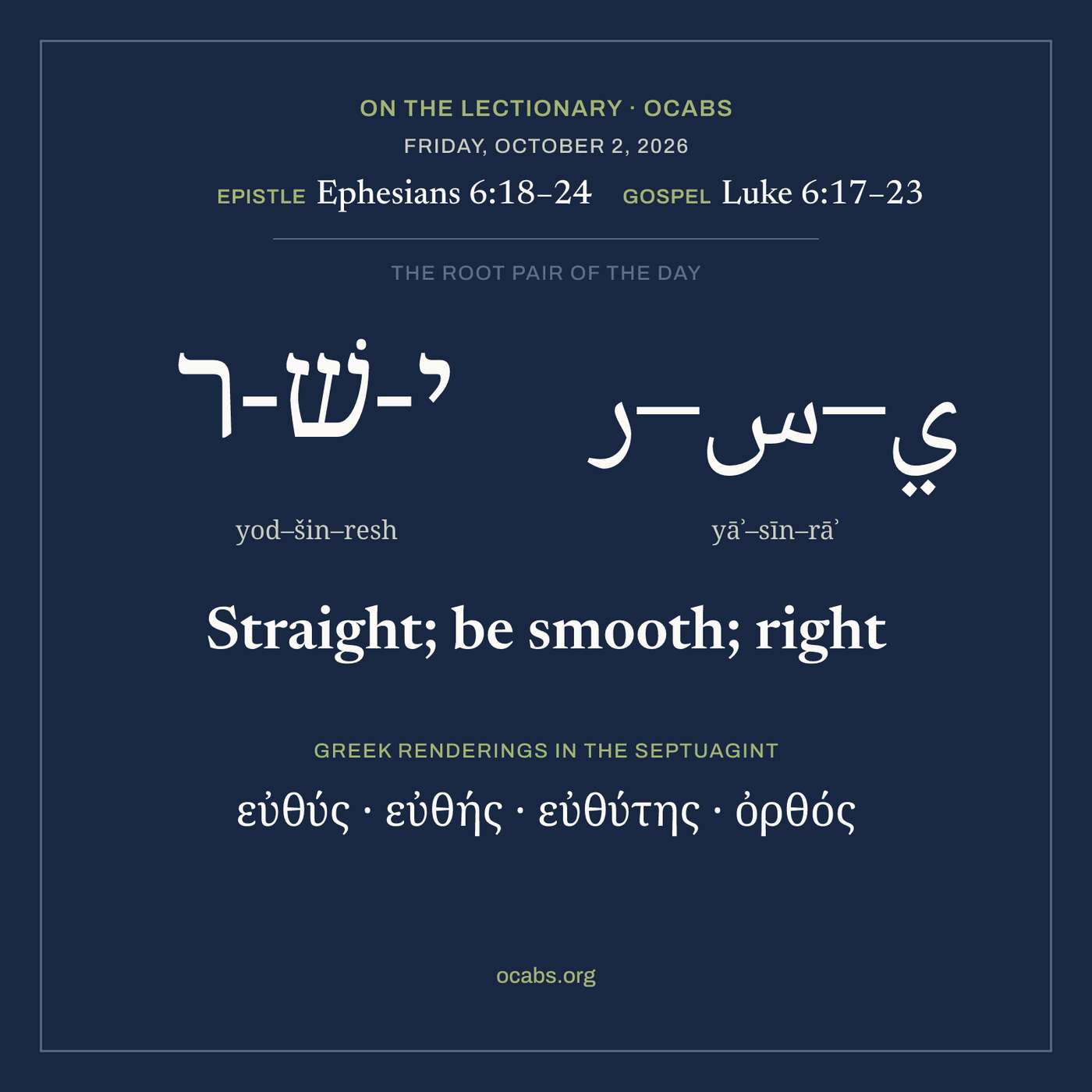
Ephesians 6:18-24 · Luke 6:17-23 — Friday, October 2, 2026
Description
A daily note from the team at OCABS.ORG, drawing on the published works of Fr. Paul Nadim Tarazi, with citations to his books and lectures.
Readings: Ephesians 6:18-24; Luke 6:17-23.
Fr. Paul reads the closing of Ephesians as the capstone of the whole letter. Paul, though "an ambassador in chains," still asks the saints' prayers so that he may speak the gospel's mystery with boldness [2]. Tychicus is sent not merely as a courier but, since his name in Greek means "whoever," as a figure for anyone who will keep reading aloud Paul's scripturalized words to the household churches, continuing his ministry much as Jeremiah and Ezekiel once carried God's word [5,12]. The letter's last words—peace, love with faith, and grace "with all those who love our Lord Jesus Christ with incorruptible love"—bracket back to its opening blessing and point toward the heavenly places where imperishable glory awaits [3,4,7].
In Luke, Jesus comes down and stands "on a level place," not a mountain, a detail that fixes the scene to Ezekiel, where God speaks to the prophet in the plain [15,18,24]. Fr. Paul's lectures note the crowd gathered from Judea, Jerusalem, and the coast of Tyre and Sidon, both Jews and Gentiles healed by his power, before Jesus delivers teaching organized like Moses' law—blessings matched by woes—so that this new law of Christ is given in a plain just as Ezekiel's word of life was given there [13,16]. The four blessings answer four woes; those hated, excluded, and mocked "for the Son of Man's sake" are told to rejoice, for their fathers did the same to the prophets [14,19].
Across both readings the gospel travels through those who risk rejection for speaking it: Paul in chains asking for boldness, and the disciples whom Jesus sends out to meet the same fate as Ezekiel, opposed by those unwilling to hear [2,19]. The blessed who hunger and are reviled now are promised a reward "great in heaven," the same imperishable glory toward which Ephesians' closing grace already points [4,14].
The root pair of the day · י-שׁ-ר yod–šin–resh, יָשָׁר yašar · ي–س–ر yāʾ–sīn–rāʾ, يَسِير yasīr · straight; be smooth; right. Luke's Jesus stands "on a level place," the mišor of this root, echoing the plain where Ezekiel heard God's word, as the note observes. The same root's Greek euthus, "straight," and orthos, "upright," underlie the leveling of blessings and woes Jesus delivers there, a new law given plainly, not from a height. cf. The Consolation of Consonants
Sources: Tarazi, Ephesians and 2 Thessalonians: A Commentary, p. 109; Tarazi, Ephesians and 2 Thessalonians: A Commentary, p. 112; Tarazi, Ephesians and 2 Thessalonians: A Commentary, p. 113; Tarazi, Ephesians and 2 Thessalonians: A Commentary, p. 109; Tarazi, Ephesians and 2 Thessalonians: A Commentary, p. 111; Tarazi, Ephesians and 2 Thessalonians: A Commentary, p. 110; Tarazi, The New Testament: An Introduction, vol. 2, Luke and Acts, “Luke’s Sources Other then Mark”; Orthodox Audio Bible Commentary, Luke (vol. 42), part 1, at 2:15:48; Orthodox Audio Bible Commentary, Luke (vol. 42), part 1, at 2:13:39; Tarazi, The New Testament: An Introduction, vol. 2, Luke and Acts, “The Law of Christ”; Orthodox Audio Bible Commentary, Luke (vol. 42), part 1, at 2:11:24; Orthodox Audio Bible Commentary, Luke (vol. 42), part 1, at 2:17:53; Tarazi, The New Testament: An Introduction, vol. 2, Luke and Acts, “The Raising of the Widow's Son at Nain (11–17)”.
Opening music: Taksim Arbi, Bichi Slama, oud (Tunis, Archives de la Parole, 1930s), public domain. Source: gallica.bnf.fr / BnF.