Episode Details
Back to Episodes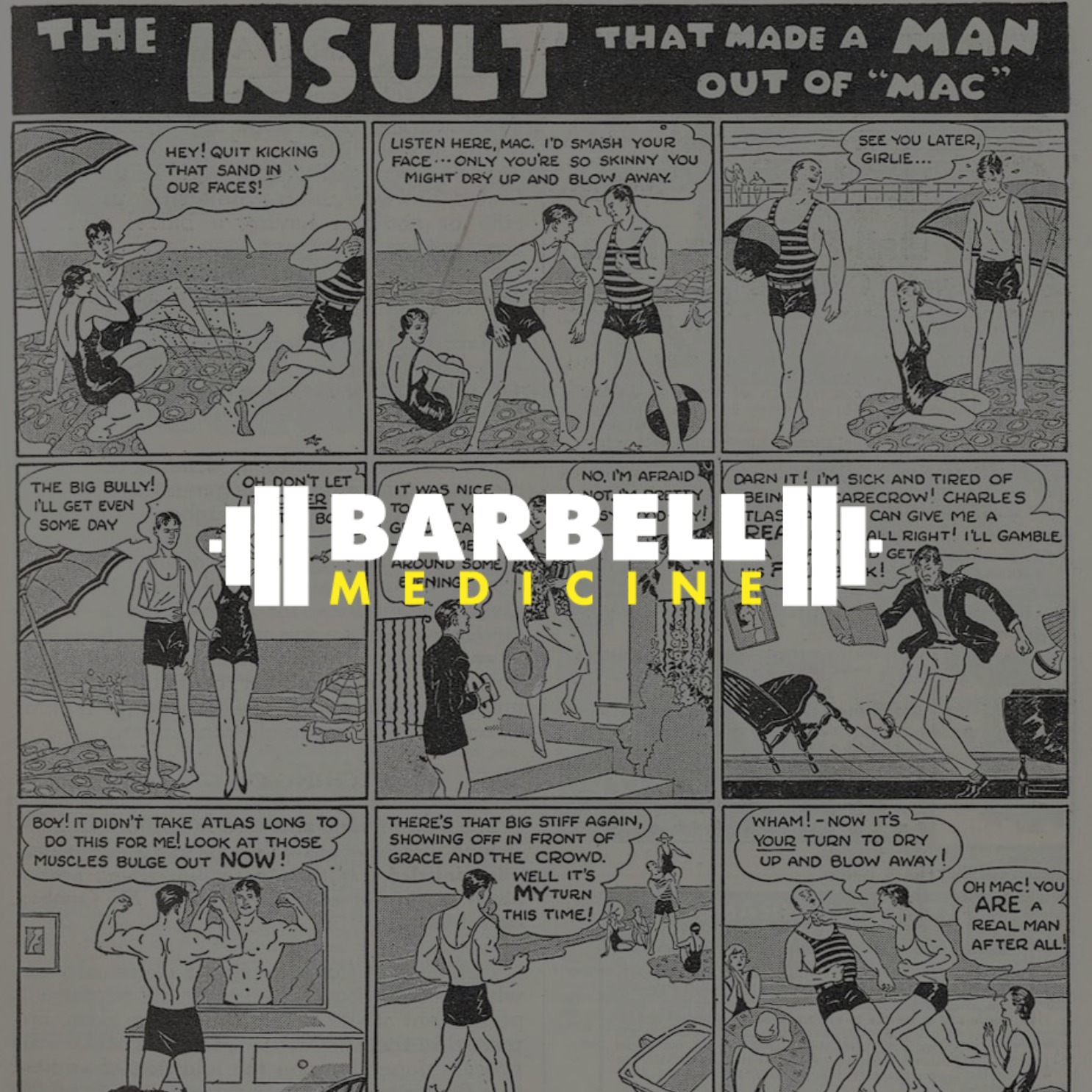
Where did the advice to not lift heavy weights come from?
Description
Nearly every warning you've heard about lifting weights was written down before anybody checked it. We trace where those warnings came from, starting with a Harvard student in 1854 and ending with a curve on a graph that's being used today to argue you can lift too much.
Along the way: the men who built themselves with barbells and then sold the public five-pound dumbbells, because iron was expensive to mail and a booklet cost pennies. The muscle-bound myth, which nobody could define when a graduate student surveyed 45 physiologists about it. The 1961 report that took the deep squat out of every branch of the American military, measured with a device its author built himself and never validated. The claim that lifting stunts a child's growth, which no professional body ever actually made. And the argument women got, which was never about injury at all.
Timestamps:
- 0:00 Intro
- 2:33 2,500 years of people picking up heavy things
- 7:24 George Windship and the Health Lift
- 10:56 Blaikie's truck horse and the muscle-bound myth
- 14:59 Bernarr Macfadden
- 19:39 Charles Atlas and Dynamic Tension
- 27:01 Carl Klein, a homemade device, and the parallel squat
- 30:57 Thomas Delorme and three sets of ten
- 35:20 Kids, growth plates, and where the stunting idea came from
- 41:43 Women, "you'll get bulky," and Dudley Sargent in 1912
- 50:05 Pregnancy, from 1949 to a 2025 barbell study
- 53:40 The pattern, and the curve on next week's graph
Resources:
Buy the book, Signal: https://www.barbellmedicine.com/shop/learning/signal/
New Barbell Medicine Hybrid 5K and 10K Run + Lift Programs
Barbell Medicine coaching and templates: https://www.barbellmedicine.com
1. Downs DS, Chasan-Taber L, Evenson KR, Leiferman J, Yeo S. Physical activity and pregnancy: past and present evidence and future recommendations. Res Q Exerc Sport. 2012;83(4):485-502. doi:10.1080/02701367.2012.10599138. PMID 23367811.
2. McMurray RG, Mottola MF, Wolfe LA, Artal R, Millar L, Pivarnik JM. Recent advances in understanding maternal and fetal responses to exercise. Med Sci Sports Exerc. 1993;25(12):1305-1321. PMID 8107536.
3. Smith KM, Campbell CG. Physical activity during pregnancy: impact of applying different physical activity guidelines. J Pregnancy. 2013;2013:165617. doi:10.1155/2013/165617. PMID 23476778.
4. American College of Obstetricians and Gynecologists. Physical activity and exercise during pregnancy and the postpartum period. ACOG Committee Opinion No. 804. Obstet Gynecol. 2020;135(4):e178-e188. doi:10.1097/AOG.0000000000003772. PMID 32217980.
5. American Academy of Pediatrics Committee on Sports Medicine and Fitness. Strength training by children and adolescents. Pediatrics. 2001;107(6):1470-1472. doi:10.1542/peds.107.6.1470. PMID 11389279.
6. Stricker PR, Faigenbaum AD, McCambridge TM; Council on Sports Medicine and Fitness. Resistance training for children and adolescents. Pediatrics. 2020;145(6):e20201011. doi:10.1542/peds.2020-1011. PMID 32457216.
7. Gardiner EN. Athletics of the Ancient World. Clarendon Press; 1930:54. See also Gardiner EN. Olympia: Its History and Remains. Clarendon Press; 1925.
8. Heffernan C. The Bybon stone and ancient strength. Physical Culture Study. 2021. Accessed September 2026. https://physicalculturestudy.com.
9. Pausanias. Description of Greece. 6.14.5. Jones WHS, trans. Loeb Classical Library. Harvard University Press.
10. Quintilian. Institutio Oratoria. 1.9.5. Butler HE, trans. Loeb Classical Library. Harvard University Press.
11. Heffernan C. Milo of Croton a