Episode Details
Back to Episodes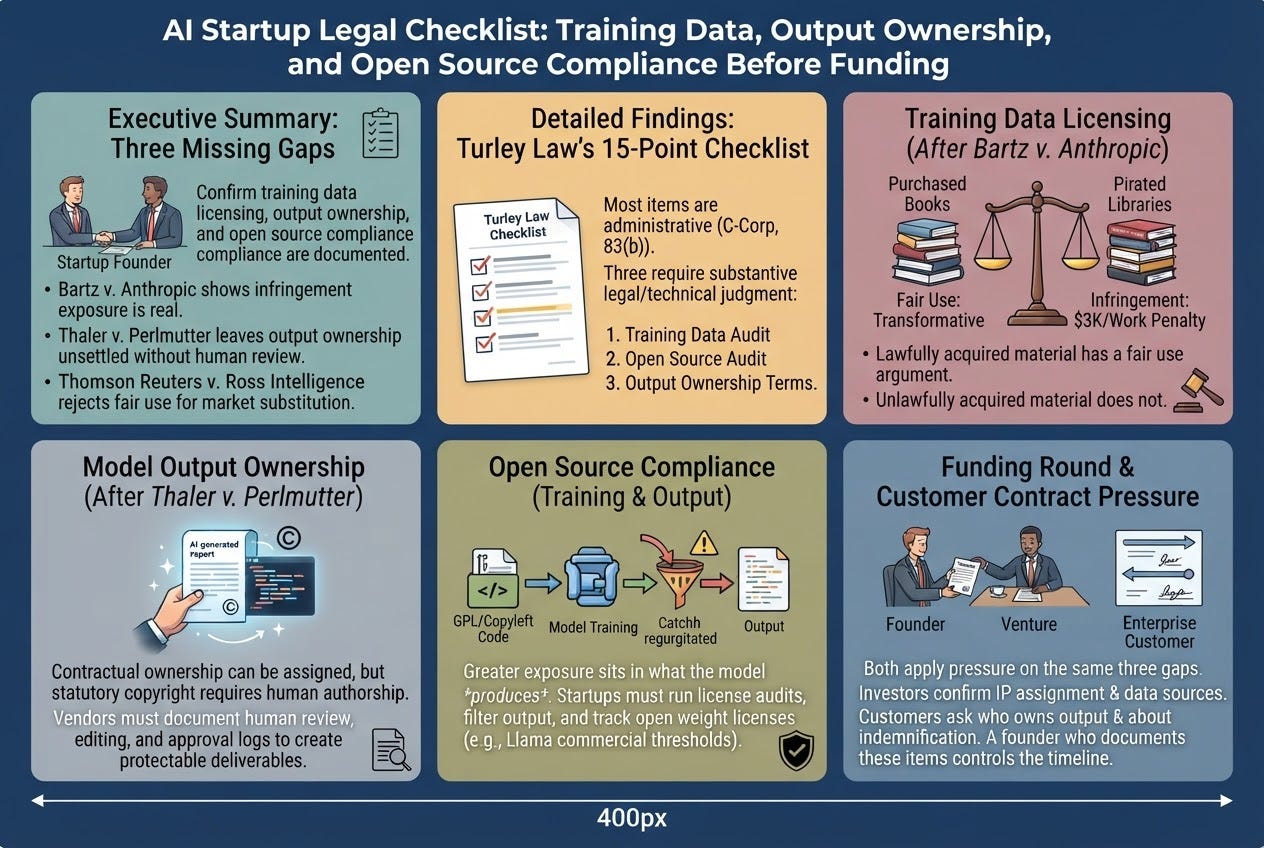
What AI Startups Should Document Before A Funding Round
Description
Training data licensing, model output ownership, and open source compliance are the three gaps a founder’s counsel must close before financing, as Bartz v. Anthropic now confirms. The Northern District of California approved a $1.5 billion settlement in that case on July 20, 2026, paying roughly $3,000 per copyrighted work, four times the statutory minimum, after the court found that training on purchased books was fair use but training on pirated copies was not. Thomson Reuters Enterprise Centre GmbH v. Ross Intelligence Inc. had already rejected a fair use defense outright on February 11, 2025, when a Delaware court found that Ross’s competing legal research product made the use a market substitute, not a fair use. Together the two rulings tell a founder exactly what a diligence team will ask: where the data came from, whether it was purchased or scraped, and whether a competing product sits on the other side of the license.
Turley Law’s 2026 fifteen point legal checklist for artificial intelligence startups names training data licensing, model output ownership, and open source license compliance as the items most often missing before a product launch. The checklist sits alongside the Delaware C corporation formation and the stock option plan that most founders already handle correctly. The three items that get skipped are the ones that require someone to sit down with the actual training pipeline, the actual customer contract, and the actual dependency tree, not a template.
A training data audit means producing a list of every source, a license or receipt for each, and a note on where the scraped and public domain material sits. Reliance on publicly available material that still carries a copyright is not protection on its own: Bartz distinguished the purchased library from the shadow library that Anthropic’s engineers had also assembled, and the shadow library is what cost four times the statutory minimum per work. A founder who can show a signed license agreement for every commercial dataset, and a documented fair use analysis for everything else, walks into due diligence with an answer instead of an apology.
Model output ownership carries a second layer of difficulty that training data licensing does not: the Copyright Office will not protect the output at all unless a human did more than type a prompt. The Supreme Court left that rule standing on March 2, 2026, when it denied certiorari in Thaler v. Perlmutter, closing the appeal of an inventor who had registered artwork generated entirely by his own AI system. The courts below had already found that even detailed prompting, in that case more than 624 separate text instructions, does not amount to the selection, arrangement, or editing that copyright law treats as authorship. A customer contract that promises to assign the vendor’s rights in generated output to the customer is only half the solution. The other half is a record, kept inside the product itself if possible, of who selected, arranged, or revised the material the model produced, because that record is what will separate a protectable deliverable from material anyone can copy.
Open source license compliance is the least glamorous of the three items and the one with the fewest excuses. Turley Law’s checklist puts it bluntly: GPL licensed code inside an AI pipeline creates a contamination risk, and the fix is to map every dependency and flag every copyleft license before an investor’s own technical diligence team does it first. The risk is not confined to training. Doe v. GitHub, the litigation over GitHub Copilot, survived a motion to dismiss on its open source license breach and Digital Millennium Copyright Act Section 1202 claims in the Northern District of California in 2024, even after the broader infringement theory was narrowed. A model that reproduces a recognizable block of GPL code inside a customer’s closed product does not need a court to rule on whether the model itself i