Episode Details
Back to Episodes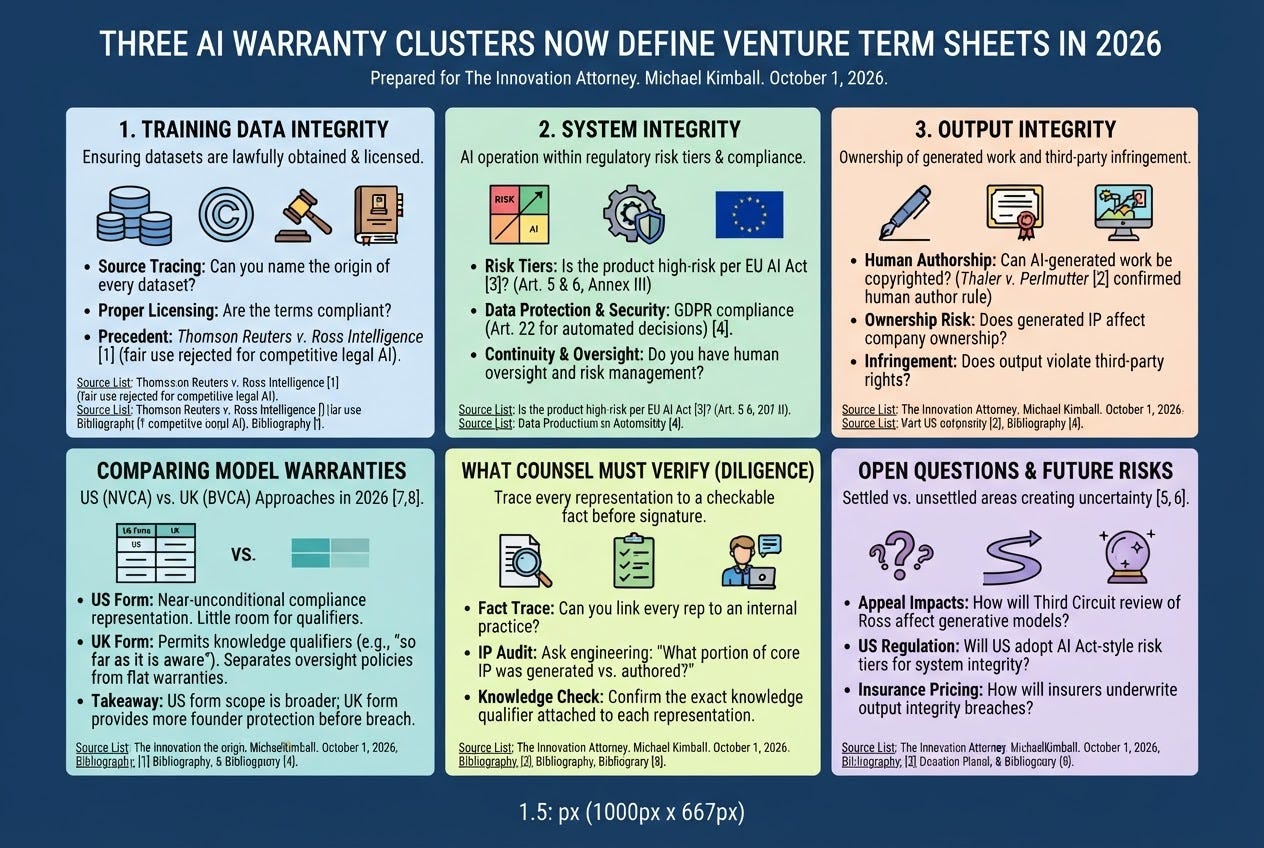
What AI Representations Should Founders Review Before A Term Sheet
Description
In February 2025, a federal judge in Delaware told Ross Intelligence that training a competing legal research product on Thomson Reuters’s copyrighted headnotes was not fair use, and venture lawyers on both coasts started rewriting their diligence checklists before the ink on Thomson Reuters Enterprise Centre GmbH v. Ross Intelligence Inc. had dried. A year later, a guide published for venture backed companies raising capital across borders sorted every artificial intelligence representation now showing up in a term sheet into three clusters: training data integrity, system integrity, and output integrity. The grouping is useful because it tells a founder exactly where to look before signing, rather than leaving counsel to decode a paragraph of defined terms borrowed from last year’s deal.
Model financing documents have been chasing artificial intelligence practice for three years now. The standard American venture capital stock purchase agreement added its first generative artificial intelligence representation in October 2023, requiring a company to confirm it uses generative tools in compliance with license terms and has not fed trade secrets or sensitive personal information into a tool that will use that data for further training. The standard British venture capital subscription agreement went further, naming the European Union’s Artificial Intelligence Act directly and asking a company to show it can explain an automated decision in language a person can actually read. Neither form existed in anything like its current shape five years ago, and neither will look the same five years from now.
Training data integrity is the cluster a court has already tested. Judge Stephanos Bibas found that Ross’s tool served the same purpose as Thomson Reuters’s own product, competed for the same customers, and therefore failed the fair use test regardless of how the underlying technology worked. He confined his reasoning to a non generative system, which means whether a generative model trained on protected material gets a different answer is still being argued in front of the Third Circuit. A founder whose product depends on a dataset the company did not build from scratch should be able to say, specifically, where every meaningful training set came from and what license covers it, because that is the exact fact pattern an investor’s counsel is now trained to ask about.
System integrity is the cluster that regulation, not litigation, is writing. The European Union’s Artificial Intelligence Act sorts systems into risk tiers under Article 6 and Annex III, and a company whose product touches employment screening, credit decisions, or similar uses inherits documentation and human oversight duties whether or not its financing documents say so. The standard British venture capital warranty already tracks that tiering. The standard American warranty does not mention the regulation at all, which leaves a company selling into Europe exposed to a gap between what it actually owes under the regulation and what it has promised an investor it owes. I have sat across the table from investor’s counsel who wanted to know, system by system, which large language model touched a client’s production code, and watched a founder realize mid meeting that nobody inside the company had ever written that list down.
Output integrity is the cluster the Supreme Court closed, at least for now. The Court of Appeals for the District of Columbia Circuit held in Thaler v. Perlmutter that copyright protection requires a human author, and the Supreme Court let that holding stand when it denied certiorari on March 2, 2026. A company that built a meaningful share of its core intellectual property through a generative tool, rather than with a generative tool assisting a human author, may be sitting on an asset that cannot be registered at all, and the standard American warranty on this point asks the company to say so directly: has a generative to