Episode Details
Back to Episodes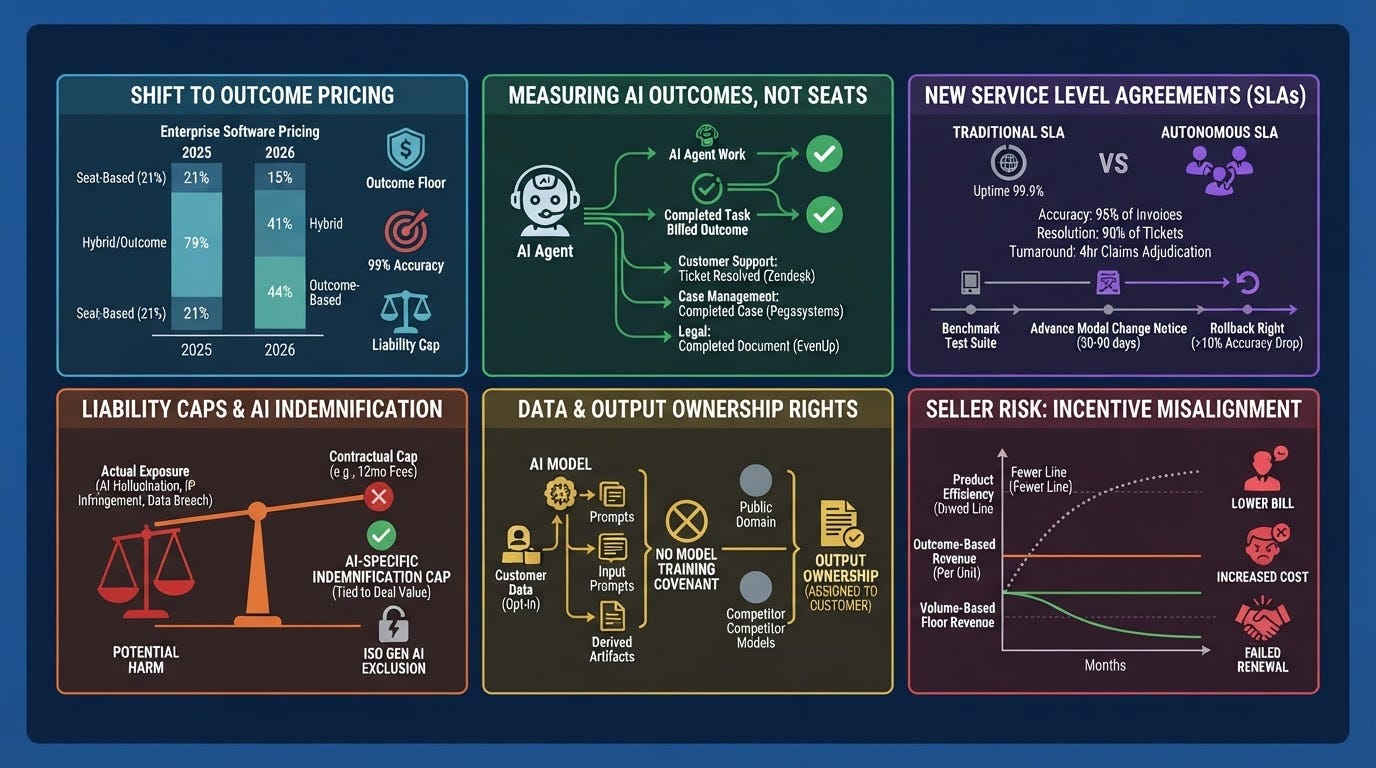
How To Negotiate Outcome Based Pricing In An AI Contract
Description
A startup that still prices its enterprise AI product by the seat is negotiating last year’s contract. Enterprise buyers in 2026 want to pay for a completed outcome, and the master service agreement that gets that wrong on pricing, service levels, or liability will not survive its first renewal.
The mechanic most founders miss is not the pricing model itself. It is the sequence. A company that lets a customer adopt its product for free or at a steep discount during a pilot, then proposes a market rate contract once the workflow depends on it, has already taught that customer to treat the real price as a surprise, not a plan. The negotiation that follows starts from suspicion, not partnership, and every term after that, the floor, the benchmark, the liability cap, gets read by the customer’s procurement team as something to extract, not something to agree to.
The shift away from the seat is already visible in the numbers. Enterprise software priced per seat fell from 21 percent of contracts to 15 percent in a single year, while hybrid pricing, a base subscription paired with a usage or outcome component, grew to 41 percent of the market. One industry forecast published in late 2025 projects that 40 percent of enterprise software will carry an AI agent by the end of 2026, up from roughly 5 percent a year earlier, because a single agent can now finish work that once required several people logged into separate seats.
Zendesk has already rebuilt its pricing around that fact. The company bills a customer only when its AI agent resolves a support ticket without a human stepping in, and a case that still needs a human agent counts for nothing on the invoice. Pegasystems charges a fixed fee for each completed case instead, absorbing the model cost itself, a structure its chief operating and financial officer, Ken Stillwell, has said customers accept because a completed case cannot be argued with the way a vague service description can. Intercom charges 0.99 dollars for each support ticket its Fin agent resolves. Leena AI tried pure consumption pricing first and switched to an outcome model after enterprise customers pulled back instead of risking an unpredictable monthly bill, the opposite of what consumption pricing was supposed to deliver.
None of that means a startup should copy Zendesk’s pricing line for line. It means the next master service agreement needs three specific protections that a pure outcome structure does not include on its own. The first is a floor: a base fee that covers a minimum level of access regardless of volume, so a slow quarter for the customer does not become a crisis for the seller’s own cash position. A chief financial officer will not approve a budget built entirely on an unknown resolution rate, and a seller that shows up to a renewal with only a per unit price invites that budget to get pushed into next year’s cycle instead of signed now.
The second protection is a service level agreement that measures the job, not the server. A traditional uptime commitment, 99.9 percent availability, says nothing about whether the AI did its work correctly. An agreement for a system that acts on the customer’s behalf should instead specify a benchmark test suite built from the customer’s own sample prompts, with a stated tolerance, commonly plus or minus 5 percent, that a new model version has to stay within before it replaces the one the customer approved. It should also include a rollback right if accuracy drops by 10 percent or more after an update, and a service credit schedule, typically 10 to 25 percent of the monthly fee, that pays out automatically, not after a dispute.
The third protection is a liability cap sized to the actual exposure, not a reflexive 12 months of fees. A common clause limits total liability, indemnification included, to the trailing year of payments, which means a 100,000 dollar contract caps recovery at 100,000 dollars no matter how large the under