Episode Details
Back to Episodes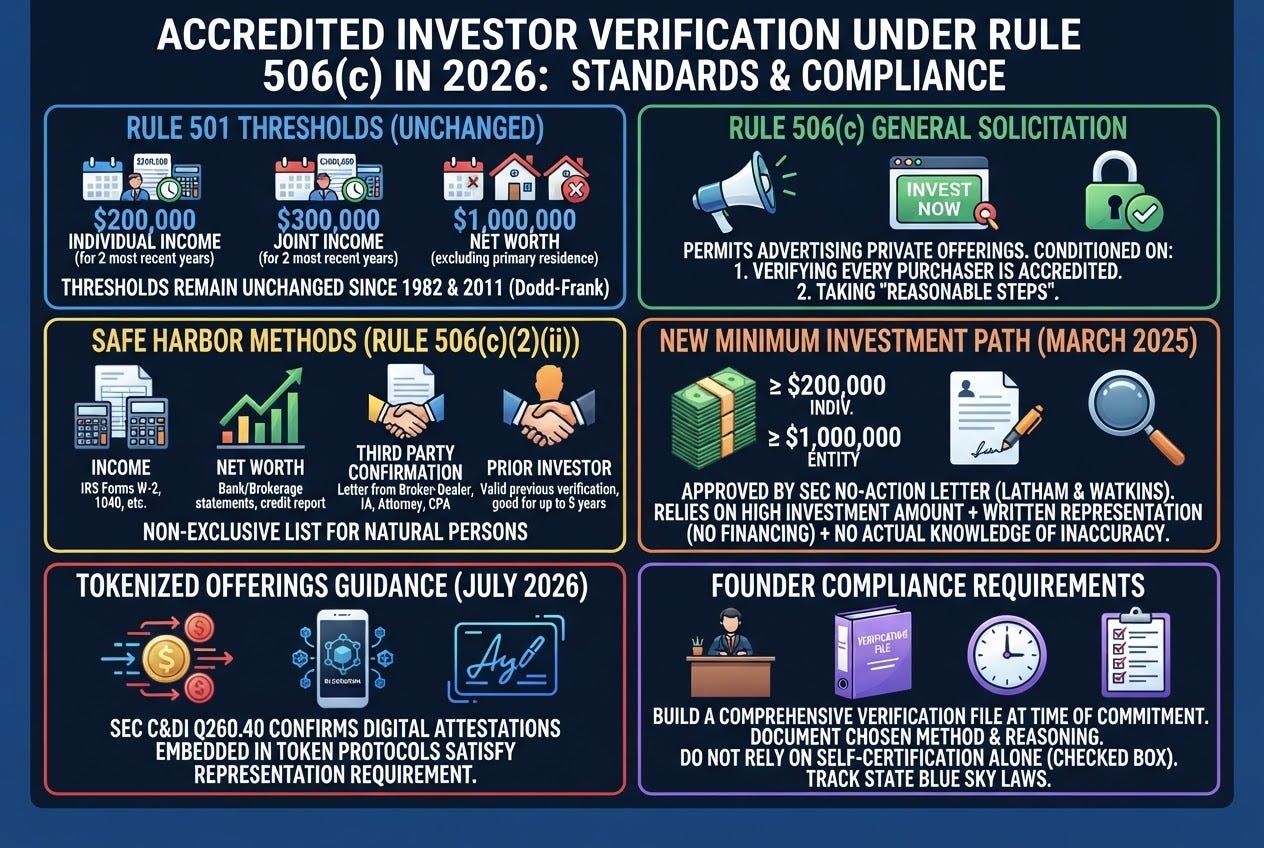
How Do Founders Verify Accredited Investor Status
Description
On March 12, 2025 the Securities and Exchange Commission’s Division of Corporation Finance told Latham and Watkins LLP it would not recommend enforcement action against an issuer that skips tax returns and bank statements entirely, so long as the purchaser writes a check of at least $200,000 and signs two sentences of representations. Founders who spent the last decade collecting W-2s and brokerage statements from every investor in a Rule 506(c) raise now have a shorter path, and the dollar figures that decide who counts as an accredited investor in the first place have not moved since the Commission recalculated the net worth test in December 2011.
That stability is easy to miss because the compliance conversation around accredited status has gotten louder, not quieter. The $200,000 individual income figure, the $300,000 joint income figure, and the $1,000,000 net worth figure all trace to the Commission’s original 1982 adoption of Regulation D. The only change since then came in Release No. 33-9287, adopted December 21, 2011 under the mandate of Section 413(a) of the Dodd-Frank Act, which excluded the value of a primary residence from the net worth calculation. A December 14, 2023 staff report confirmed the Commission still has no proposal on the table to raise any of the three figures, even though an inflation adjusted net worth threshold would run past $3,000,000.
Rule 506(c) itself is newer than the thresholds it borrows. Section 201(a)(1) of the JOBS Act of 2012 directed the Commission to lift the decades old ban on general solicitation for offerings sold only to accredited investors, and the Commission adopted Rule 506(c) in Release No. 33-9415 on July 10, 2013, effective September 23, 2013. The bargain in that rule is simple: an issuer may advertise the raise publicly, but only if every purchaser is in fact accredited and the issuer took reasonable steps to confirm it. Rule 506(c)(2)(ii) lists the traditional methods an issuer can lean on without more: tax returns and a current year income representation, bank and brokerage statements dated within three months alongside a liability disclosure, or a letter from a broker dealer, registered investment adviser, attorney, or certified public accountant.
The March 2025 letter did not replace any of that. It added a path. An issuer may treat a minimum investment of $200,000 from a natural person, or $1,000,000 from a legal entity, as a relevant factor supporting a reasonable steps conclusion, provided the purchaser represents in writing that the money is not financed by a third party for the purpose of making that specific investment and the issuer has no actual knowledge suggesting otherwise. The Division was careful to say the conclusion is fact specific and carries no force beyond the facts it reviewed, a qualification that matters more than it sounds: an issuer who drops the minimum to $100,000 or skips the financing representation is not covered by the same letter.
The pattern repeated in 2026. On July 21 the Division added Question 260.40 to its Compliance and Disclosure Interpretations, confirming that a purchaser in a tokenized Rule 506(c) offering can deliver the same accredited status and no third party financing representations through a digital attestation built into the token protocol, rather than a signed PDF. The dollar figures carried over without change. What changed was the form the record takes, and the interpretation is explicit that an issuer still needs to keep records showing how the protocol captured and checked the representation.
In thirty years of closing seed and Series A rounds, I have never once seen counsel reject a $5,000,000 check because the investor would not produce a W-2; the real question was always whether the issuer’s file would hold up if the Commission asked. The March 2025 letter formalizes what seasoned issuers already treated as true in practice: the size of the check is itself evidence of so