Episode Details
Back to Episodes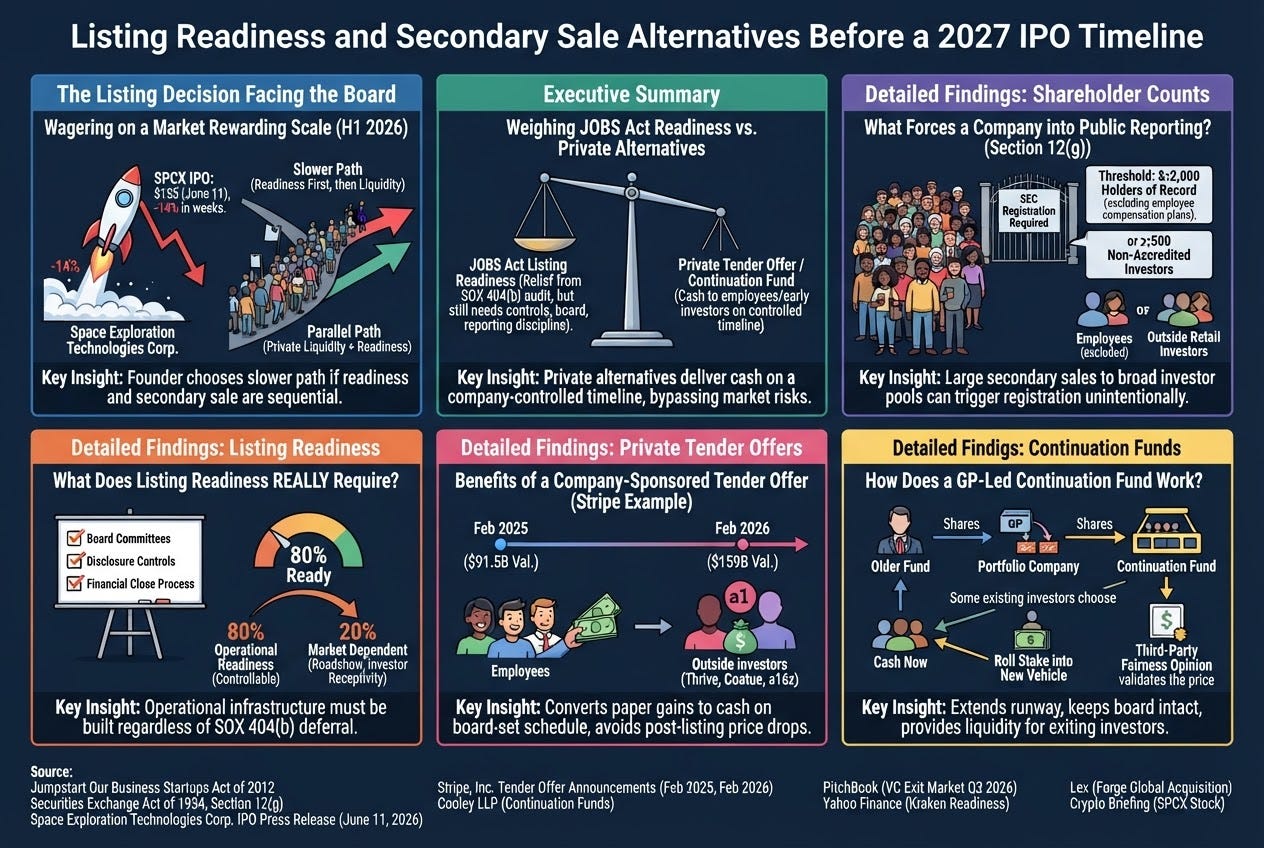
SpaceX’s IPO Shows How Narrow the IPO Window Really Is
Description
Space Exploration Technologies Corp. priced its initial public offering at $135.00 a share on June 11, 2026, raised close to $75 billion, and watched its stock fall roughly 14 percent from that price within weeks of trading on the Nasdaq Global Select Market under the ticker SPCX. A venture backed company without that kind of scale should not assume the same door will open on the same calendar, and a board setting a 2027 listing date should put a private tender offer or a continuation fund on the table now rather than treating either as a fallback.
Most boards still plan the public offering first and the private liquidity option second, as if the second were a consolation prize. The mechanic most founders miss is the opposite ordering: a company that lines up a tender offer or a continuation fund while it is still building toward listing readiness keeps optionality on the calendar, while a company that commits the board to a fixed public offering date gives up that optionality the moment the resolution passes.
Section 12(g) of the Securities Exchange Act forces public reporting once a company passes 2,000 holders of record or 500 non-accredited holders, a threshold the JOBS Act of 2012 raised from 500 total holders and from which it excluded employee compensation related holders entirely. That exclusion is the reason Stripe, Inc. could run a tender offer at a $91.5 billion valuation in February 2025, and a second one at $159 billion on February 24, 2026, a 49 percent increase in roughly five months, funded mostly by Thrive Capital, Coatue, and Andreessen Horowitz, without approaching the reporting trigger a comparable sale to the public would carry.
Listing readiness is a different project from the 20 percent that actually gates a listing. The Jumpstart Our Business Startups Act of 2012 lets an emerging growth company skip the external audit of its internal controls under Section 404(b) of the Sarbanes Oxley Act for up to five years after listing, but only for companies under $1.235 billion in revenue, and the exemption says nothing about the board committees, disclosure controls, and closing process a company needs before its first annual report. Kraken’s co-chief executive Arjun Sethi said at Consensus Miami on May 5, 2026, that the exchange considered itself approximately 80 percent ready to list, with board oversight and compliance work already done and investor receptivity as the remaining variable. That split, operational readiness largely finished, market timing still outside the company’s control, is the one every founder should expect.
A general partner led continuation fund solves a different problem than a tender offer solves. Where a tender offer moves cash to employees and early investors while the company stays on its existing capitalization table, a continuation fund lets a venture fund’s own manager buy a portfolio company out of an older fund, giving that fund’s investors a choice between cash now or rolling into the new vehicle. A dedicated secondary buyer underwrites the price, a third party fairness opinion tests it even though the Securities and Exchange Commission’s rule requiring such opinions for private fund advisers was vacated in 2024, and the company gets fresh capital and a longer runway without a public listing or a sale to a strategic acquirer on anyone else’s calendar.
A secondary trading platform is not a neutral utility sitting underneath these transactions. Charles Schwab bought Forge Global in November 2025 for $660 million, about one third of the valuation Forge carried when it went public through a special purpose acquisition company, despite Forge having processed an estimated $17 billion in lifetime transaction volume. Across thirty years of advising companies through exactly this fork, the boards that wait for market validation before building a parallel liquidity plan are usually the ones explaining a stalled timeline to employees who were told liquidit