Episode Details
Back to Episodes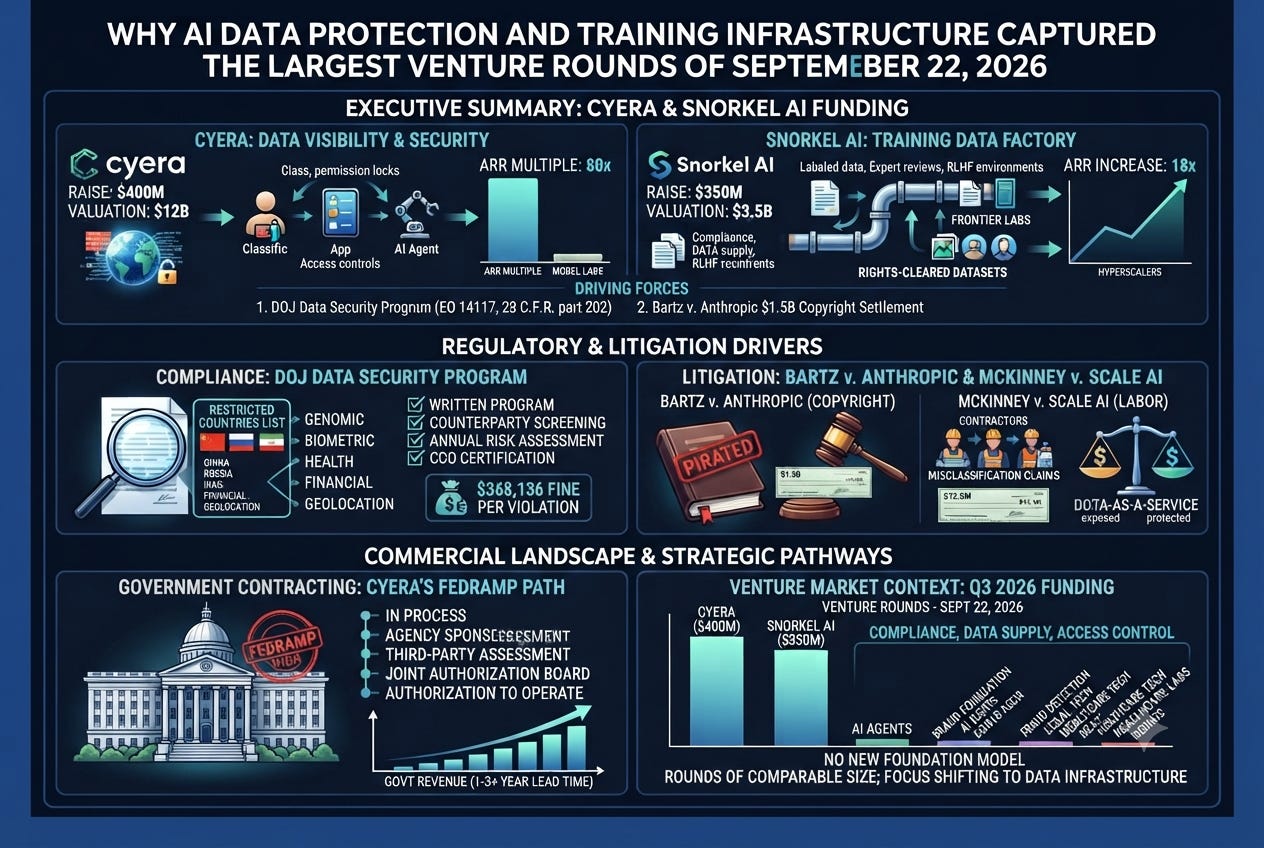
Why Is Venture Capital Funding AI Data Infrastructure Instead Of Models
Description
Cyera raised $400 million at a $12 billion valuation and Snorkel AI raised $350 million at a $3.5 billion valuation on September 22, 2026, and neither sold a foundation model. Cyera sells the map of where an enterprise’s sensitive data sits and who, or what software agent, is allowed to touch it. Snorkel AI sells the labeled, rights cleared data that frontier laboratories feed into the models everyone else is racing to build. The capital went to the toll booth, not the highway.
The detail most founders miss when they read a headline valuation is the mechanism behind it: a company that classifies data or supplies clean training data is not selling intelligence. It is selling a compliance and provenance function that a regulator or a plaintiff’s lawyer can now put a dollar figure on. Two events in the last fifteen months did that pricing work for the entire market, and neither one involved a model release.
The first event is regulatory. The Department of Justice’s Data Security Program, issued under Executive Order 14117 and codified at 28 C.F.R. part 202, took effect on April 8, 2025, and its audit and certification obligations phased in on October 6, 2025. The rule restricts transactions that would give China, Cuba, Iran, North Korea, Russia, or Venezuela access to bulk human genomic data, biometric identifiers, precise geolocation data, personal health data, personal financial data, or covered personal identifiers above defined volume thresholds, and it requires the responsible company’s chief compliance officer to certify annually, on the record, that the company knows where that data lives and who can reach it. Cyera’s product answers exactly that question, which is why federal market penetration is a named use of the $400 million it just raised, on top of a FedRAMP High “In Process” designation the company secured in April 2026.
The second event is a courtroom, not an agency. In Bartz v. Anthropic PBC, No. 3:24-cv-05417 (N.D. Cal.), Judge William Alsup ruled in June 2025 that training on lawfully acquired books qualified as fair use because training builds a new statistical model rather than reproducing the books themselves, but that Anthropic’s retention of a library built in part from pirated copies was not protected by that finding. The case settled for $1.5 billion in September 2025. The ruling did not punish training itself. It punished the acquisition, and that distinction is the one every general counsel negotiating a data license now has to price. A vendor that can document where every training example came from, and warrant it, is worth more than a vendor that cannot, because the buyer’s counsel has a specific, recent, nine figure reason to ask for that warranty before signing.
Snorkel AI built its round around exactly that shift. The company moved from selling software that helps a customer label its own data to selling finished, subject matter expert reviewed datasets and reinforcement learning environments directly, with the human labor cost absorbed into the price of the deliverable rather than passed through as marketplace revenue. Annual recurring revenue reached $375 million, an eighteen fold increase over the prior year, and the new round priced the company at $3.5 billion, close to triple its valuation seventeen months earlier.
The competitor whose mistakes made that shift look necessary is Scale AI. In McKinney v. Scale AI, Inc., No. CGC-24-620481 (Cal. Super. Ct., San Francisco County), the company paid $12.5 million to settle claims that it misclassified data annotation contributors as independent contractors under California Labor Code section 2775, the ABC test, based on allegations that it monitored contributor screens, docked pay for slow tasks, and reassigned contributors without notice. That is the profile of an employer, not a marketplace operator, under California law. A company that sells a finished dataset rather than hourly platform labor is harder to fit int