Episode Details
Back to Episodes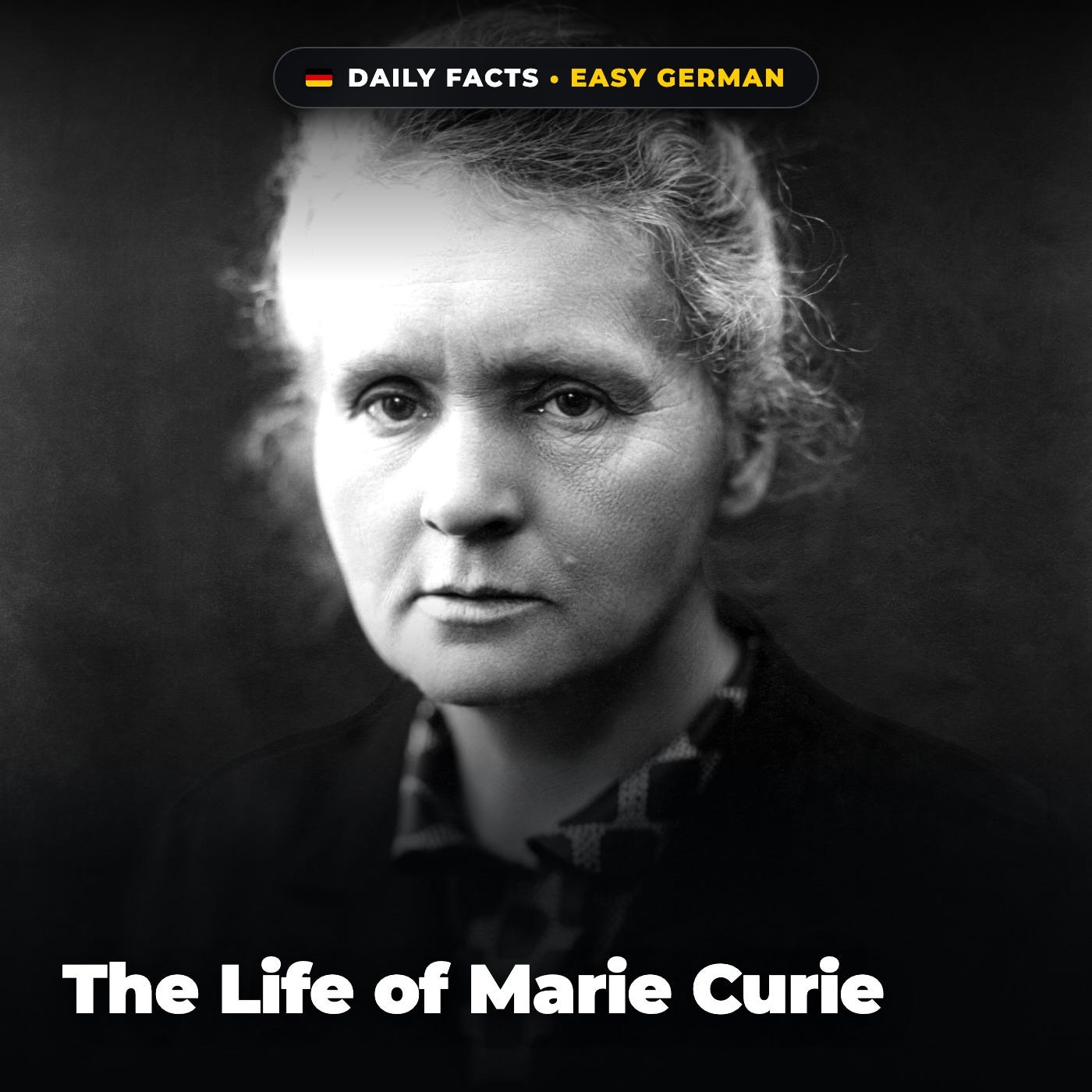
The Life of Marie Curie in Easy German
Published 3 weeks, 3 days ago
Description
Transcription: https://dailyfactsineasygerman.substack.com/p/the-life-of-marie-curie-in-easy-german?showTranscript=true
Discover "The Life of Marie Curie" in clear, natural German!
Celebrate the inspiring life and scientific brilliance of Marie Curie, one of history's greatest pioneers. Born in Warsaw, she overcame poverty and discrimination to study at the Sorbonne in Paris.
Discover how her tireless research into uranium rays led to the discovery of two new chemical elements—polonium and radium—and revolutionized physics and medicine, earning her two Nobel Prizes.
Key Topics & Highlights:
• Marie Curie was the first woman to win a Nobel Prize and the only person to win in two different scientific fields.
• She discovered two radioactive elements: Polonium (named after her homeland Poland) and Radium.
• She coined the term 'radioactivity' to describe the spontaneous emission of energy from atoms.
• During World War I, she developed mobile X-ray units ('Petites Curies') to help wounded soldiers on the front.
Key German Vocabulary:
• die Wissenschaftlerin (female scientist)
• das Element (element)
• die Strahlung (radiation)
• der Nobelpreis (Nobel Prize)
Chapters:
00:00 - Introduction & A Pioneer in Science
03:29 - Early Hardships & Paris University
07:50 - Discovering Polonium and Radium
12:36 - Two Nobel Prizes & Mobile X-Rays
18:55 - Lasting Legacy in Modern Medicine
Audio: 100% German • Spoken slowly and clearly (0.8x speed)
This is a public episode. If you would like to discuss this with other subscribers or get access to bonus episodes, visit dailyfactsineasygerman.substack.com