Episode Details
Back to Episodes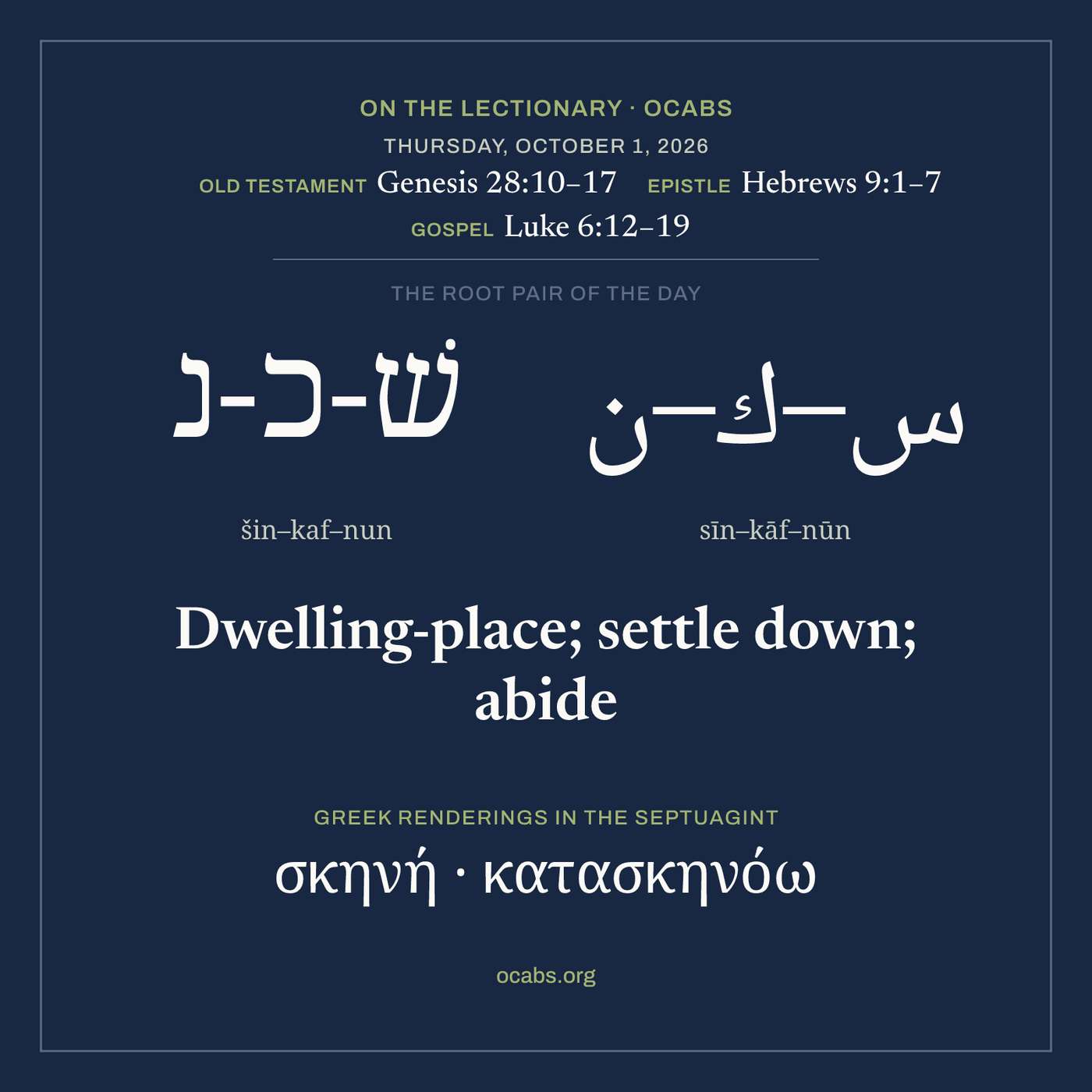
Genesis 28:10-17 · Ezekiel 43:27-44:4 · Proverbs 9:1-11 · Hebrews 9:1-7 · Ephesians 5:33-6:9 · Luke 6:12-19 — Thursday, October 1, 2026
Description
A daily note from the team at OCABS.ORG, drawing on the published works of Fr. Paul Nadim Tarazi, with citations to his books and lectures.
Readings: Genesis 28:10-17; Ezekiel 43:27-44:4; Proverbs 9:1-11; Hebrews 9:1-7; Ephesians 5:33-6:9; Luke 6:12-19.
Jacob's night at Bethel opens what Fr. Paul reads as an exile rather than a pilgrimage: he leaves Beer-sheba "in enmity with his own brother" instead of carrying forward the covenant of peace his father had kept with the Philistines there. In the dream God simply repeats to him the promise already made to Abraham and Isaac—land, descendants, and the pledge "I will not leave you until I have done that of which I have spoken to you." Jacob names the place Bethel, house of God, but Fr. Paul points out that in doing so "he imagines that God needs a house when what God actually wants is that his will be done." His recorded commentary adds that the Hebrew word behind the name is the same one that gives us Bethel, and that scripture grants Jacob two chances to be brought home, the first back to Canaan from Haran, the second, harder one, back only as a corpse from Egypt.
Ezekiel's new temple ends in a shut eastern gate, because the Lord himself has entered by it, so that only the prince, never again a king, may use its porch to eat bread before the Lord. Fr. Paul notes the earlier abomination this answers: kings had set their thresholds and corpses beside God's own, "so I have consumed them in my anger," and God now vows to dwell among a people who no longer defile his holy name. When the glory fills the house, Ezekiel falls on his face, a scene Fr. Paul sets beside Isaiah's temple vision of the Lord "high and lifted up." He also observes that the people cannot see this structure as the prophet does; they can only hear it described, so that the hearer is meant "to understand with his 'mind,' the Hebrew leb (heart, core)."
Proverbs' wisdom builds her own house and spreads her table for the simple, acting, as Fr. Paul puts it, "as God would build his temple," and issuing her invitation the way God calls his people to his festivities. Her counterpart, the foolish woman of the following verses, imitates this same invitation with a false house of her own.
The root pair of the day · שׁ-כ-נ šin–kaf–nun, מִשְׁכָּן miškan · س–ك–ن sīn–kāf–nūn, مِسْكِين miskīn · dwelling-place; settle down; abide. Miškan and miskīn link God's chosen dwelling-place to the needy who depend on it. Jacob names Bethel as if God needed a house, but the deeper word, as in Exodus 25:8, 'let them make me a sanctuary, that I may dwell among them,' shows dwelling as God's gift to the poor, not a human construction. Ezekiel's shut gate marks that same dwelling, now purified. cf. The Consolation of Consonants
Sources: Tarazi, Genesis: A Commentary, p. 164; Orthodox Audio Bible Commentary, Genesis (vol. 1), part 2, at 50:37; Tarazi, Genesis: A Commentary, p. 163; Tarazi, The New Testament: An Introduction, vol. 3, Johannine Writings, p. 101; Tarazi, Ezekiel: A Commentary, p. 331; Tarazi, Land and Covenant, p. 160; Tarazi, Ezekiel: A Commentary, p. 147; Tarazi, The Old Testament: An Introduction, vol. 3, Psalms and Wisdom, p. 92; Tarazi, The Old Testament: An Introduction, vol. 3, Psalms and Wisdom, p. 91.
Opening music: Taksim Arbi, Bichi Slama, oud (Tunis, Archives de la Parole, 1930s), public domain. Source: gallica.bnf.fr / BnF.