Episode Details
Back to Episodes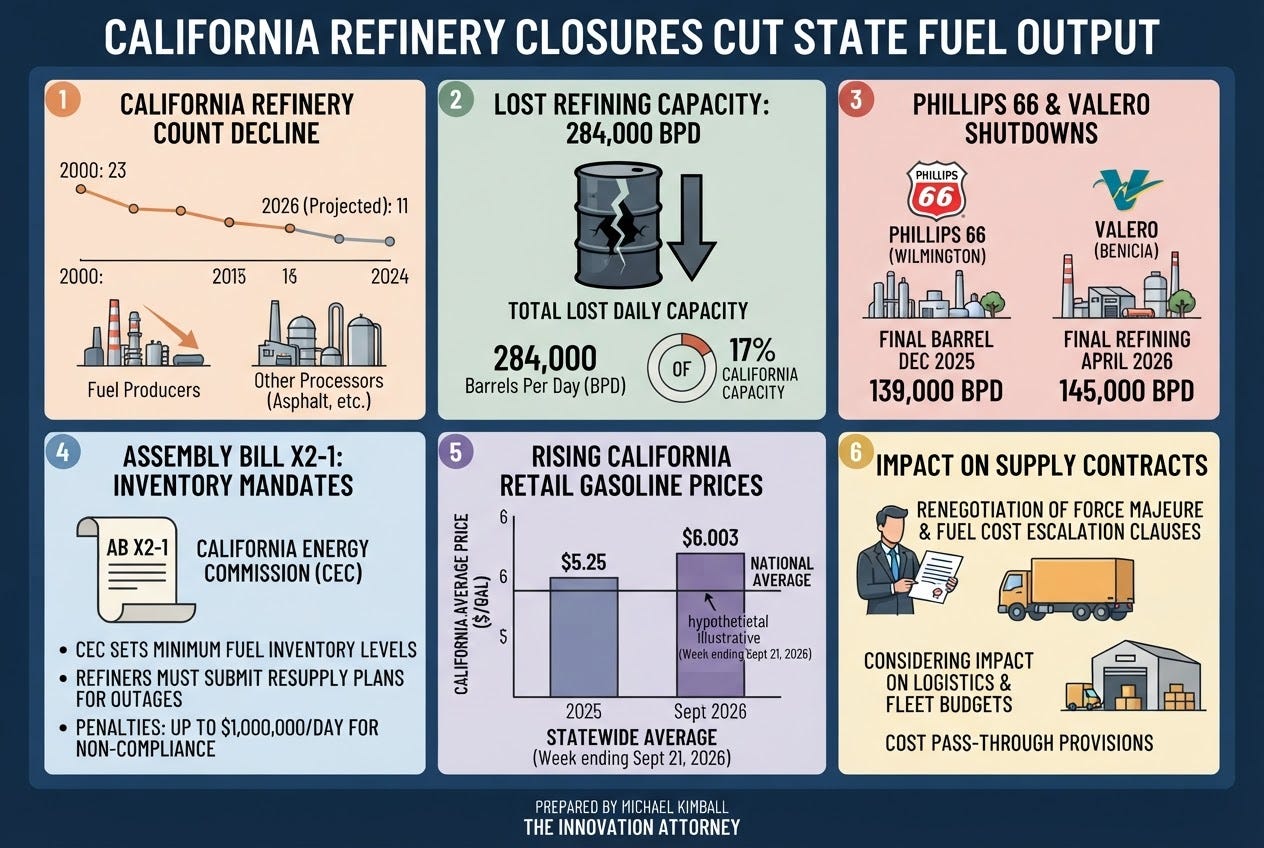
Why California Fuel Prices Are So High
Description
California lost 284,000 barrels per day of refining capacity when Phillips 66 closed its Los Angeles refinery in 2025 and Valero shut Benicia in April 2026. The two shutdowns removed roughly seventeen percent of the state’s operable refining capacity within a six month span, leaving eight refineries to supply California’s gasoline and diesel market. Federal government data puts total operable capacity at 1,637,871 barrels per calendar day at the start of 2025 and 1,499,171 barrels per calendar day at the start of 2026, a count that does not yet reflect the Benicia exit. Two economic analyses of what this means for pump prices reach very different conclusions, and the state legislature has responded with inventory mandates rather than new refining capacity.
This report separates the confirmed capacity numbers from the contested price forecasts, traces the two closures to their regulatory and financial causes, and identifies a third Valero refinery in Wilmington whose future is not yet decided. It also examines Assembly Bill X2-1, the 2024 law that gives the California Energy Commission authority to set minimum fuel inventory levels, and the Low Carbon Fuel Standard amendment that took effect on July 1, 2025 with its own contested cost estimate. The audience for this analysis is the founder, investor, or executive whose supply chain, facilities budget, or logistics contracts touch California fuel markets, whether directly through fleet diesel purchases or indirectly through vendor cost pass through provisions.
Detailed Findings
How many refineries in California still make gasoline and diesel
Eight oil refineries in California produce transportation fuel as of the California Air Resources Board’s most recent facility inventory, updated May 5, 2026. Four sit in the Los Angeles basin: Marathon Petroleum in Los Angeles, Chevron in El Segundo, PBF Energy in Torrance, and Valero in Wilmington. Two sit in the Bay Area: Chevron in Richmond and PBF Energy in Martinez. Two smaller, non integrated plants operate in Bakersfield: Kern Energy and San Joaquin Refining Company. Three additional California refineries process asphalt or other non transportation output, not gasoline or diesel, bringing the state’s total refinery count to eleven, a figure the American Petroleum Institute projects for the end of 2026 and that the Air Resources Board’s own inventory independently confirms.
The count has been falling for a quarter century. The American Petroleum Institute puts the statewide refinery total at 23 in 2000 and 14 at the start of 2024. Phillips 66 alone accounted for two exits in that span: its Rodeo plant converted to exclusive renewable fuel production in 2024, and its separate Los Angeles refinery in Wilmington processed its final barrel of crude oil in December 2025. Both moves removed conventional gasoline and diesel capacity even though only one, the Wilmington shutdown, is a full closure of a fuel producing facility.
How much capacity did the Phillips 66 and Valero shutdowns remove
The Phillips 66 Los Angeles refinery in Wilmington processed 139,000 barrels of crude oil a day before its final shutdown in December 2025, following an October 16, 2024 closure announcement. Valero’s Benicia refinery, a plant built for Humble Oil in 1969 and acquired by Valero in 2000, is scheduled to stop refining by the end of April 2026 at a rate the U.S. Energy Information Administration puts at 145,000 barrels a day, a figure the agency ties to a April 2025 closure notice. Combined, the two facilities equal 284,000 barrels a day, which the Energy Information Administration calculates as seventeen percent of California’s refinery capacity and eleven percent of capacity across the five state West Coast petroleum district that includes Alaska, Washington, Oregon, California, and Hawaii.
Government capacity data confirms the scale of the decline independent of either company’s own figures. Operable atmo