Episode Details
Back to Episodes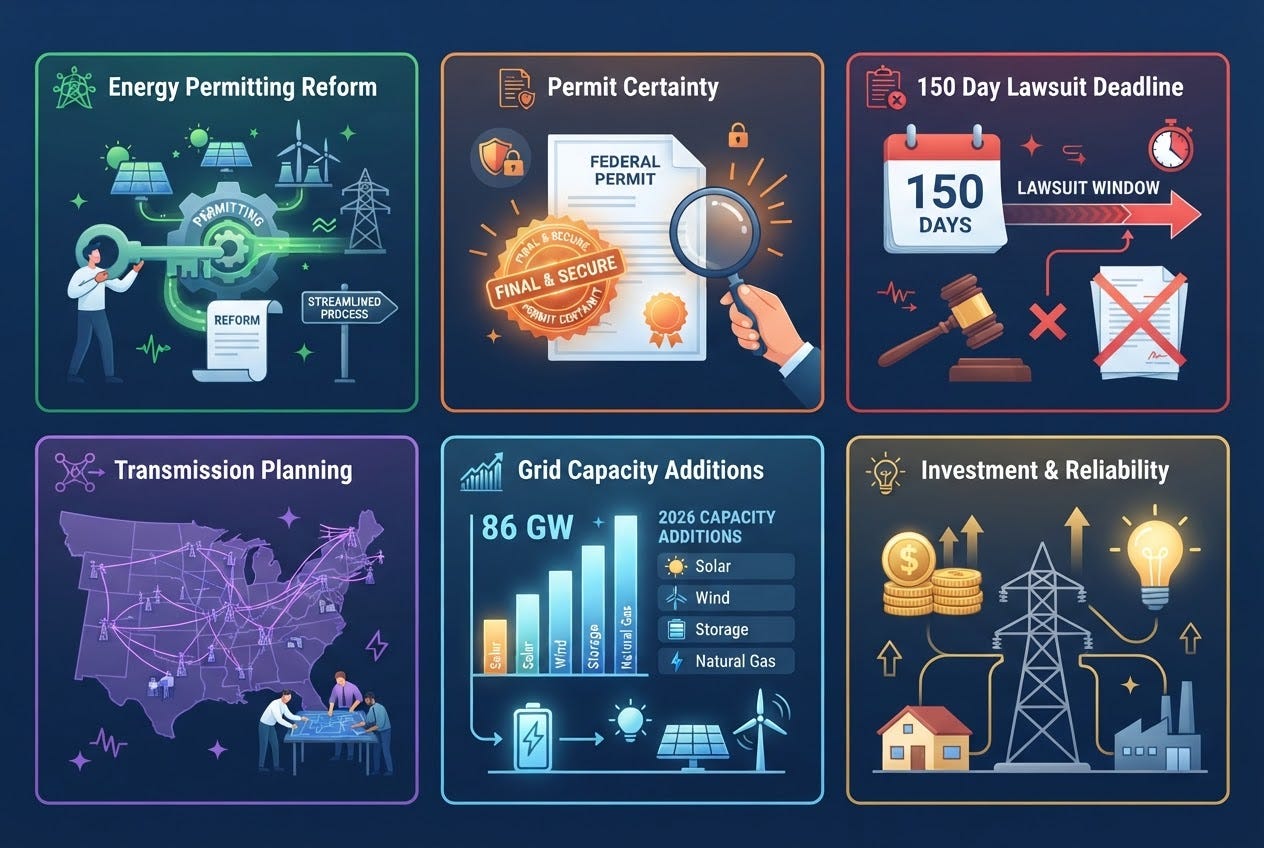
Energy Permit Certainty
Description
Permit certainty provisions in the Bipartisan American Affordability and Jobs Act of 2026 would bar federal agencies from revoking issued energy permits absent extraordinary circumstances, legal violations, or court order.
The 417 page Senate text, released September 30, 2026, pairs that limit with a 150 day deadline for lawsuits against environmental reviews and with statutory review deadlines of one year for environmental assessments and two years for environmental impact statements. Developers and lenders gain a fixed regulatory baseline, and the discretion behind the December 2025 pauses affecting five offshore wind projects ends for permits already issued. Federal courts vacated or enjoined those pauses under the Administrative Procedure Act. Language covering wind and solar remains under negotiation, and a floor vote is not expected before the November 3, 2026 midterm elections.
The Energy Information Administration projects a record 86 gigawatts of new grid connected generating capacity in 2026, and solar, wind, and storage supply 92 percent of it. Lawrence Berkeley National Laboratory counts 1,312 gigawatts of generation in interconnection queues, about 15 times the 2026 build plan, and finds that 13 percent of capacity requested between 2000 and 2020 reached commercial operation. Investors should price permit durability as a distinct risk. Policymakers should expect the Senate text to meet a House record that already includes a NEPA rewrite and a proposed Treasury compensation fund.
Detailed Findings
What does the permit certainty provision in the Senate bill do?
The provision guarantees that a permitted energy or infrastructure project keeps its permit absent extraordinary circumstances, violations of law, or a court order. Project Certainty appears as Title IV, Sections 1401 through 1403 of the released text, and it protects federal authorizations held by nonfederal sponsors. Sponsors describe the goal as lower energy costs, faster approvals, and preserved Tribal consultation rights.
Accounts of the text differ on technology coverage. One summary reports fair treatment of onshore wind, offshore wind, coal, natural gas, nuclear, and geothermal. Another reports that wind and solar language remains under negotiation with the executive branch. The released text controls, and this report treats the wind and solar coverage as contested until the final bill is filed.
The mechanism fixes the permit as a baseline before any agency acts. The Administrative Procedure Act, 5 U.S.C. Section 706, paragraph 2, subparagraph A, already lets a court set aside agency action that is arbitrary and capricious. Relief under that provision arrives after the harm. The Senate text moves the constraint into the agency authority itself. I spent years in a reactor plant where a certified valve lineup changed only through a written procedure and a named authorizing officer. Lenders I have worked across the table from treat a final permit the same way, as a certified baseline listed among the conditions to funding. A permit that an agency can withdraw on a phone call does not meet that standard.
Why are Congress and the courts limiting agency power over energy permits now?
Executive actions against permitted offshore wind projects produced a string of court losses between 2025 and 2026 and a legislative response in 2026. A January 20, 2025 presidential memorandum withdrew offshore areas from wind leasing and directed agencies to pause new approvals. On December 22, 2025, the administration paused five East Coast projects: Empire Wind at 2,076 megawatts, Revolution Wind at 704 megawatts, Sunrise Wind at 924 megawatts, Coastal Virginia Offshore Wind at 2,600 megawatts, and Vineyard Wind 1 at 880 megawatts. Those figures sum to 7,184 megawatts. The tracker that reports them states a total of 7.784 gigawatts, a discrepancy this report flags and resolves in favor of the arithmetic.
Courts