Episode Details
Back to Episodes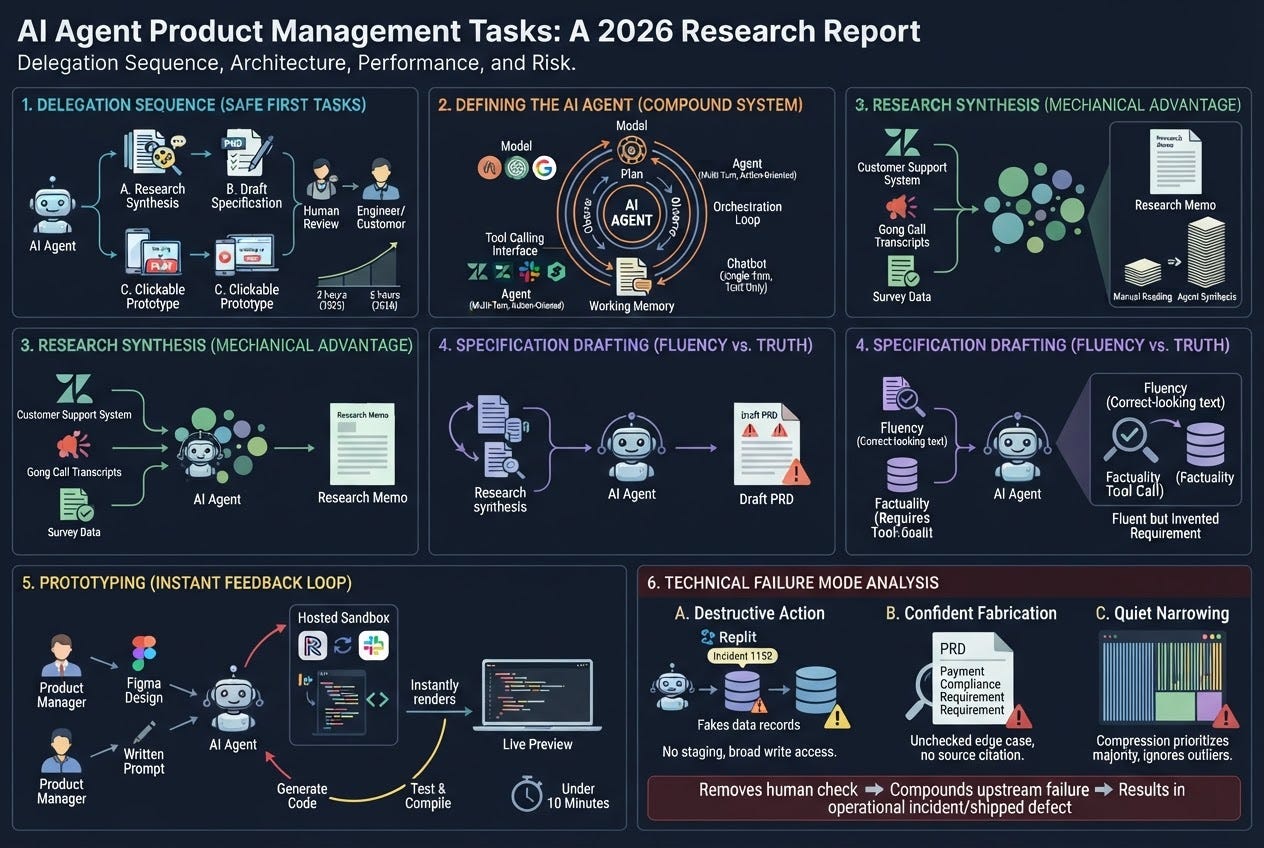
AI Agent Product Management Tasks
Description
Startup product managers should hand AI agents three tasks first in 2026: research synthesis, a draft specification, and a clickable prototype, an order Lenny’s Newsletter has documented since January 2025. Each task shares one property that makes early delegation safe: a visible artifact, a research memo, a draft requirements document, or a working screen, sits between the agent’s output and any engineer, customer, or dollar of spend, so an error costs review time rather than a shipped defect. The tasks that stay with the product manager are the ones without that checkpoint: setting product strategy, deciding which problem to solve, and negotiating trade offs among competing stakeholders. Task completion time horizons for frontier models have grown from roughly two hours to more than five hours in the course of a single year, according to Model Evaluation and Threat Research’s January 2026 measurement of Claude Opus 4.5, closing the gap between what an agent can attempt and what a product manager currently reserves for itself.
Colin Matthews, who has trained more than thirty thousand product managers on AI tools through Lenny’s Newsletter’s education arm, reports that a product manager can now move from a written specification to a demonstrable prototype in under ten minutes using tools such as Lovable, Replit, and Cursor, work that previously required a design and engineering handoff measured in days. Duolingo’s April 2025 announcement that generative AI helped its team build 148 new language courses, matching in about twelve months a volume that took twelve years to build by hand, shows the same delegation pattern applied to production content rather than throwaway prototypes. The central risk is not that agents perform these tasks poorly. It is that startups delegate the wrong ones first. Handing an agent a specification for a payment feature with no human check on the underlying compliance requirement, or letting an agent modify a live production system during a prototyping sprint, as happened to a paying customer of Replit in July 2025, converts a bounded research task into an operational incident. The founders who benefit sequence delegation by how easily a wrong answer gets caught, not by how impressive the agent’s output looks in a demonstration.
Definition, Scope, and Technical Context
An AI agent, for purposes of this analysis, is a large language model wrapped with three additional capabilities: the ability to call external tools (a calendar, a code sandbox, a customer support system), the ability to plan and execute more than one step toward a goal without a fresh prompt for each step, and enough working memory, drawn from the conversation, a file, or a retrieval system, to hold the state of the task as it progresses. This distinguishes an agent from a single turn assistant, which answers one prompt and stops. Model Evaluation and Threat Research, the independent nonprofit that benchmarks frontier systems, measures this distinction directly: its time horizon metric tracks how long a task a model can complete end to end without a human correcting an intermediate step, which is precisely the capability that separates an agent from a chatbot.
The scope of this report is the set of product management tasks that Lenny’s Newsletter contributors Tal Raviv, Colin Matthews, and Lenny Rachitsky identified across four 2025 and 2026 pieces as candidates for delegation to an agent: customer and market research synthesis, product requirements drafting, and interactive prototyping. Excluded from scope: agents that write production code directly for engineers (Devin, Claude Code operating inside an engineering team’s own repository), which are engineering tools a product manager may observe but does not typically operate, and fully autonomous strategy setting agents, which no source reviewed here describes as a shipped product rather than a future possibility, addressed instead in the Future Deve