Episode Details
Back to Episodes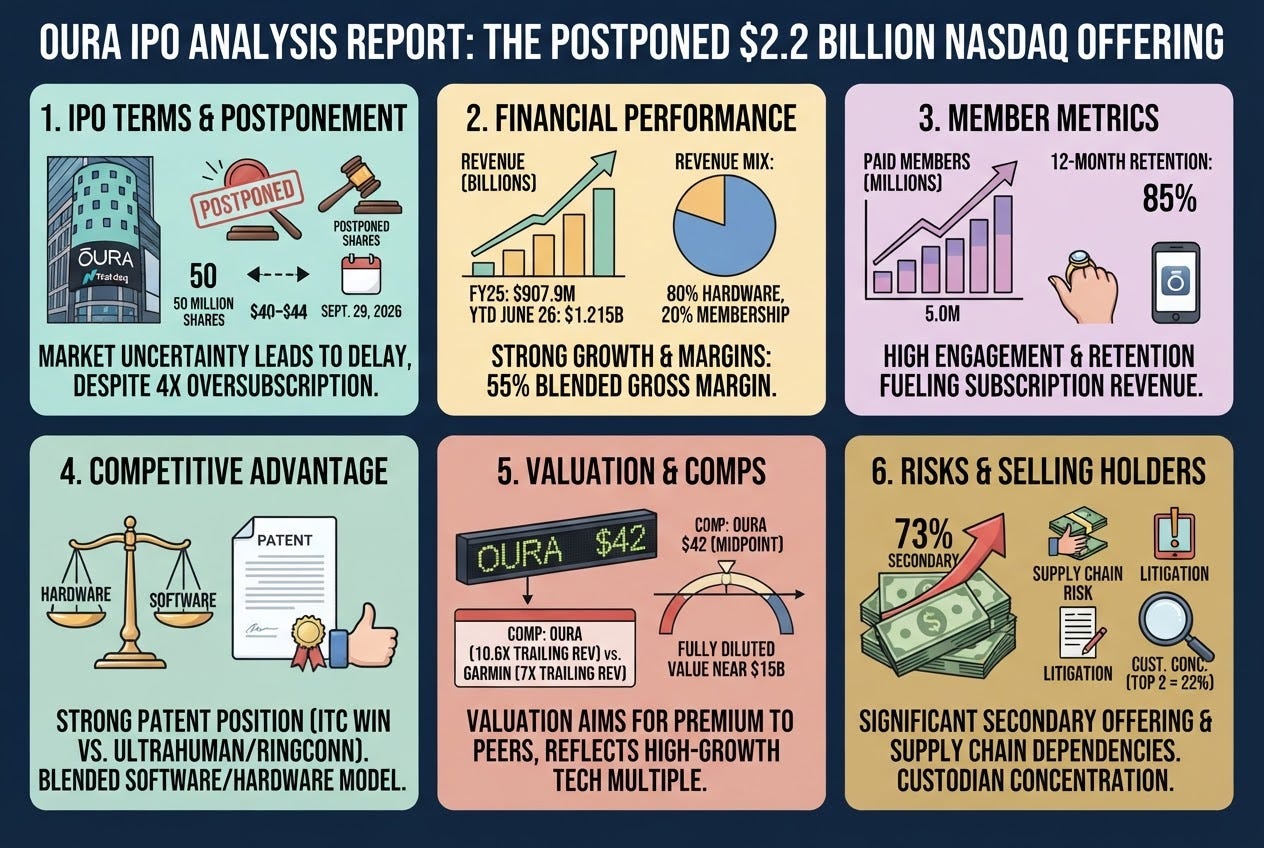
Oura Postponed Its $2.2 Billion IPO
Description
Oura postponed its $2.2 billion Nasdaq IPO on September 29, 2026, citing market uncertainty after orders reached roughly four times the 50 million shares offered at $40 to $44. The company sold 13.5 million of those shares and existing holders sold 36.5 million, so the price range mattered far more to sellers than to the company treasury. A price at the bottom of the range also lands within $0.18 of the $40.18 per share Oura paid in its February 2026 tender offer.
Oura makes a ring that tracks sleep, heart rate, and temperature, and it runs a subscription business wrapped around that piece of hardware. In the nine months ended June 30, 2026, the company booked $1.2145 billion of revenue, up 74% from about $697 million a year earlier, and earned net income of $60.8 million. Hardware supplied about 80% of the revenue at a gross margin near 46%, while the $5.99 monthly membership supplied 20% at 89%. Those two margins hold the whole valuation argument in miniature, because the market was asked to pay about 10.6 times trailing revenue of $1.42 billion, and Garmin trades near 7 times.
Start with who was selling. The preliminary prospectus on Form S1 put 36.5 million of the 50 million shares in the hands of existing holders, among them Forerunner Ventures and Lifeline Ventures, which is 73% of the deal. Between $44 and $40, the company’s 13.5 million shares lose $54 million of proceeds and the sellers lose $146 million. The chief executive said, “We aim to deliver an extraordinary IPO for our employees and investors and we have the luxury of choosing our moment,” and the arithmetic shows who gains most from waiting.
Then look at the price history. In February 2026 Oura ran a tender offer that repurchased $534 million of stock at $40.18 per share, and the filing reports another $437 million of repurchases at prices up to $56.25. Across fiscal 2025 and the first nine months of 2026 the company spent about $1.3 billion buying stock while it raised more than $1 billion of preferred. A range of $40 to $44 begins at the February tender price and ends below the highest repurchase price. In my experience counseling technology issuers, the last tender price becomes the floor in every pricing conversation, because the employees who sold at that number compare it with the IPO price on the first morning of trading.
Restricted stock units explain why time costs money. Outstanding units total 18.8 million shares with $169 million of unrecognized stock compensation, and the filing says proceeds will fund the withholding taxes when those units settle after the IPO. At the $42 midpoint the units carry a value near $790 million. The company holds $371.8 million of cash and about $380 million of debt, including a drawn $375 million revolver, and it carries that position until a price prints.
The prospectus also carries risks that a pricing meeting has to weigh. The top two customers account for 22% of revenue. Revenue per ring has fallen from $332 in fiscal 2024 to $326 in fiscal 2025 and $311 in the latest period. A third party summary of the filing reports a Samsung complaint at the International Trade Commission that could restrict imports for a company that owns no factories. Oura’s own record at that commission supplies the counterweight: the final determination effective October 21, 2025 under Section 337 of the Tariff Act of 1930, 19 U.S.C. 1337, upheld every asserted claim of the patent against Ultrahuman and RingConn and produced exclusion orders.
The market the deal walked into was harder than the demand suggested. Seven IPOs were postponed in the third quarter of 2026 against four in the second, and four companies postponed or withdrew in a single week, with bond yields at a 19 year high and interest rate increases resumed. Bamboo Insurance Services postponed a $665 million offering days earlier. An index of recent IPOs was still up 17.9% for the year against 13.5% for the S&P 500 as of September 24, 2