Episode Details
Back to Episodes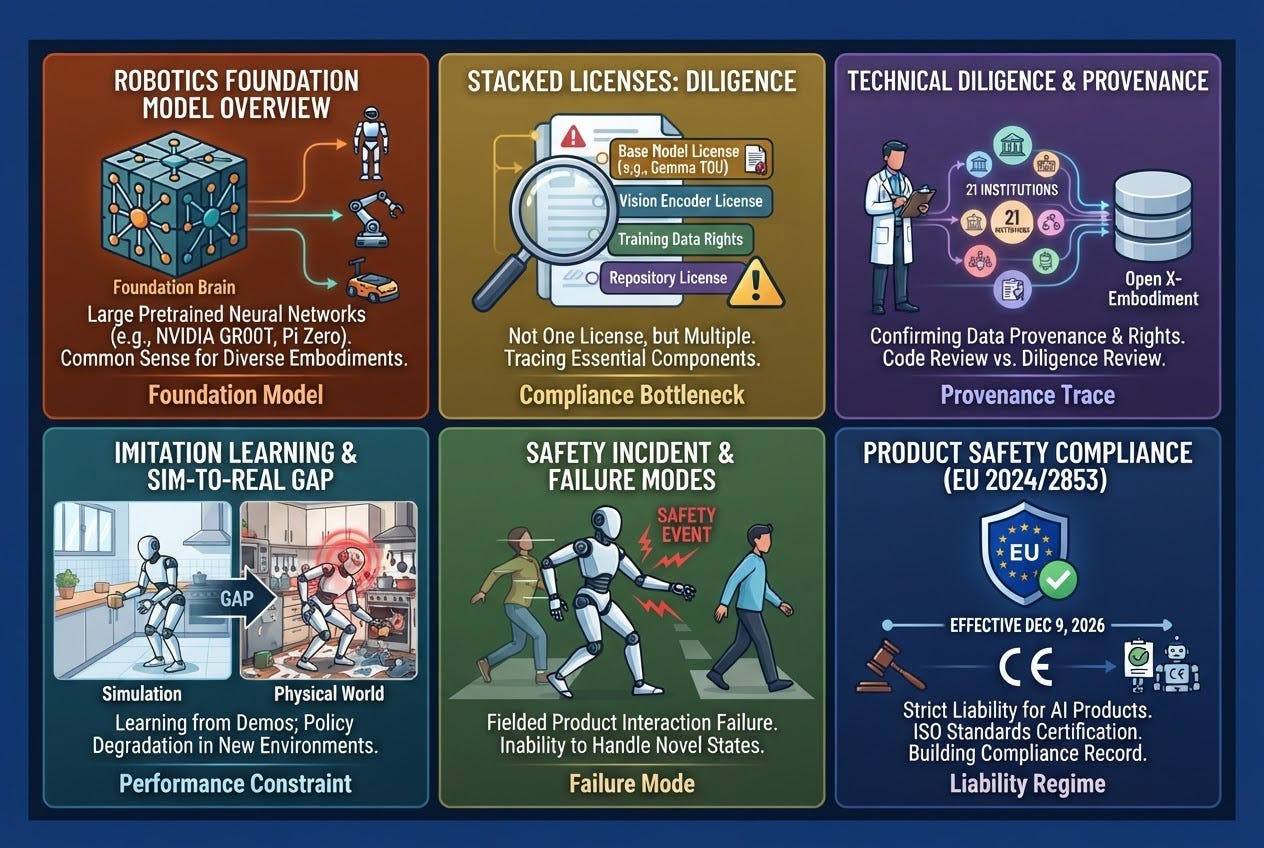
Open Source Robot Models Carry Licensing Risk
Description
A humanoid robot startup that fine tunes Physical Intelligence’s pi zero checkpoint for a customer pilot is not running one open source license. It is running at least three: Physical Intelligence’s own Apache 2.0 terms on the training code, Google’s Gemma Terms of Use on the language model buried inside the checkpoint, and, if that startup ever ships the fine tuned weights to a customer instead of only running them as a service, a redistribution question that neither company’s documentation answers cleanly. Nobody reads a stack of three licenses before a demo day pitch. Somebody has to read all three before a term sheet closes, and by the time most founders learn that, they have already built a product roadmap on top of a checkpoint they do not fully own the right to ship.
IEEE Spectrum asked in 2026 whether open source AI models were giving robotics its own ChatGPT moment. Its own reporting, and a companion piece on the open source robotics stack building up around Hugging Face’s LeRobot library, NVIDIA’s Isaac platform, and a wave of Chinese releases including Alibaba’s RynnBrain and X Square Robot’s embodied AI stack, gives a firm answer to a narrower question: the training data and the released checkpoints have reached a size that makes fine tuning a viable path to a commercial prototype for a team that could never have collected that data itself. Hugging Face’s own dataset count for robotics grew from 1,145 entries at the end of 2024 to more than 58,000 within about a year. The Open X-Embodiment corpus behind much of that growth spans 22 robot embodiments and 21 research institutions, 527 skills, and 160,266 recorded tasks. That is a real inflection in what a small team can build on. It is not evidence that the legal terms attached to that data have caught up with its scale.
NVIDIA’s own license is instructive because it gets the headline right and buries the trap in the footnotes. The NVIDIA Open Model License Agreement grants a broad, commercially usable right to its Isaac GR00T models, no charge, no royalty, redistribution permitted with attribution. Read past the grant and two clauses do the real work. First, the license terminates automatically if a licensee disables or impairs the model’s safety guardrails, a standard that public developer discussion around the GR00T release in 2025 showed even NVIDIA’s own user community struggling to apply consistently to specific checkpoint variants. Second, the license requires the licensee to indemnify NVIDIA against third party claims arising from the licensee’s own use, an allocation of risk that runs the opposite direction from what most engineering teams assume when they see the words open and free attached to a model release.
Physical Intelligence’s structure is a different trap built the same way. The openpi repository is Apache 2.0, about as permissive as software licensing gets. But the pi zero checkpoint pairs that permissive wrapper with Google’s Gemma language model as its reasoning backbone, and Gemma comes with its own Terms of Use and a Prohibited Use Policy that restricts automated decision making in domains affecting individual rights or well being. A robot that assists in a warehouse is probably fine. A robot whose foundation model makes decisions that touch employment, housing, insurance, or healthcare access, even as one function among several, is now reading the Gemma policy’s language, not the Apache license a due diligence checklist would have flagged first.
None of this sits still. Directive (EU) 2024/2853 takes effect on December 9, 2026 and folds software and AI systems into the European Union’s strict product liability regime, meaning a claimant will need to show only a defect, damage, and a causal link, not negligence, and the directive’s open source exemption reaches only software distributed without a commercial purpose. A founder shipping a commercial robot into Europe on a free foundation model checkpoint gets no shelte