Episode Details
Back to Episodes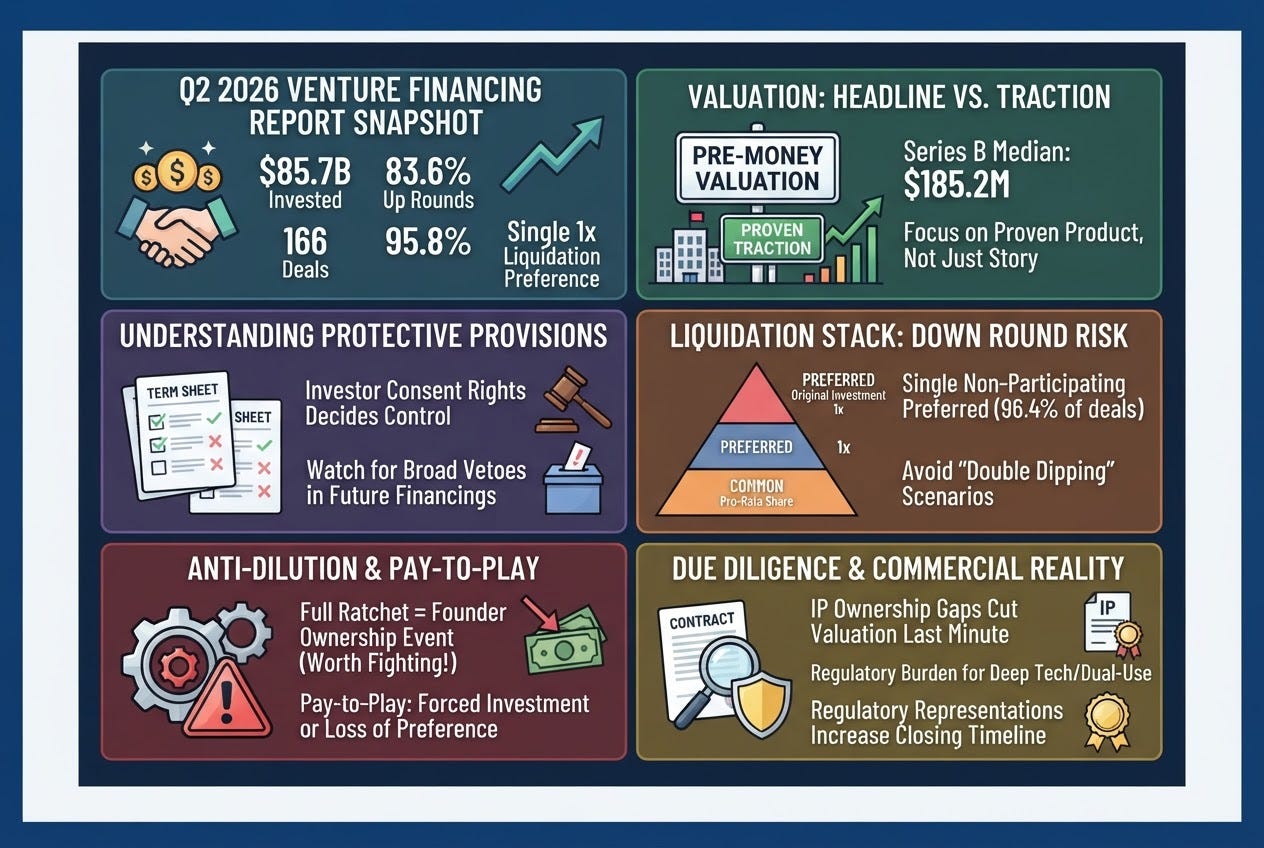
Venture Capital Hit $85.7 Billion
Description
Venture investors put $85.7 billion into 166 deals in the second quarter of 2026, and the next priced round should close as an up round with a single liquidation preference. That single, non participating structure now holds for most companies raising capital this year, not for the largest names alone.
The mechanic most founders miss is not the price on the term sheet’s cover page. It is the future financings protective provision buried three pages in, the clause that lets a single existing investor block a later round the company has not yet priced, drafted broadly enough to cover any new series of stock rather than only a series senior to the one that investor already holds. A founder who reads that clause as boilerplate has already given away the leverage the next financing will need.
Start with what the headline number actually says. Up rounds held at 83.6 percent of surveyed deals, down rounds rose to 12.1 percent and flat rounds to 4.3 percent, and the Series B median pre money valuation climbed from $152.5 million to $185.2 million in a single quarter, a 21 percent jump. Forty eight percent of all surveyed deals closed above $100 million, up from 41 percent the prior quarter. That is a market paying up for traction, not a market repricing every stage of company at once.
The reported Series D and later median told a stranger story, falling from $2.4 billion to $600 million in the same quarter. A sample that small moves on a handful of financings rather than a trend, so a founder preparing a late stage round should build a comparable set from named, completed transactions in its own sector rather than trust a single quarterly median that can swing by billions of dollars.
The average check size across the quarter works out to roughly $516 million, and technology sector deals alone averaged closer to $778 million across 95 financings, against roughly $41 million across 27 life sciences deals. That is not one capital market. It is two, running side by side, and a founder outside the small group commanding nine figure checks should plan around the deal count, 166 in a single quarter, not the headline dollar figure.
Now to the terms that actually decide who controls the company. A single, one times liquidation preference appeared in 95.8 percent of deals and non participating preferred stock in 96.4 percent, the friendliest structural mix for common stockholders in several years. Broad based weighted average anti dilution, which adjusts the conversion price using a formula tied to total shares outstanding, is close enough to a market standard that a founder’s counsel should accept it without extended negotiation and spend that negotiating capital elsewhere.
Full ratchet anti dilution is where that capital belongs. It resets an earlier round’s entire conversion price to match a later, lower priced round regardless of how many shares the later round issues, and it can turn a modest down round into a founder ownership event that erases ten percent or more of the capitalization table in a single financing. No founder should sign a term sheet carrying full ratchet anti dilution without first running the actual capitalization table math against a realistic exit range.
Pay to play is the term moving fastest against founders, covering 8.4 percent of deals this quarter, up from 7 percent the quarter before. It forces every existing preferred stockholder to buy its full pro rata share of a new round or suffer mandatory conversion to common, stripping away the liquidation preference, the protective provisions and often the board seat that came with the original investment. In re Trados Inc. Shareholder Litigation, decided by the Delaware Court of Chancery in 2013, held that a board composed largely of preferred designated directors did not breach its fiduciary duty by approving a sale that paid the preferred stockholders in full and left the common stockholders with nothing, because the board’