Episode Details
Back to Episodes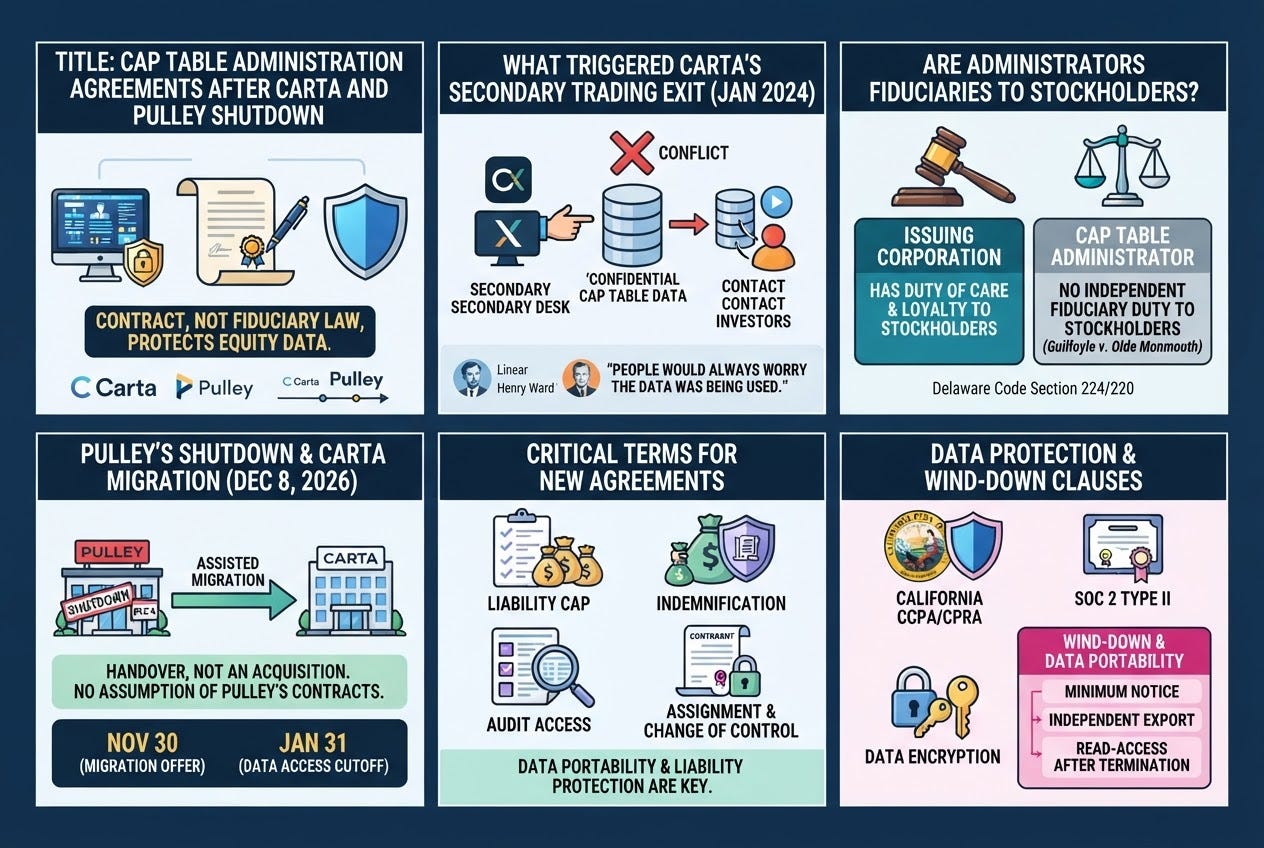
Shutdown Forces New Cap Table Agreement Terms
Description
Pulley told its customers on September 16, 2026, that it would shut down entirely on December 8. Yin Wu, the company’s founder, posted that the closing of one chapter would not be the end of her team’s ambitions, and offered no account of why a company that raised more than fifty million dollars from General Catalyst, Stripe, and Founders Fund could not survive against Carta, the rival it was built to challenge. The customers left holding equity records on a platform with a countdown clock got something more useful than an explanation: a forced negotiation.
That negotiation is not a renewal. A Dealroom.co reporting note on the shutdown makes the point plainly: Carta is absorbing Pulley’s customer base, but no buyer has inherited Pulley’s contracts or its obligations. Every company migrating off Pulley is signing a new agreement, from whatever position it can still occupy before the November 30, 2026 discount deadline closes and before Pulley’s own data access narrows on January 31, 2027. A new agreement is a chance to fix the terms the last two years exposed as missing.
Start with the conflict Carta itself created and then resolved. On January 7, 2024, Linear’s chief executive Karri Saarinen reported that a Carta representative had contacted a family member investor, whose Linear holdings were never public, with an unsolicited offer to buy shares through CartaX, Carta’s secondary trading marketplace. Reporting at the time found similar unsolicited outreach touching Airtable, Deel, Navan, Brex, and Flexport, several of them companies whose confidential cap table data Carta already held as their administrator. Chief executive Henry Ward closed CartaX within a day of the story breaking and wrote the sentence that should sit on every founder’s desk during a vendor review: because Carta had the data, he said, people would always worry the data was being used even when it was not. Carta gave up an estimated three million dollars a year in secondary trading revenue to protect the far larger cap table business, a trade that only made sense because the conflict was structural, not a matter of one employee’s judgment.
Reported developments through 2026 describe Ward pushing back toward a secondary marketplace, this time under what sources describe as a more compliant regulatory structure, with several senior hires carrying financial services regulatory backgrounds. No public SEC or FINRA action confirms what that structure actually requires, which means the company signing a fresh agreement with Carta during the Pulley migration may be negotiating with a vendor rebuilding the exact business line that produced the 2024 scandal.
Here is the part most founders get wrong: none of this is protected by fiduciary law. Section 224 of Title 8 of the Delaware Code lets a corporation keep its stock ledger on an electronic system a third party administers, but the statute leaves the corporation itself responsible for producing a legible record on demand. Section 220 gives a stockholder the right to inspect the corporation’s books, a right that runs against the company, not against Carta. At the federal level, Section 17A of the Securities Exchange Act of 1934 and the transfer agent rules the SEC adopted under it register Carta as a transfer agent, a relationship between Carta and the Commission with the issuer as client, not a duty owed to individual shareholders. The Nevada Supreme Court closed the door further in Guilfoyle v. Olde Monmouth Stock Transfer Co., holding in 2014 that a transfer agent’s obligations track its statutory duty to process a submitted transfer request and nothing broader. A federal court reached a similar split result five years later in Shaw v. Empire Stock Transfer Inc., letting a narrow statutory claim over a restrictive legend proceed while dismissing the plaintiff’s fiduciary and unjust enrichment theories outright. Both cases draw the same line: a specific statutory duty survives, a general