Episode Details
Back to Episodes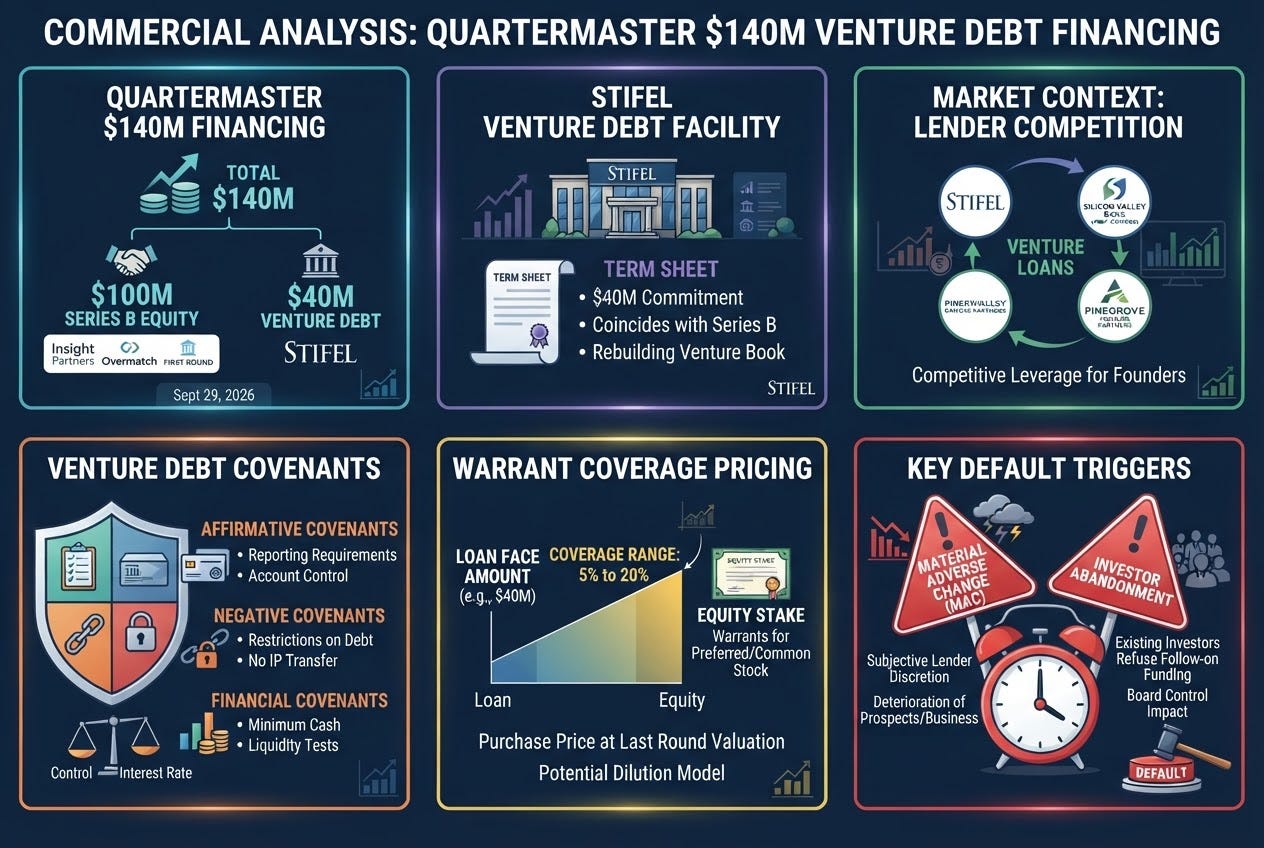
The Price of Venture Debt After Silicon Valley Bank
Description
Stifel arranged a $40 million venture debt facility for Quartermaster on September 29, 2026, the same week the maritime intelligence company closed a $100 million Series B led by Insight Partners, and the pairing previews exactly the covenant and warrant terms a company should expect to negotiate the next time it layers debt onto an equity round. The debt equaled 40 percent of the equity tranche, a common ratio, but the covenant package behind that number is where a founder either protects the business or hands a lender leverage the company will regret needing in year three of a five year term.
Here is the mechanic most founders miss: a venture debt term sheet prices risk two ways at once, through the interest rate and through warrant coverage, and a founder who negotiates only the rate has negotiated half the deal. Warrant coverage on a facility Quartermaster’s size, at the 5 to 20 percent of loan value that is standard in this market, works out to a warrant position worth $2 million to $8 million at the round’s own valuation, exercisable for up to 12 years and occasionally 15. That warrant costs the company nothing in cash today and appears nowhere on the term sheet’s front page, which is exactly why it gets underweighted in negotiation while the interest rate gets fought over line by line.
Silicon Valley Bank failed in March 2023, and three years of competition to replace it has reshaped what a company can now negotiate. HSBC hired more than 40 former Silicon Valley Bank bankers within weeks of the collapse, while Brex, Mercury, and Arc built venture banking products aimed at smaller companies. None of them fully replaced Silicon Valley Bank’s role in venture lending. Stifel built a venture banking book toward $12 billion in commitments instead, and Katya Kohen, the managing director who leads that group, calls the approach venture banking 3.0: human relationships paired with the digital tools founders now expect, plus a path into treasury services, wealth management, and investment banking as a company matures past its first debt facility. Silicon Valley Bank itself, absorbed into First Citizens BancShares, has been earning back the trust it lost: Marc Cadieux, the bank’s commercial banking president, cut the minimum share of a borrower’s deposits the bank requires from 80 percent to 50 percent and raised the runway a new venture debt applicant must show from about 12 months to about 18. In March 2025, Silicon Valley Bank and Pinegrove Venture Partners, which had bought SVB Capital the year before, committed $2.5 billion in new venture debt to deploy together, on top of more than $10 billion in loans the two organizations had already placed across 550 deals.
A company sitting between three well funded lenders chasing the same mandate has a negotiating position most founders underestimate, and the place to spend it is on covenant language, not on the interest rate. Financial covenants split into two families in this market. A lighter package, priced around prime plus 3 to 4 percentage points, carries little more than a minimum cash test. A heavier package, priced a few points cheaper, adds debt to EBITDA ratios, interest coverage tests, or minimum revenue thresholds that a company still building distribution, the way Quartermaster is building out its sensor network across 650 vessels in 25 countries, will trip on schedule rather than by surprise. A savings on the coupon is rarely worth a covenant a company is going to breach within eighteen months.
Two default triggers do more damage than a missed payment ever will. A material adverse change clause lets a lender call the loan on its own reading of the company’s prospects, language loose enough to cover a soft quarter, a bad news cycle, or a slower fundraising market. An investor abandonment clause lets the lender call the loan if the company’s own investors decline to fund a round the company needs to keep paying the debt, handing an outside bank