Episode Details
Back to Episodes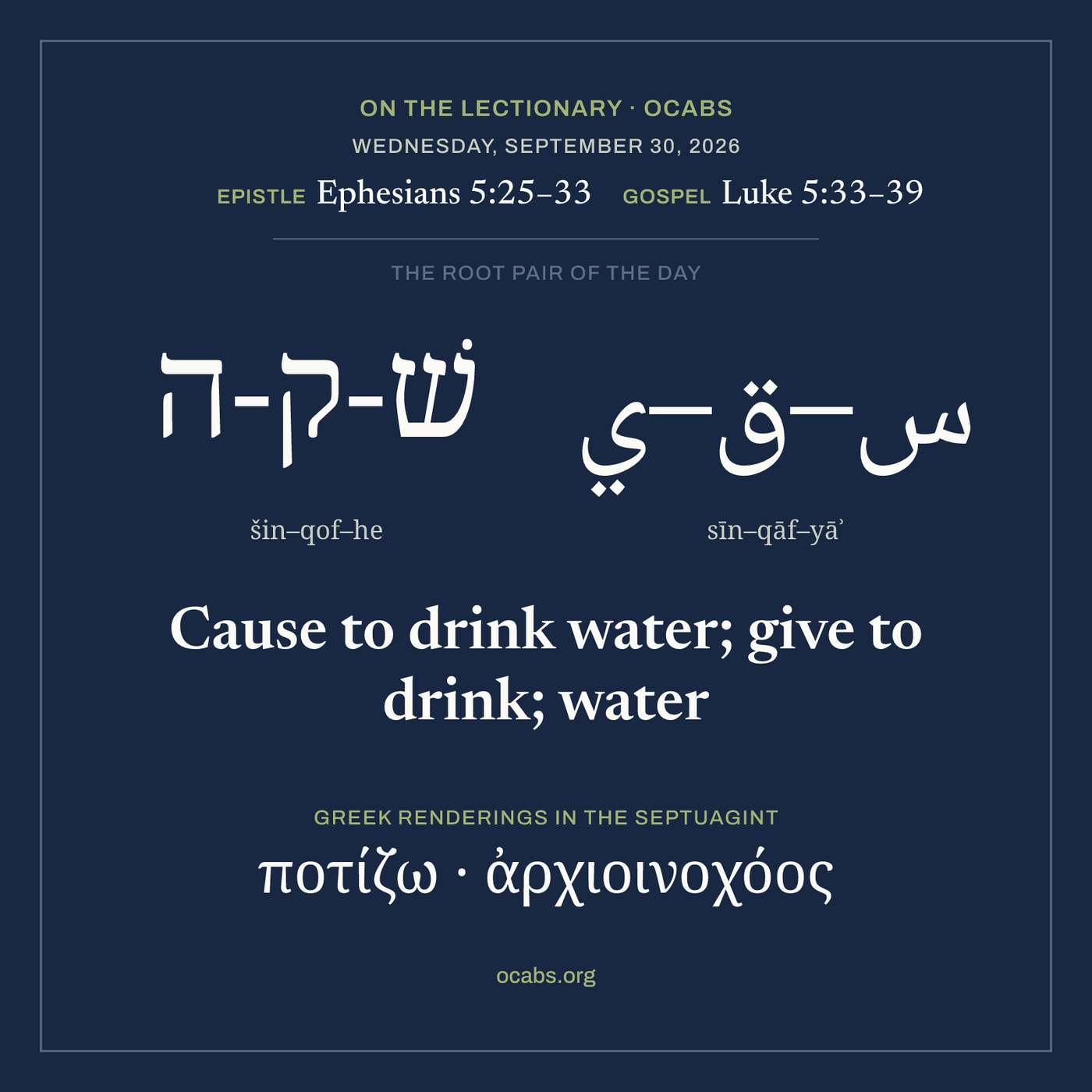
Ephesians 5:25-33 · Luke 5:33-39 — Wednesday, September 30, 2026
Description
A daily note from the team at OCABS.ORG, drawing on the published works of Fr. Paul Nadim Tarazi, with citations to his books and lectures.
Readings: Ephesians 5:25-33; Luke 5:33-39.
Paul's charge that husbands love their wives as Christ loved the assembly rests on picturing the church as Christ's bride, "cleansed by the washing of water with the" word, so that she may be presented without spot or wrinkle. Fr. Paul, commenting on this same verse from his Corinthians volume, insists that this cleansing is verbal rather than merely ritual water: as he puts it elsewhere, "the water is just the expression of the ablution" of the word. He also warns against the classical assumption that the bride-church is automatically pure while her members stay sinful; rather the church "is coextensive with its members who remain" called until judgment, when only a few are chosen. The same bridal figure, he notes, appears in letters that resist gnostic blurring of male and female, where marriage instead "liken[s] the relationship between Christ the redeemer and the church to a marriage." This household teaching sits inside the letter's larger frame of love, opened earlier by the call to "walk in love, as Christ loved us and gave himself up for us."
The same cleansing-by-word pattern surfaces in John's vine discourse, where the disciples are told they are clean "by the word which I have spoken to you," a phrase Fr. Paul links directly to Ephesians 5:25-27 as stating the same reality found across the corpus.
Luke's question about fasting turns on the bridegroom's presence: Fr. Paul observes that so long as the bridegroom sits at table, "we eat with anyone, with everyone," and only his removal brings fasting back. The parable of new wine and fresh skins that follows uses the rare verb rendered "must be thrown," the only such form in the New Testament, marking the necessity of a new container for the new reality. Fr. Paul connects this bridegroom language forward to the wedding at Cana, "where the bridegroom ultimately is Jesus, because he takes center place," and to Revelation's marriage imagery, since "Paul was the first to use this analogy" before it entered the Gospels as parable. He also notes that Luke's phrase "the days will come" recurs only once more in the Gospel, at 21:6, linking the bridegroom's absence to the same coming judgment.
The root pair of the day · שׁ-ק-ה šin–qof–he, שָׁקָה šaqah · س–ق–ي sīn–qāf–yāʾ, سَقَى saqā · cause to drink water; give to drink; water. Sāqāh and saqā gloss 'to give water to drink,' the same field as Luke's charge that Jesus' disciples 'eat and drink' while the bridegroom sits at table. The Greek archioinochoos, 'chief wine taster,' echoes the wine imagery that follows in the parable of new wine and old skins, tying drinking to the note's stress on feasting so long as the bridegroom remains. cf. The Consolation of Consonants
Sources: Tarazi, 2 Corinthians: A Commentary, p. 195; Tarazi, The New Testament: An Introduction, vol. 3, Johannine Writings, p. 225; Orthodox Audio Bible Commentary, Luke (vol. 42), part 1, at 1:19:52; Tarazi, Galatians: A Commentary, p. 176; Tarazi, Ephesians and 2 Thessalonians: A Commentary, p. 92; Orthodox Audio Bible Commentary, Luke (vol. 42), part 1, at 2:01:39; Orthodox Audio Bible Commentary, Luke (vol. 42), part 1, at 2:03:49; Tarazi, The Pastorals: A Commentary, p. 139; Tarazi, The New Testament: An Introduction, vol. 3, Johannine Writings, p. 111; Tarazi, The New Testament: An Introduction, vol. 2, Luke and Acts, “Further Debate and Final Denouncement (41–47)”.
Opening music: Taksim Arbi, Bichi Slama, oud (Tunis, Archives de la Parole, 1930s), public domain. Source: gallica.bnf.fr / BnF.