Episode Details
Back to Episodes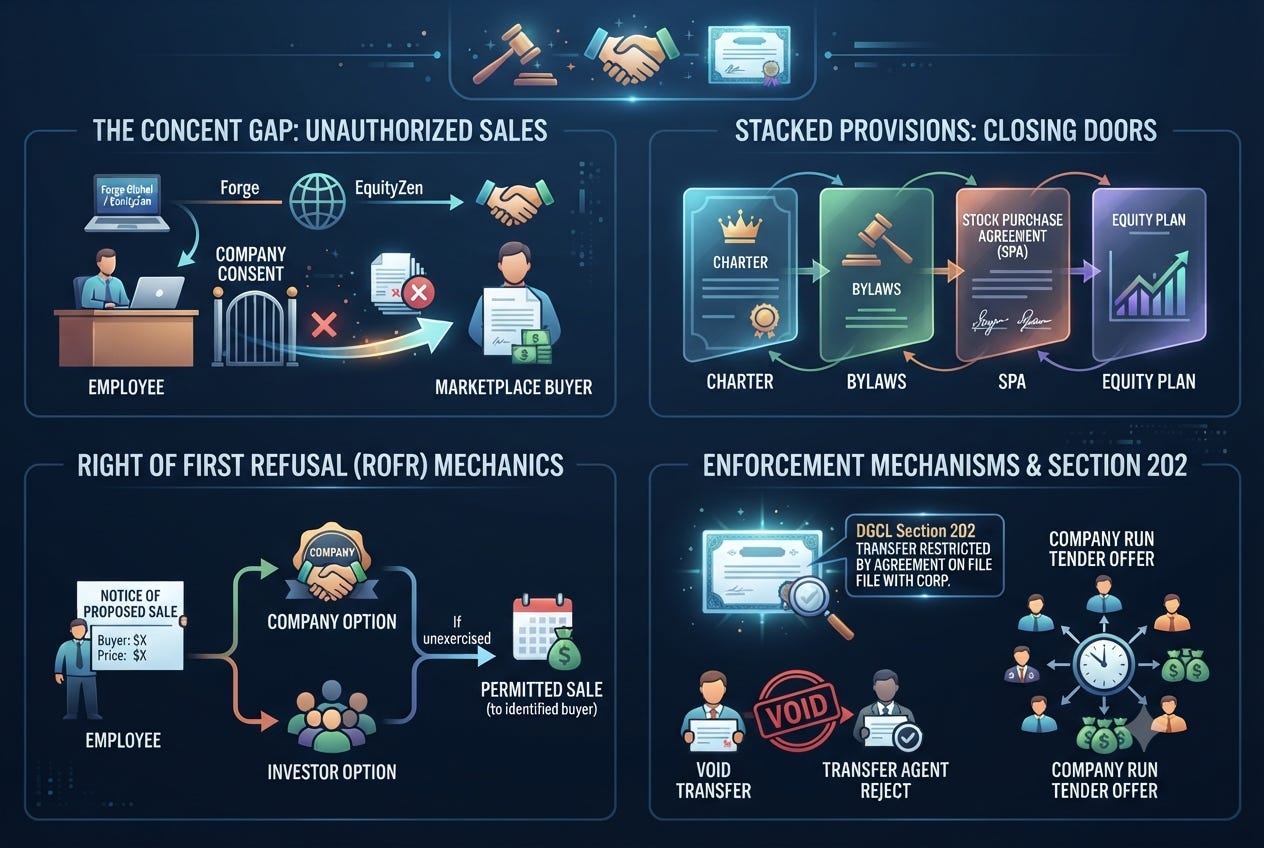
How To Stop Employees Selling Stock On Secondary Marketplaces
Description
A startup stops an employee’s unconsented sale on Forge Global or EquityZen only with a Delaware Section 202 compliant transfer legend and a right of first refusal. That legend, not the underlying contract alone, is what binds a marketplace buyer who never signed anything, together with a consent clause in the bylaws and a matching restriction in every option agreement the equity plan has ever generated.
Most cap tables carry exactly one of those four pieces. A founder signs a stock purchase agreement at incorporation with a right of first refusal buried in section eight, the lawyer moves on to the next matter, and nobody circles back when the company adopts an option plan two years later or issues a new class of preferred stock two years after that. The restriction that looked complete on the day it was signed now covers a fraction of the capitalization table, and the fraction shrinks every time someone exercises an option under a plan that never repeated the language.
I have sat across the table from a general counsel who learned, three days after the wire cleared, that a departed engineer had already sold shares to a marketplace buyer, because the only transfer restriction anywhere in the company’s paper lived in a 2019 purchase agreement that nobody had ever printed onto a certificate. The company had a contract claim against a former employee it could not locate. It had nothing against the buyer.
Delaware General Corporation Law Section 202 explains why. The statute lets a corporation write a right of first refusal, a consent requirement, or an outright transfer prohibition into its governing documents, and it lists those categories without much room for argument. What it does not forgive is a restriction nobody wrote down where a buyer would see it. Section 202 binds a purchaser without actual knowledge of a restriction only if that restriction is noted conspicuously on the certificate or, for book entry shares, stated in the notice required under Section 151(f). A right of first refusal that exists only in a stock purchase agreement the marketplace buyer never read is a promise between the company and the seller. It is not a restriction that travels with the stock.
The Delaware Supreme Court came close to testing that boundary in Manti Holdings, LLC v. Authentix Acquisition Co. in September 2021. The court enforced a stockholders agreement clause waiving appraisal rights against the stockholders who had actually signed it, on the theory that sophisticated, counseled parties can bargain away a statutory right. The opinion stopped there. It did not decide whether that same obligation would have bound someone who acquired the stock later without signing anything, because the case did not require the court to reach it. A general counsel who reads only the headline of that decision, and concludes that Delaware will enforce any transfer restriction against anyone who ends up holding the stock, is reading past the part of the opinion that actually matters.
Building the right of first refusal correctly starts with the notice trigger. The market standard right of first refusal and co-sale structure used across venture financings requires the selling stockholder to notify the company and the investor parties of a proposed transfer, naming the buyer, the price, and the terms, before any transfer occurs, and gives the company a window, typically thirty to sixty days, to exercise. That window has to fire the moment a term sheet is signed with a marketplace buyer, not after the platform has already matched funds to shares, because a right that only activates after money has moved is a right to sue somebody, not a right to stop a sale. The agreement should also say plainly that a transfer made in violation of the right of first refusal is void, not merely voidable, since a transfer agent processing paperwork has no independent duty to investigate whether a breach occurred.
None of that reaches sh