Episode Details
Back to Episodes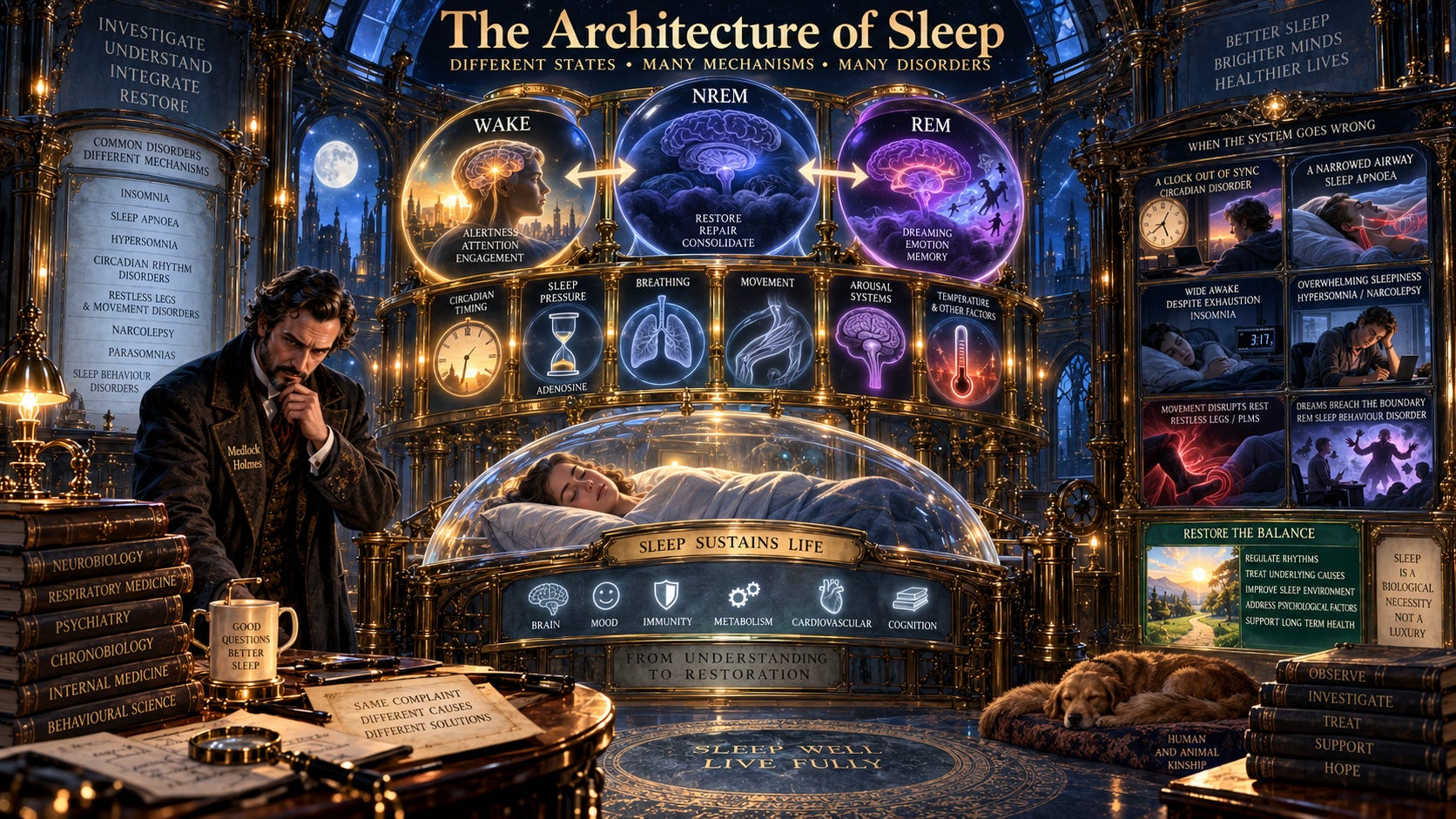
PSYCH 136: Sleep Disorders
Description
Sleep disorders arise when the mechanisms controlling sleep quantity, timing, breathing, movement, arousal or dream-state boundaries become disrupted - and the consequences can range from chronic distress to accidents, cardiovascular disease and major functional impairment.
Medlock Holmes enters an immense Neo-Victorian institution called The Grand Observatory of Sleep and Wakefulness.
At first glance, the building appears quiet.
But Holmes quickly realises that nothing is truly inactive.
Behind the walls, electrical signals rise and fall.
Eyes move beneath closed lids.
Muscles alternate between tone and near-paralysis.
Breathing changes.
Body temperature cycles.
Hormones oscillate.
The brain repeatedly travels through distinct states of consciousness.
Above the entrance is engraved:
“Sleep is not one state. Sleep is a sequence of states.”
The chapter begins with three fundamental principles.
First:
SLEEP IS REQUIRED FOR NORMAL BRAIN FUNCTION.
Sleep deprivation impairs:
* attention
* memory
* reasoning
* mood regulation
* physiological function.
Second:
SLEEP IS NOT A SINGLE PROCESS.
Different forms of sleep have distinct:
* physiology
* functions
* neural regulation.
Deprivation of a particular sleep stage may produce selective rebound when sleep is later permitted.
Third:
SLEEP IS ACTIVE.
Certain sleep states involve substantial cerebral activation and metabolism rather than global neural shutdown.
Holmes enters the Classification Hall.
Three enormous books stand open:
DSM-5-TR
ICSD-3
ICD
Each classifies sleep disorders somewhat differently.
The most detailed map comes from the International Classification of Sleep Disorders, which divides the field into major families:
INSOMNIA
SLEEP-RELATED BREATHING DISORDERS
CENTRAL DISORDERS OF HYPERSOMNOLENCE
CIRCADIAN RHYTHM SLEEP–WAKE DISORDERS
PARASOMNIAS
SLEEP-RELATED MOVEMENT DISORDERS
Holmes begins with the chamber most familiar to psychiatry:
INSOMNIA
The old model says:
“Find the psychiatric disorder causing the insomnia and treat that.”
The modern model is different.
Insomnia can become an independent disorder, even when originally triggered by:
* depression
* anxiety
* pain
* environmental disruption
* another medical illness.
The precipitating factor may disappear while insomnia remains.
A bedroom becomes conditioned with:
frustration
clock-watching
effort
fear of not sleeping
The bed itself becomes a cue for arousal.
Holmes sees the paradox:
THE HARDER THE PERSON TRIES TO SLEEP, THE MORE AWAKE THEY BECOME.
Psychophysiological insomnia therefore resembles performance anxiety.
The person may lie awake in their own bed but fall asleep unexpectedly while watching television or sleep better in an unfamiliar hotel room.
Another chamber is labelled:
PARADOXICAL INSOMNIA
Here subjective and objective sleep diverge.
A person insists:
“I did not sleep at all.”
Yet polysomnography shows:
* normal sleep onset
* few awakenings
* high sleep efficiency
* several hours of sleep.
The chapter warns clinicians not to dismiss this as fabrication.
Sleep-state perception and electrophysiological sleep can genuinely b