Episode Details
Back to Episodes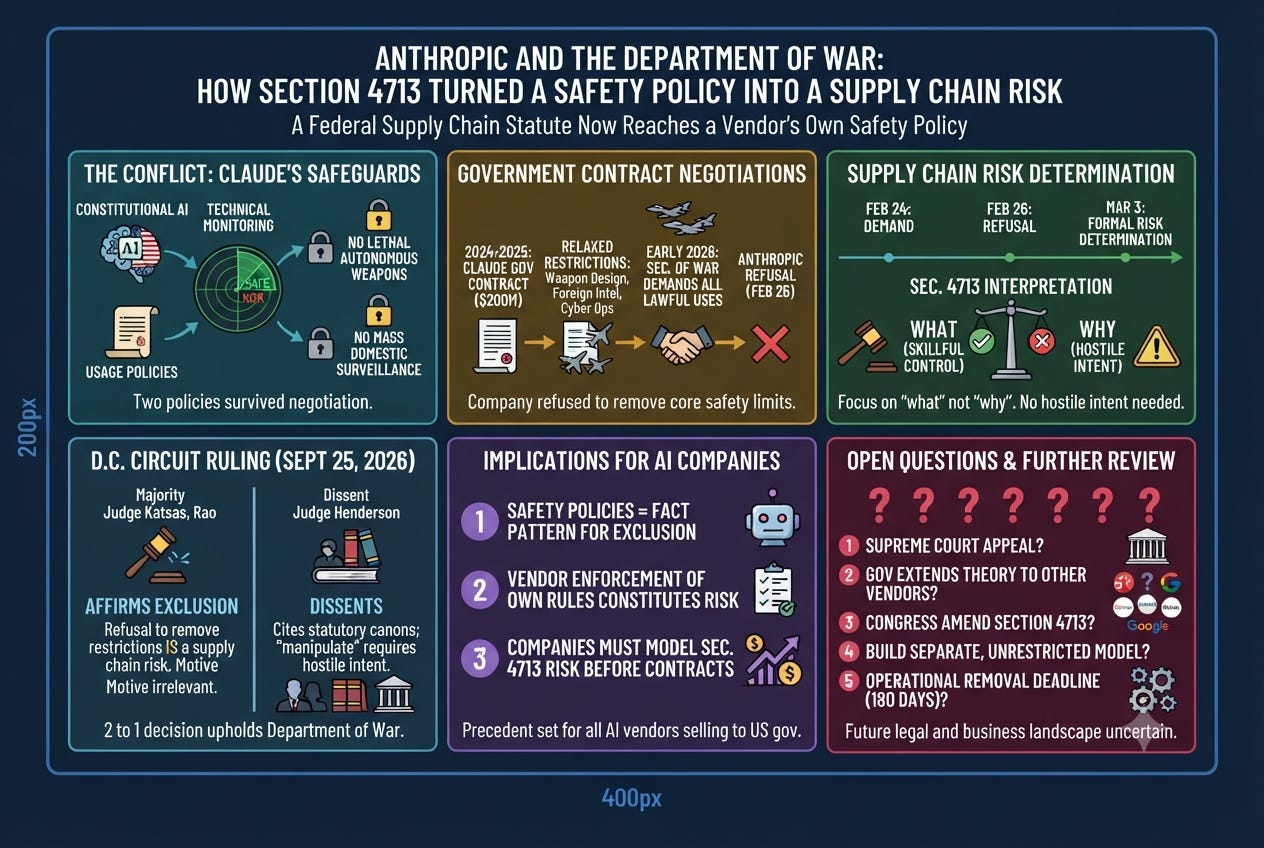
Anthropic Ruled a Supply Chain Risk by D.C. Appeals Court
Description
Inside the D.C. Circuit ruling that lets Section 4713 treat Anthropic’s autonomous weapons and surveillance limits as reasons to exclude it from federal contracts.
A company can now lose eligibility for federal contracts specifically because it refused to let its own artificial intelligence system fight autonomously or spy on Americans. On September 25, 2026, the D.C. Circuit upheld the Department of War’s exclusion of Anthropic from the federal supply chain under Section 4713 of the Federal Acquisition Supply Chain Security Act, a statute Congress built in 2018 for foreign hardware laced with hidden sabotage, not for a domestic vendor’s own safety commitments. The 2 to 1 ruling in Anthropic PBC v. Department of War means Anthropic cannot sell Claude to the federal government, and it means every AI company holding a government contract now has to treat its published use restrictions as evidence a procurement officer can use against it.
Anthropic did not refuse the government wholesale. The company had already agreed to loosen Claude’s restrictions for weapon design, foreign intelligence analysis, and offensive cyber operations through a government specific product called Claude Gov, work that helped it land a two hundred million dollar contract with the Department in 2024 and 2025. Two restrictions never moved: a prohibition on fully autonomous lethal weapons, meaning no human in the loop, and a prohibition on using Claude for mass surveillance of Americans. Chief executive Dario Amodei later wrote that the surveillance limit guards against serious and novel risks to civil liberties and that the weapons limit reflects a judgment that the technology is not yet reliable enough for autonomous lethal use.
The relationship broke in five weeks. In January 2026, an Anthropic executive questioned whether Claude had been used in what the court’s opinion describes only as a sensitive military operation abroad, later reported to be the operation to capture Venezuelan President Nicolas Maduro. The Department’s Under Secretary said the episode raised material doubts about whether Anthropic’s software would keep functioning when it mattered most. On February 24, the Secretary of War met with Amodei and demanded a contract term covering all lawful government uses by February 27. Amodei refused publicly on February 26. The Secretary issued a formal written determination on March 3 that Claude posed a significant supply chain risk, and the Department ordered Claude removed from operational use within one hundred eighty days.
Anthropic petitioned the D.C. Circuit within days, the only forum Section 4713 allows, and lost. Judge Gregory Katsas, writing for himself and Judge Neomi Rao, read the statute on its own terms: a supply chain risk turns on what a contractor does to a covered system, not why. To manipulate an article, the majority held, means to skillfully control or arrange it, regardless of purpose or motive, and Anthropic’s own chief science officer had told the court the company seeks to embed safety considerations directly into the model itself. That admission, framed as a description of responsible engineering, became the factual basis for a finding of risk. The majority also rejected Anthropic’s First Amendment claim, holding that the Department removed the company not because of its public advocacy but because it refused a contract term the Department deemed essential to national security.
Judge Karen Henderson dissented, and her disagreement turns on one word. She read manipulate the way a court reads any word grouped with sabotage and malicious data extraction, as carrying an implicit requirement of hostile or deceptive intent, the same principle a library invokes when it bans patrons from talking loudly on the phone, playing music, or otherwise disturbing others: the word loudly governs the whole list. Weeks earlier, a federal judge in the Northern District of California had set aside a related e