Episode Details
Back to Episodes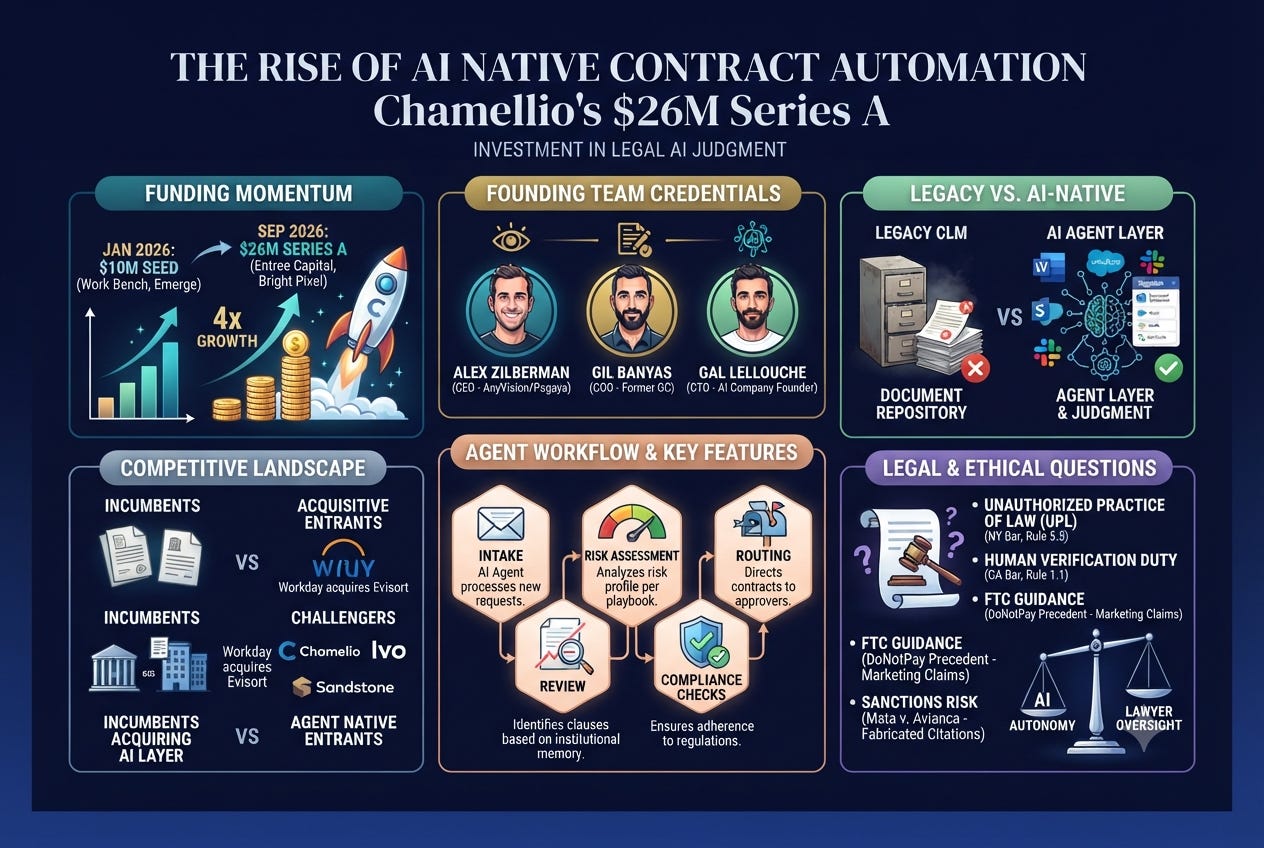
Chamelio’s $26 Million Series A Bets on AI Contract Automation
Description
On September 22, 2026, an Israeli founded legal technology company most in house counsel had never heard of a year earlier raised $26 million to convince corporate legal departments that a piece of software, not a first year associate, should redline their next vendor contract. Entree Capital led the round. Work Bench, Emerge Ventures, and Bright Pixel Capital, the technology investment arm of Portugal’s Sonae Group, joined in. Eight months earlier, the same company, Chamelio, had closed only a $10 million seed round. Its chief executive, Alex Zilberman, framed the bet plainly: the mistake in legal artificial intelligence has been assuming the future simply looks like today’s lawyer with faster fact checking.
That framing matters more than it sounds. Chamelio is not selling a faster search box over a contract repository, which is what most contract lifecycle management software has been since the category emerged two decades ago. It is selling agents: separate processes that handle intake, assess risk, route a document to the right approver, review its terms against a company’s own playbook, and check it against compliance requirements, largely without a person touching each transaction. A feature called Negotiate works inside Microsoft Word itself, redlining incoming paper using a company’s own negotiation history rather than a generic template. The platform reaches into Salesforce, Slack, and NetSuite so a contract moves through approval the way an email would, except nobody has to forward it.
Founder Gil Banyas spent fifteen years in house, including a stint as general counsel at the computer vision company AnyVision, where chief executive Zilberman also served as chief operating officer before a leadership role at Pagaya. That is not a detail for a company biography. It means the product’s central design choice, letting an agent decide what counts as a deviation worth escalating, was made by someone who has personally carried the malpractice exposure of getting that judgment wrong.
The incumbents are responding the way large companies usually respond to a category they did not build: by buying it. Workday, primarily a human resources and finance platform, signed a definitive agreement on September 17, 2024, to acquire Evisort, an artificial intelligence native contract intelligence vendor, and folded it into a product now sold as Workday CLM. Icertis and Ironclad, the two platforms most in house lawyers already associate with contract management, have not made a comparable move at the same scale, leaving them to defend document repository strength against a wave of challengers, Chamelio among them, alongside named rivals such as Ivo and Sandstone, built around autonomous review from the first line of code.
Here is where the deal stops being a financing story and becomes a legal one. The American Bar Association’s Formal Opinion 512, issued July 29, 2024, requires a lawyer using generative artificial intelligence to independently verify its output, with the degree of verification tied to the specific task, and to obtain informed consent before feeding client information into a tool that learns from it. California has gone further. Following an August 22, 2025 directive from the state’s Supreme Court, the State Bar’s ethics committee approved amendments in March 2026 that would require a lawyer to independently review, verify, and exercise professional judgment on any artificial intelligence output, with no exception carved out for routine or high volume work. Applied to a platform that routes and approves contract terms across dozens of transactions at once, that rule does not plainly bend to scale. It asks for the same individual review of each output that the entire pitch is built to avoid.
New York’s State Bar Association has already drawn the sharper line. Its ethics committee found that a document review tool exercising legal judgment in determining which documents were relevant raises