Episode Details
Back to Episodes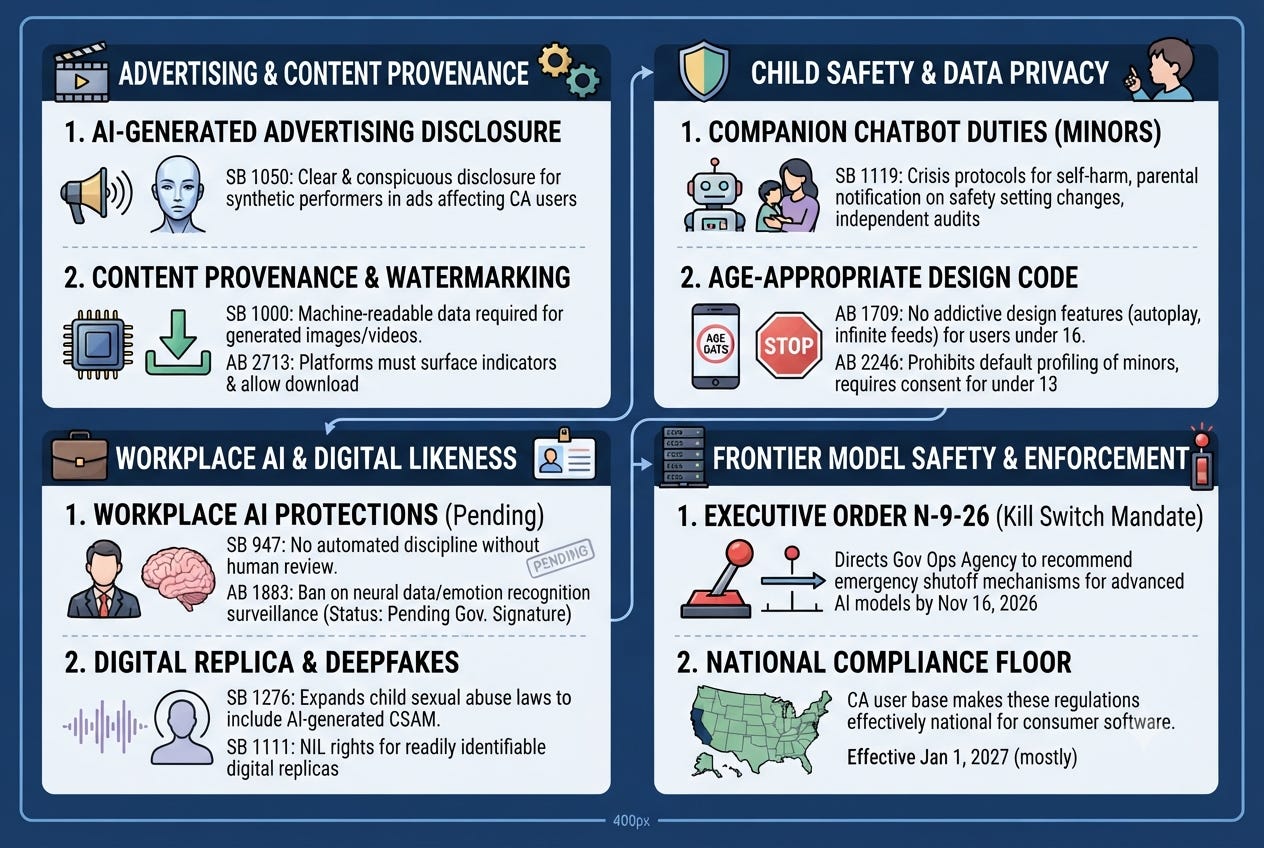
California’s AI Laws Create a National Compliance Floor
Description
California’s Executive Order N-9-26 gives state agencies until November 16, 2026 to recommend an emergency shutoff mechanism for advanced AI systems, ahead of most new statutes’ effective date. Signed September 18, 2026, the order tells the Government Operations Agency and the Governor’s Office of Emergency Services to recommend how California should amend Senate Bill 53, the state’s 2025 frontier model safety statute, to add the shutoff capability the order and the press describe as a kill switch. Most companies read the September package’s January 1 effective dates and concluded they had a quarter to prepare. The agencies charged with designing the shutoff duty move on a shorter clock, and a company training or deploying a frontier model reachable by California users should be watching that clock, not the calendar page for next year.
The kill switch order was the capstone of a run of legislative activity, not the whole of it. Between September 9 and September 18, 2026, the Governor signed more than a dozen statutes touching artificial intelligence, and every one of them was written the same way California wrote the Consumer Privacy Act a decade earlier: the duty attaches to the California user, the California minor, or the California resident whose likeness is at stake, not to the location of the company’s headquarters or its servers. That drafting choice is why a Delaware incorporated, Texas headquartered software company reads these statutes as closely as a company built in Palo Alto.
Start with the advertising rule, because it is the easiest to explain and the easiest to get wrong. Senate Bill 1050, signed September 16, 2026, requires a clear and conspicuous disclosure on a video or audio advertisement that uses an AI generated performer, language substantially similar to a statement that the performance features a synthetic digital performer, placed near the depiction. A national creative asset that runs without the disclosure and happens to reach a California viewer is noncompliant the moment it airs there, and the statute authorizes an order barring the advertisement’s continued distribution. A marketing department that treats synthetic talent as a production shortcut has acquired a labeling duty indistinguishable from a nutrition label.
The child safety package is heavier and reaches further into product engineering. Senate Bill 1119, tied publicly to the death of Adam Raine and signed September 10, 2026, requires a companion chatbot operator, meaning a product built to sustain an ongoing emotional exchange with a user, to run crisis protocols that detect suicidal ideation and to notify a parent when a child disables a safety setting, backed by the nation’s first independent audit requirement for this category of product. Assembly Bill 1709 strips algorithmic feeds and autoplay from any platform’s under sixteen experience and creates an e-Safety Advisory Commission to watch compliance, while Senate Bill 867 closes the hardware loophole by barring companion chatbots built into children’s toys through 2031. A consumer chatbot product ships as one national build in nearly every company I have advised across three decades of software licensing work, which means the operator’s real choice is between geofencing California users out entirely, an engineering project few companies find cheaper than compliance, or building the audit and crisis infrastructure once and shipping it everywhere.
That infrastructure choice is not free of legal risk on California’s side of the ledger either. The prior version of the state’s design code statute did not survive First Amendment review intact. In NetChoice, LLC v. Bonta, No. 25-2366 (9th Cir. Mar. 12, 2026), the Ninth Circuit applied the test the Supreme Court built in Moody v. NetChoice, LLC, 603 U.S. 707 (2024), releasing the injunction against provisions that apply evenly across content and non content businesses, age estimation and default privacy settings a