Episode Details
Back to Episodes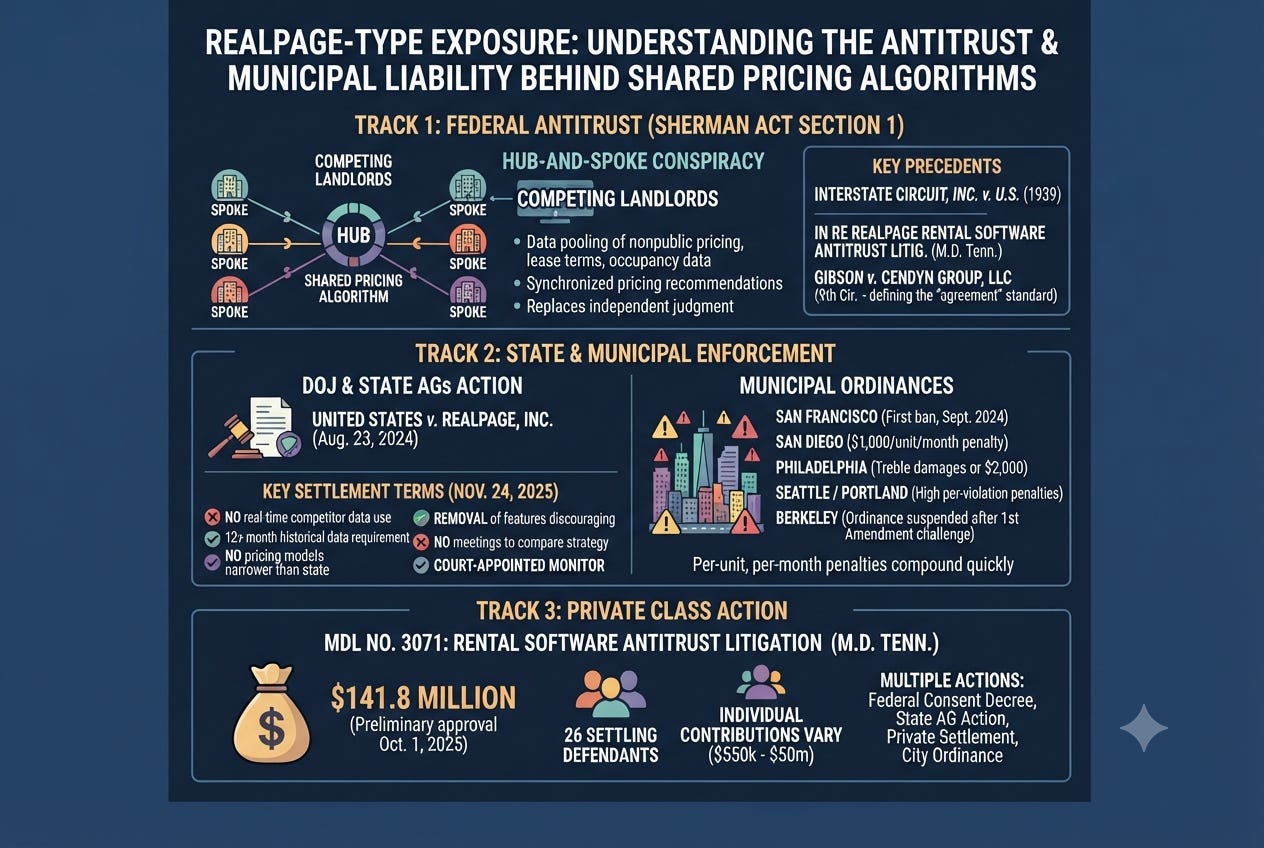
What Is Realpage Type Exposure For Landlords And Software Companies
Description
On November 24, 2025, the Department of Justice closed its case against RealPage, Inc. with a consent decree that tells every company running a shared pricing algorithm exactly what it can no longer do. Twenty-six defendants in the parallel private litigation had already agreed to pay $141.8 million to settle the same underlying conduct a month earlier. A company that built a software product around pooling customer data to improve a shared recommendation, in real estate or in any other industry, now has a compliance checklist instead of a hypothetical risk.
The theory behind the settlement traces back to Interstate Circuit, Inc. v. United States, decided by the Supreme Court in 1939, when a group of film distributors adopted identical exhibition terms after a single letter passed through one intermediary. Antitrust lawyers still call this the hub-and-spoke structure. A single actor sits at the center, spokes reach out to each competitor, and the rim forms when the competitors move in the same direction without ever having to speak to one another directly. RealPage played the role of hub for a large share of the multifamily housing market. Its software pulled nonpublic lease terms, occupancy rates, and future concessions from competing landlords, fed the pool into a pricing model, and returned a recommended rent for each unit. The Middle District of Tennessee let the resulting antitrust claims proceed in 2023, in the consolidated case now docketed as MDL No. 3071, because the complaint alleged both the data pooling and a documented rate of price acceptance among the landlords using the software.
I have redlined SaaS agreements for two years now solely to strip a clause letting a vendor pool one customer’s transaction data with other customers’ data to improve a shared recommendation engine, language that looked routine before RealPage. Clients in logistics, in healthcare staffing, and in short term rental management now ask whether their vendor’s algorithm quietly makes them a spoke in someone else’s conspiracy, the same question the multifamily industry did not ask early enough.
The consent decree, entered in United States v. RealPage, Inc., No. 1:24-cv-00710 in the Middle District of North Carolina, bars RealPage from using a competitor’s active lease data in real time pricing, requires that any historical competitor data used to train its models be aged at least twelve months, and forbids pricing models built at a geography narrower than the state level. RealPage must also remove features that discouraged landlords from lowering prices and stop hosting meetings where competing property managers compared pricing strategy. A court-appointed monitor will confirm compliance. Several of RealPage’s largest landlord customers, including Greystar Management Services, LLC and Cortland Management, LLC, settled the Sherman Act Section 1 and Section 2 claims against them rather than litigate whether adopting the algorithm’s recommendations counted as an agreement with every other landlord who did the same.
The private plaintiffs did not wait for the Department to finish. Twenty-six defendants in the consolidated case, In re RealPage, Inc., Rental Software Antitrust Litigation (No. II), MDL No. 3071 in the Middle District of Tennessee, reached a preliminary settlement of $141.8 million on October 1, 2025, with individual contributions ranging from $50 million down to $550,000 depending on how much of the market each landlord controlled. Cortland Management, LLC and William C. Smith and Company, Inc. also settled separately with the Department of Justice and the District of Columbia Attorney General on the same underlying conduct, one company answering to three different plaintiffs for one algorithm. State attorneys general have made clear the federal settlement does not close the file either. They are opposing landlord defendants’ motions to dismiss the remaining state claims, arguing that a national consent d