Episode Details
Back to Episodes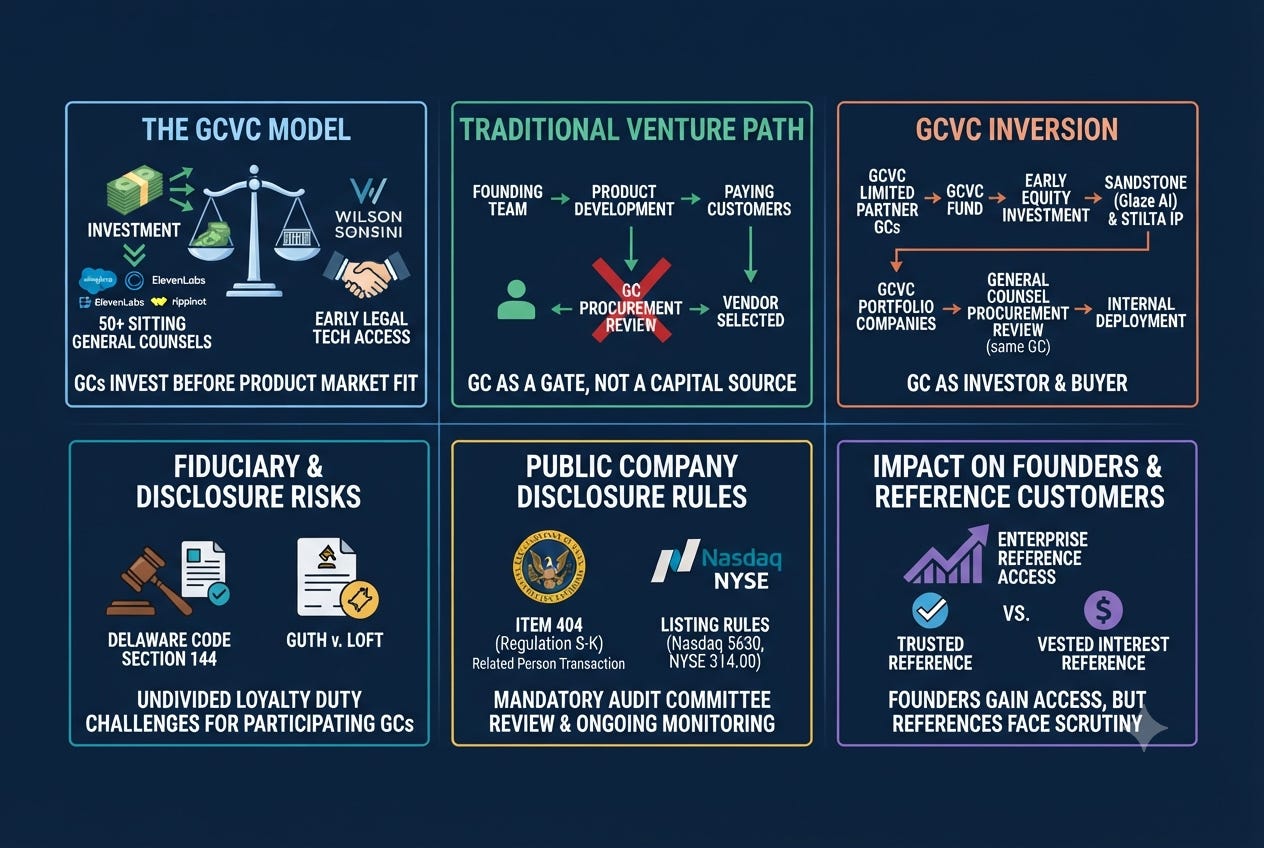
General Counsel VC Fund Lets GC’s Invest Before Product Market Fit
Description
GCVC closed two investments within days of its September 8, 2026 launch, letting its fifty general counsel backers install a portfolio company inside their own legal department first. Erick Rabin, general counsel and chief compliance officer at Bilt Rewards, and Matthew Holbreich, formerly a venture capital attorney at Fenwick and West, built the fund around limited partners who buy legal technology for a living. Wilson Sonsini Goodrich and Rosati advised the launch and became the first law firm to invest in it. The fund inverts the order enterprise software has followed for three decades: proof first, capital second.
Enterprise legal technology sells the way most enterprise software sells. A founding team builds a product, earns a handful of early adopters willing to live with rough edges, and only reaches the general counsel’s desk once a business sponsor has already run a proof of concept. The general counsel’s job in that sequence is narrow: read the master service agreement, check the data processing terms, flag the security gaps, and clear or kill the deal. Legal review functions as a gate a vendor has to survive after the sale is already made on the product’s merits.
GCVC puts fifty of those gatekeepers on the other side of the gate before any of them has cleared a single deal for the fund’s own portfolio companies. Sandstone, the trading name for Glaze AI Inc., builds relationship management and self service legal information tools for corporate legal departments. Stilta IP AB builds an agentic patent tool. Both closed their rounds with GCVC in the days after the fund’s public launch, and Sandstone’s chief executive and co founder, Nick Fleisher, described the fund’s limited partner base as bringing him a perspective a purely financial investor could not. Read plainly, that is a founder saying his earliest and most attentive customers are also his investors.
Delaware corporate law has an answer for an officer who holds an outside financial interest that touches a decision made on the company’s behalf. Delaware Code Section 144 lets an interested transaction stand if the officer’s interest is disclosed and a disinterested board or a majority of stockholders approves it, or if the deal is fair to the company regardless. Guth v. Loft, the 1939 Delaware Supreme Court decision that still anchors the corporate opportunity doctrine, asks whether the fiduciary’s personal stake and the company’s own interest point toward the same result or different ones. Section 144 and Guth v. Loft were both written for one officer and one deal. Neither anticipated fifty general counsels holding a claim on the same pool of vendors their employers might one day buy from, and neither offers a ready answer for what a board should do when the person usually trusted to flag that exact conflict is the one holding it.
Several of GCVC’s named limited partners work at public companies, Salesforce among them, where Item 404 of Regulation S-K requires disclosure of a related person transaction once the amount involved passes 120,000 dollars and an executive officer holds a material interest in it. Nasdaq Listing Rule 5630 and Section 314.00 of the NYSE Listed Company Manual go a step further, requiring the audit committee to review related person transactions on an ongoing basis rather than wait for the annual proxy statement. An audit committee applying either rule to a Sandstone or Stilta purchase would need to look past the general counsel’s own recommendation to catch the conflict, since the general counsel is ordinarily the person the committee relies on to raise it first.
A legal technology founder’s hardest early sale has never been the first customer. It is the first customer willing to take a prospect’s call and describe how the product actually performed inside a real legal department. In thirty years spent drafting the term sheets and side letters that sit behind corporate venture commitments, the recurring fi