Episode Details
Back to Episodes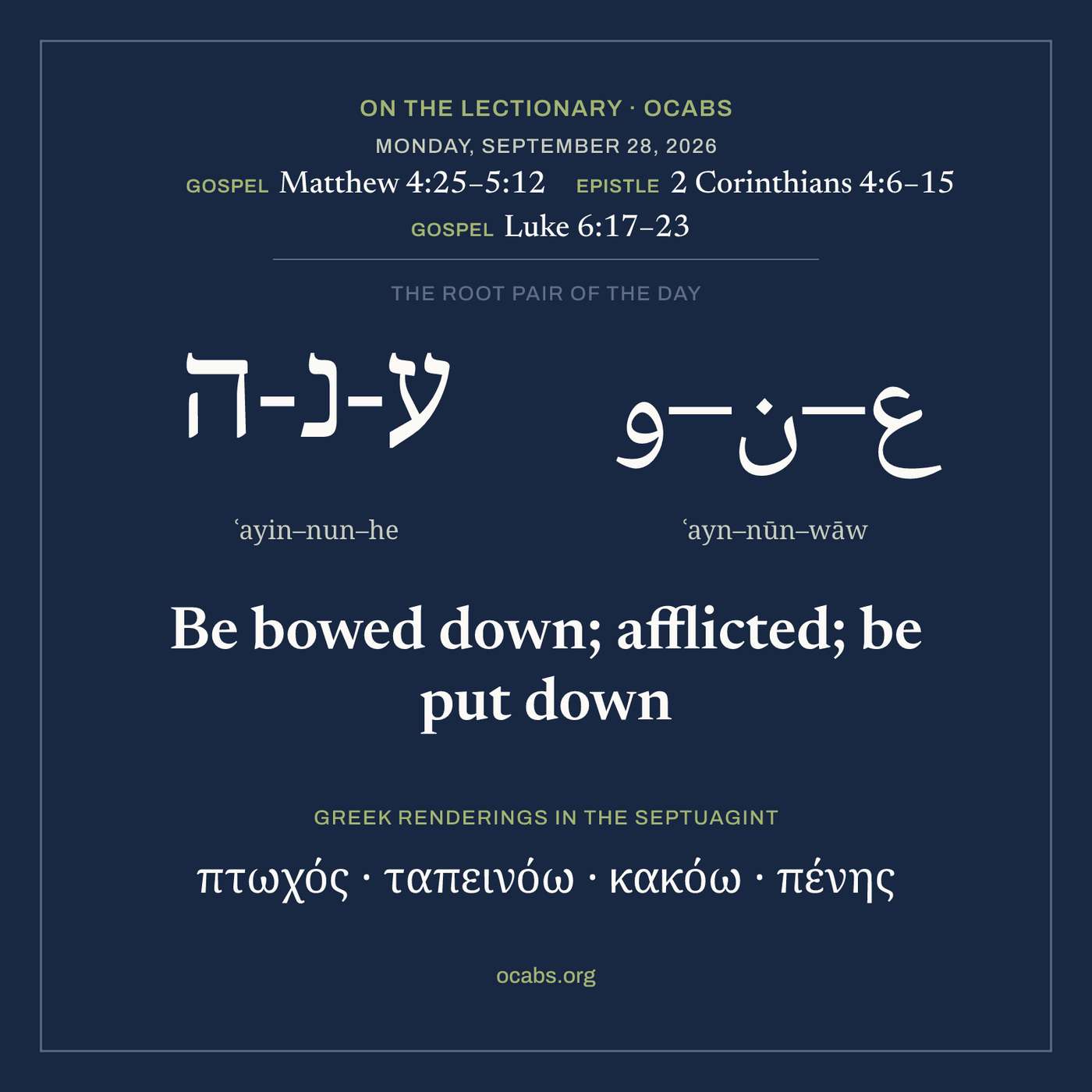
Matthew 4:25-5:12 · 2 Corinthians 4:6-15 · Luke 6:17-23 · Ephesians 4:25-32 · Luke 4:37-44 — Monday, September 28, 2026
Description
A daily note from the team at OCABS.ORG, drawing on the published works of Fr. Paul Nadim Tarazi, with citations to his books and lectures.
Readings: Matthew 4:25-5:12; 2 Corinthians 4:6-15; Luke 6:17-23; Ephesians 4:25-32; Luke 4:37-44.
Fr. Paul reads the mountain of Matthew 5 as the place from which the exalted Christ hands down his law in nine blessings, arranged in three sets of three, "the number of divine fullness" [3]. This law fulfills rather than cancels Moses, echoing Ezekiel's promise of a new heart and spirit that causes the people to walk in God's statutes, and Paul's teaching that righteousness is reached through faith [8]. The crowds gathered from Galilee, the Decapolis, Jerusalem, Judea, and beyond the Jordan are healed through the preached word, so that those healed "glorified the God of Israel" [7].
Luke instead has Jesus come down and stand "on a level place, which means the plain," which Fr. Paul reads as the Ezekielian son of man giving life in the plain rather than teaching from a mountain's height [19,22]. Addressed to disciples gathered from Judea, Jerusalem, and the coast of Tyre and Sidon, this sermon follows the pattern of blessing and curse from Deuteronomy and functions as the "Law of Christ" [17,20]. Four blessings answer four woes as one complete, universal judgment: the poor, hungry, and weeping are blessed, while the rich, full, and laughing are warned, "so their fathers did to the false prophets" [18,23].
Paul's treasure in clay vessels shows that the power at work is God's and not his own, the vessel itself able to "easily break at any time and be replaced by another" [16]. The dying of Jesus he always carries is his repeated affliction, not a mystical formula, "so that the life of Jesus may also be manifested in our bodies" [9,10,11]. This death at work in Paul produces life in the Corinthians, and the same spirit of faith lets him say with the psalm, "I believed, and so I spoke, we too believe, and so we speak" [12].
The root pair of the day · ע-נ-ה ʿayin–nun–he, עָנָה ʿanah · ع–ن–و ʿayn–nūn–wāw, عَنَتِ ʿanati · be bowed down; afflicted; be put down. The root ʿanah and ʿanati names being bowed down or afflicted, glossed as poor or humbled, and surfaces in Greek as ptochos and penes for the poor, and as tapeinoo and kakoo for humbling and harm. Matthew’s blessed poor in spirit and Luke’s blessed poor who hunger both draw on this same affliction, which the note shows Christ’s sermon transforming into blessing rather than erasing. cf. The Consolation of Consonants
Sources: Tarazi, The New Testament: An Introduction, vol. 4, Matthew and the Canon, p. 129; Tarazi, The New Testament: An Introduction, vol. 4, Matthew and the Canon, p. 202; Tarazi, The New Testament: An Introduction, vol. 4, Matthew and the Canon, p. 130; Tarazi, 2 Corinthians: A Commentary, p. 115; Tarazi, 2 Corinthians: A Commentary, p. 116; Tarazi, 2 Corinthians: A Commentary, p. 114; Tarazi, 2 Corinthians: A Commentary, p. 117; Tarazi, 2 Corinthians: A Commentary, p. 112; Tarazi, The New Testament: An Introduction, vol. 2, Luke and Acts, “Luke’s Sources Other then Mark”; Orthodox Audio Bible Commentary, Luke (vol. 42), part 1, at 2:15:48; Orthodox Audio Bible Commentary, Luke (vol. 42), part 1, at 2:13:39; Tarazi, The New Testament: An Introduction, vol. 2, Luke and Acts, “The Law of Christ”; Orthodox Audio Bible Commentary, Luke (vol. 42), part 1, at 2:11:24; Orthodox Audio Bible Commentary, Luke (vol. 42), part 1, at 2:17:53.
Opening music: Taksim Arbi, Bichi Slama, oud (Tunis, Archives de la Parole, 1930s), public domain. Source: gallica.bnf.fr / BnF.