Episode Details
Back to Episodes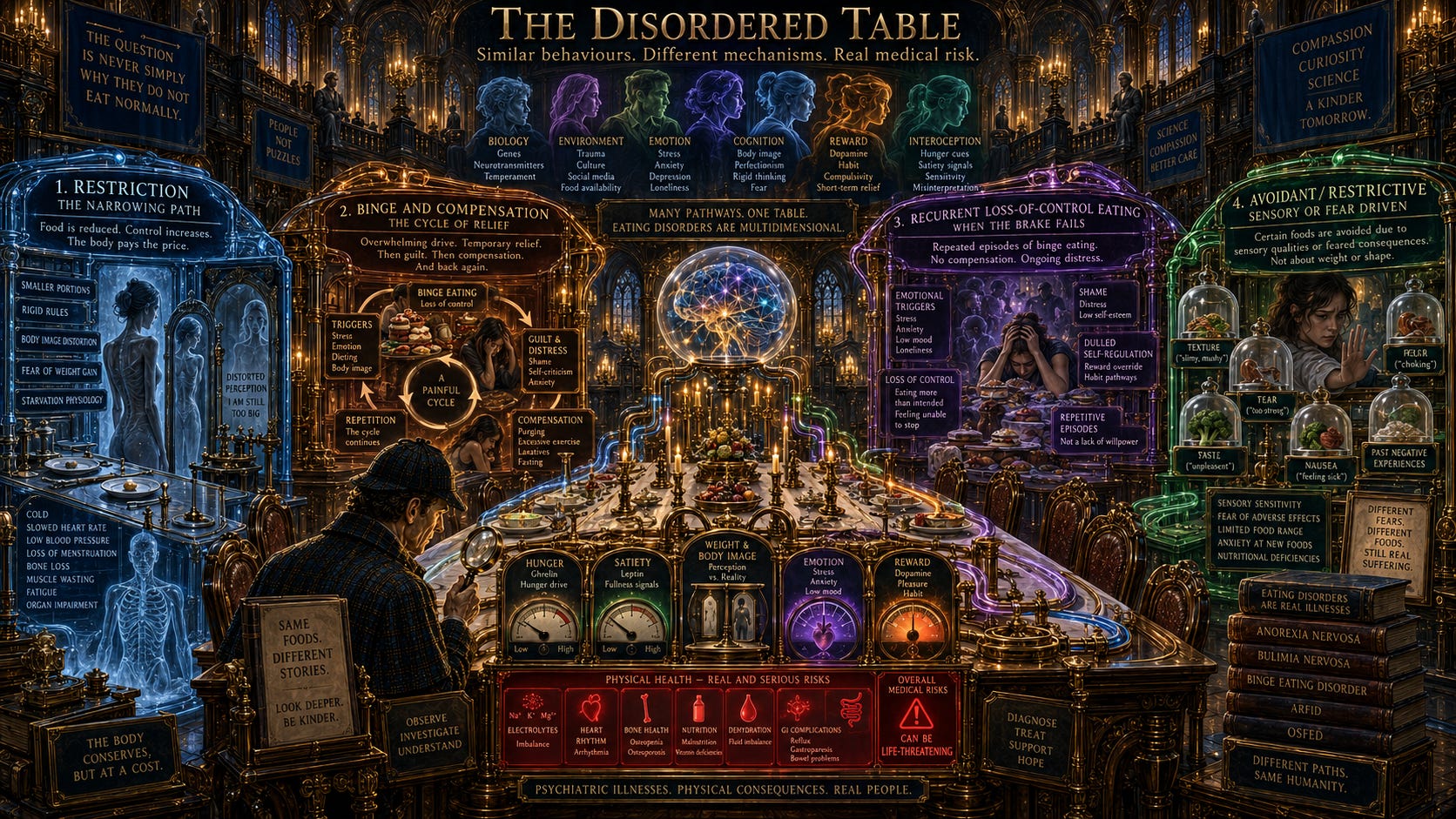
PSYCH 135: Feeding and Eating Disorders
Description
health become entangled - sometimes producing profound malnutrition, dangerous compensatory behaviours, loss of control over eating, nutritional deficiency, medical instability and substantial psychosocial impairment.
Medlock Holmes enters an immense Neo-Victorian institution called The House of Eating, Weight and Regulation.
At first, the building appears deceptively ordinary.
At its centre is a vast dining hall.
Food arrives.
People eat.
Bodies regulate energy.
Meals connect families.
Hunger rises and falls.
But surrounding the hall are six corridors in which this ordinary process has become profoundly disrupted.
One corridor grows progressively narrower.
Another alternates between enormous banquets and hidden compensatory mechanisms.
Another contains uncontrolled episodes of eating without compensation.
Another is filled with untouched foods rejected because of their texture, smell or feared consequences.
Another contains objects that were never meant to be eaten.
And in the final corridor, recently swallowed food repeatedly returns.
The doors are labelled:
ANOREXIA NERVOSA
BULIMIA NERVOSA
BINGE EATING DISORDER
AVOIDANT/RESTRICTIVE FOOD INTAKE DISORDER
PICA
RUMINATION DISORDER
Holmes quickly discovers that although these conditions share a diagnostic neighbourhood, they are not variations of a single illness.
They differ in:
* motivation
* eating behaviour
* weight
* cognition
* medical consequences
* developmental course
* prognosis
* treatment.
Yet all can profoundly interfere with life and, in some cases, become medically dangerous.
The first chamber belongs to anorexia nervosa.
The room contains mirrors that enlarge the body even as the person standing before them becomes increasingly emaciated.
Food portions shrink.
Rules multiply.
Exercise becomes compulsive.
Weight and shape gradually consume the person’s entire system of self-evaluation.
But Holmes learns that the defining feature is not simply thinness.
Three elements interact:
significantly low body weight
persistent restriction or behaviour preventing weight gain
and
disturbance in the experience or importance of weight and shape.
Fear of weight gain is common, but some individuals - particularly children or people from different cultural contexts - may not articulate that fear clearly. Persistent behaviour that prevents weight restoration can still reveal the disorder.
Holmes then enters the Starvation Engine.
Here lies one of the chapter’s most important insights:
THE ILLNESS CHANGES THE BODY - AND THE CHANGED BODY CAN THEN MAINTAIN THE ILLNESS.
As starvation progresses:
* mood worsens
* obsessionality increases
* cognition becomes less flexible
* gastrointestinal function slows
* endocrine systems suppress reproduction
* cardiovascular function slows
* bone health deteriorates.
What began as deliberate restriction can therefore become increasingly self-sustaining.
The next chamber contains a circular mechanism:
RESTRICTION → BINGE → PURGE → RENEWED RESTRICTION
This is bulimia nervosa.
The central event is the binge.
But Holmes discovers that “binge” has a specific meaning.
Under DSM-5-TR, it requires both:
an objectively unusually large amount of food
and
a subjective sense of loss of control.
The chapter’s assessment table on page 13 therefore instructs th