Episode Details
Back to Episodes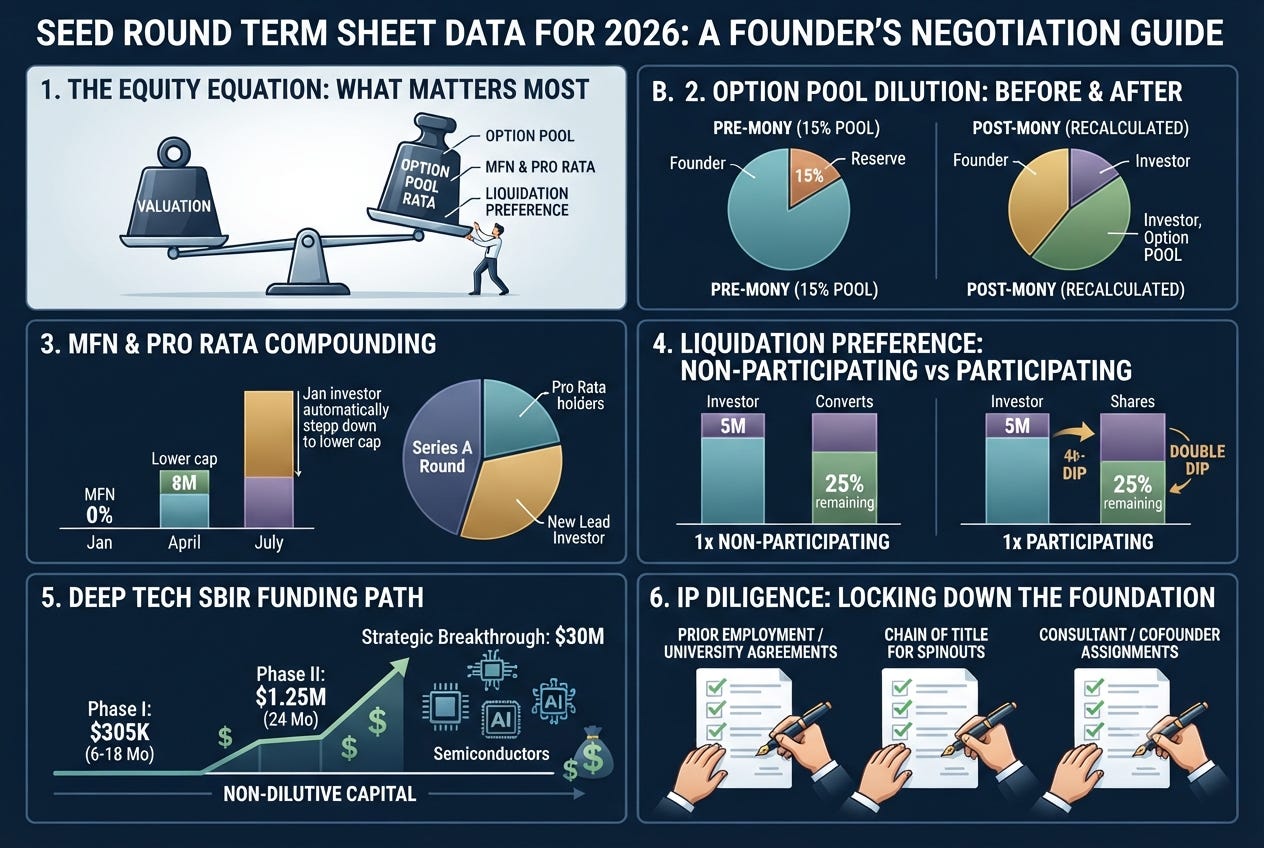
What Seed Round Term Sheet Terms Actually Cost Founders
Description
The valuation printed on a seed term sheet in 2026 tells a founder almost nothing about how much of the company they will still own at the next financing. The provisions that actually decide that number, the option pool sizing, the most favored nation clause buried inside an earlier instrument, and the pro rata right with no expiration date, rarely get read as carefully as the number on the cover page.
Here is the mechanic almost no first time founder catches before signing: a term sheet that states a pre money valuation subject to a fully diluted option pool of fifteen percent is not actually offering that pre money number. The fifteen percent pool comes out of the founder’s side of the capitalization table before the investor’s percentage is even calculated, which means the true pre money value of the company is lower than the number printed at the top of the document.
On an eight million dollar pre money valuation with a two million dollar raise and a fifteen percent pool, the true pre money value works out closer to six million eight hundred thousand dollars, a gap of one million two hundred thousand dollars that never appears on the term sheet’s cover page. Median seed post money valuations reached approximately twenty four million dollars in the first quarter of 2026, while more than ninety percent of pre seed financings closed on a simple agreement for future equity rather than priced stock.
A most favored nation clause lets an early seed investor step down automatically to any lower valuation cap a later investor receives, compounding across every stacked instrument the company has already signed. A company that signs an uncapped instrument in January and a ten million dollar capped instrument in April hands the January investor that same ten million dollar cap the moment the April instrument closes, and a third investor’s eight million dollar cap later pulls every earlier holder down again.
Pro rata rights move in the opposite direction. A right granted without an expiration clause follows an investor into every subsequent round the company raises for as long as the company keeps raising, and enough small allocations without a floor on check size can claim a meaningful share of a new round before a lead investor for that round is even in the room. A founder who grants pro rata to six seed holders can find well over a million dollars of a five million dollar Series A already spoken for, which forces a smaller round at a lower price than the business could otherwise command.
In redline after redline across three decades of seed and Series A closings, the paragraph that changes hands the least is the liquidation preference. It appears on page four in nearly identical language deal after deal: one times the investment, no participation, convert to common if that pays more instead. The paragraph founders skip past, the option pool sizing mechanic buried in the capitalization section, is the one that quietly moves the most equity.
That consistency did not happen by chance. It reflects three decades of market practice converging on one times, non participating as the term both sides can live with. What has not converged is everything downstream of it: how big the option pool is, whether a most favored nation clause is attached to any instrument already signed, how many holders carry a pro rata right and at what size, and how much of the technology’s chain of title is actually locked down in writing before the money arrives.
A company with a multi year path between a laboratory result and a first commercial sale has an option most software seed rounds do not: federal non dilutive funding through the Small Business Innovation Research program. The National Science Foundation’s fiscal year 2026 solicitation, reopened for new project pitches in June 2026, offers Phase I awards up to three hundred five thousand dollars, Phase II awards up to one million two hundred fifty thousand dolla